Dibru-Saikhowa National Park
– A Complete Travel Guide to Assam’s Riverine Wilderness
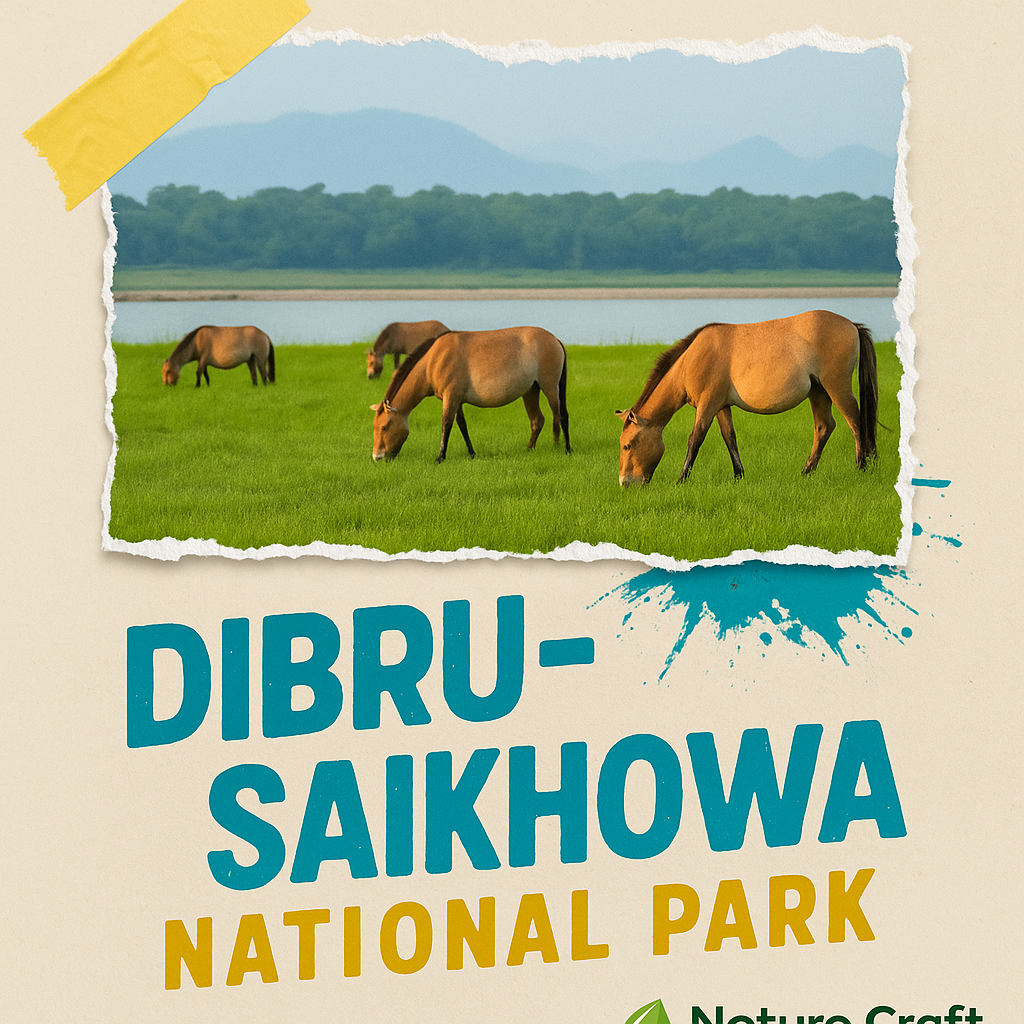
Dibru-Saikhowa National Park, located in the Dibrugarh and Tinsukia districts of Upper Assam, is one of India’s most fascinating riverine protected areas. Designated both as a National Park and a Biosphere Reserve, it lies amidst the dynamic floodplains formed by the Brahmaputra, Lohit and Dibru rivers. This unique confluence of mighty waterways has created a landscape of swamps, river islands, grasslands, scrub forests and patches of semi-evergreen woodland that together support an extraordinary level of biodiversity. Recognised as one of the important biodiversity hotspots in the region, Dibru-Saikhowa is especially famous for its feral horses, rare birds, wetland ecosystems and tranquil scenery.
The park covers a core area of about 340–350 sq km within a larger biosphere reserve of around 765 sq km, making it one of the largest swamp forest ecosystems in Northeast India. According to Dibru-Saikhowa National Park on Wikipedia, the site was declared a Biosphere Reserve in 1997 and a National Park in 1999, following a conservation history that began with reserved forest notifications in the late 19th and early 20th centuries. Today, Dibru-Saikhowa is valued as a refuge for several endangered species as well as a living laboratory for ecological studies on floodplain dynamics.
Government-authenticated information about Dibru-Saikhowa’s basic profile, climate and habitats can be found on the official tourism portal Assam Tourism – Dibru-Saikhowa National Park, which describes it as a semi-wet evergreen, moist deciduous, bamboo and grassland mosaic, still retaining much of its untouched character.
Geographical Setting and Landscape Character
Dibru-Saikhowa lies in the extreme east of Assam, in a region where several Himalayan rivers converge with the Brahmaputra. The park is bounded by the Brahmaputra and Lohit rivers in the north and the Dibru River in the south, giving it a distinct island-like configuration. The elevation is low, averaging just above 100 metres, and the terrain is largely flat with gentle undulations created by old river channels, levees and silt deposits.
Floodplain Ecology and Swamp Forests
The park’s ecology is shaped by the annual flood cycle of the Brahmaputra and its tributaries. During the monsoon, large portions of the park are inundated, replenishing soil nutrients and recharging wetlands. As the waters recede, fresh grasslands emerge on exposed riverine sandbars, attracting herbivores and ground-nesting birds. Dibru-Saikhowa is also noted for its extensive salix swamp forests – stands of willow and other flood-tolerant trees growing in seasonally waterlogged conditions.
The forest types within the park range from moist mixed semi-evergreen and moist deciduous forests to canebrakes, reed-beds and tall grasslands, creating a mosaic of habitats that supports a wide variety of species.
Rivers, Channels and Wetlands
The braided channels of the Brahmaputra and its tributaries weave around the park, forming oxbow lakes, backwaters and low-lying marshes. These wetlands sustain a rich aquatic food chain—from plankton and invertebrates to fish, reptiles, waterbirds and mammals. The constant reshaping of sandbars and islands gives Dibru-Saikhowa a dynamic, ever-changing character rarely seen in more static terrestrial parks.
Flora and Fauna of Dibru-Saikhowa
Dibru-Saikhowa is widely recognised as a stronghold of biodiversity. Its vegetation includes semi-evergreen forests, mixed deciduous patches, littoral and swamp forests and extensive grasslands. Major trees include species such as Bombax ceiba (silk cotton), Mesua ferrea, Terminalia species, Ficus species and various riverine trees that tolerate periodic flooding. Tall grasses such as Imperata cylindrica, Phragmites karka and Saccharum species dominate many open tracts.
Mammals
The park supports a variety of mammalian fauna characteristic of the Brahmaputra valley. Notable species include:
- Feral horses – descendants of animals believed to date back to World War II, now semi-wild and a hallmark of the park’s grassy wetlands.
- Asian elephant – occasionally observed moving through forested areas and open meadows.
- Bengal tiger – a top predator, largely elusive but present in the park’s denser tracts.
- Leopard and smaller cats such as leopard cat.
- Wild water buffalo in certain zones.
- Hog deer, barking deer and wild boar commonly using grassland and ecotone habitats.
- Primates including capped langur and other arboreal species in forest patches.
The presence of large mammals, combined with an intact prey base, indicates that Dibru-Saikhowa continues to function as a healthy ecosystem within its floodplain setting.
Birdlife – A Paradise for Ornithologists
Dibru-Saikhowa is an Important Bird Area (IBA) and a renowned birding destination. More than 350 species of birds have been recorded, including several rare and threatened species. Among its notable avian inhabitants are:
- White-winged Wood Duck – one of the world’s rarest ducks, previously a focal species for conservation in this region.
- Jerdon’s Babbler and Black-breasted Parrotbill – two highly localised species associated with tall grass and reed beds.
- Spot-billed Pelican, storks, egrets and herons occupying wetland zones.
- Numerous species of raptors, kingfishers, bee-eaters, drongos and warblers.
During the monsoon and winter seasons, the park attracts migratory waterfowl and offers superb opportunities for bird photography. Many birdwatchers and eco-travellers plan wider wetland circuits linking areas like Dibru-Saikhowa with other major river delta systems using resources such as Sundarban Travel, which help illustrate how different floodplain and mangrove habitats contribute to continental-scale migration routes.
Unique Experiences and Things to Do
Boat Trips and River-Based Exploration
One of the defining experiences at Dibru-Saikhowa is exploring its waterways by boat. Travellers typically start from Guijan Ghat or other designated embarkation points, boarding country boats or motorised craft operated by authorised guides. As the boat glides through placid channels, visitors can observe riverine vegetation, feral horses grazing on distant sandbars, flocks of birds feeding in shallow waters and occasional sightings of dolphins in the main river channels.
Island Walks and Grassland Excursions
In certain seasons and under the guidance of forest authorities, short walks on stable islands and grassland tracts can be organised. These excursions allow visitors to examine plant communities, animal tracks and bird activity at closer range. Given the floodplain’s sensitivity, such activities are carefully regulated to minimise disturbance to wildlife.
Birdwatching and Photography
For birdwatchers and photographers, Dibru-Saikhowa offers a rich palette of subjects throughout the year. Early morning and late afternoon excursions yield particularly rewarding sightings, with soft light illuminating the misty water and grasslands. Serious birders often plan multi-day stays to cover different habitats – open water, reed beds, forest edges and scrublands.
Nearby Cultural and Natural Attractions
The surrounding Tinsukia and Dibrugarh region is known for its tea gardens, riverfronts and small towns with vibrant marketplaces. Many itineraries also include visits to nearby villages and viewpoints that showcase rural Assamese life and the cultural landscape of Upper Assam.
Major Distances and Location Reference
Dibru-Saikhowa National Park is situated relatively close to important transport hubs, making it accessible while still feeling secluded. Key approximate distances are:
- Tinsukia to Dibru-Saikhowa (Guijan side) – about 12–13 km to the main entry ghat.
- Dibrugarh town to Dibru-Saikhowa – roughly 50–60 km by road, depending on the chosen route and ghat.
- Dibrugarh Airport (Mohanbari) to Dibru-Saikhowa – approximately 50 km.
- Dibrugarh to Tinsukia – around 45–50 km.
- Guwahati to Dibru-Saikhowa – about 500–520 km by road (usually covered with an intermediate halt).
Travellers planning extended wildlife circuits across Assam often combine Dibru-Saikhowa with destinations such as Kaziranga, Nameri and Orang. Route concepts, park combinations and nature-focused travel ideas are frequently referenced using planning resources like
Dibru-Saikhowa National Park, which integrate multiple protected areas into coherent itineraries.
How to Reach Dibru-Saikhowa National Park
By Air
The nearest airport is Dibrugarh Airport (Mohanbari), which receives regular flights from major Indian cities including Guwahati, Kolkata and Delhi (either direct or via connections). From the airport, travellers can hire taxis or pre-booked vehicles to reach Tinsukia and then proceed to the designated ghats leading to the park.
By Rail
Tinsukia is the primary railway gateway for visiting Dibru-Saikhowa. Tinsukia Junction is well connected by trains to Guwahati, Dibrugarh, Kolkata and other parts of India. Dibrugarh town also has railway connectivity, but Tinsukia lies closer to the park and is generally preferred as the base for onward travel.
By Road
Good road connectivity links Tinsukia with Dibrugarh and other towns in Upper Assam. State-run buses, private buses and shared vehicles operate frequently along these routes. From Tinsukia, local cabs, autos or pre-arranged vehicles carry visitors to Guijan or other ghats, where authorised boats take them into the park.
Staying Options (Properties) Around Dibru-Saikhowa
While there are no large hotels inside the core of Dibru-Saikhowa National Park, the surrounding areas provide a variety of stay options suitable for wildlife tourists, birdwatchers and family travellers.
Eco-Camps and River-Adjacent Stays
Near Guijan and other approach points, eco-camps and nature-oriented lodges offer tented accommodations, cottages and basic amenities. These properties are typically set amidst greenery, often with views of rivers or wetlands, and focus on low-impact tourism. They may include in-house naturalists, guiding services, and arrangements for boat trips and birding excursions.
Hotels and Guesthouses in Tinsukia
Tinsukia town has a range of mid-range hotels and simple guesthouses suitable for travellers who prefer staying in an urban base and visiting the park during the day. These properties provide standard comforts and easy access to markets, restaurants and transport facilities.
Stays in Dibrugarh
Some visitors choose to stay in Dibrugarh, known as the “Tea City of India”, which offers more extensive accommodation choices—from business hotels to boutique stays. While this increases travel time to the park, it allows travellers to combine wildlife experiences with tea garden tours and riverside walks along the Brahmaputra.
Best Time to Visit Dibru-Saikhowa
The best time to visit Dibru-Saikhowa National Park is generally between November and April, when the monsoon floods have receded, trails and sandbars are more stable and temperatures are pleasant. During this period, boat rides and birdwatching excursions are easier to organise, visibility is clearer and wildlife is often concentrated around water sources within the park.
The monsoon months (June to September) transform the park into a vast green and blue expanse as rivers overflow and wetlands fill up. While general tourist access may be limited due to safety concerns and operational constraints, this season is ecologically crucial for the park’s regeneration and for migratory bird movements.
Responsible Travel and Visitor Guidelines
Dibru-Saikhowa is a sensitive floodplain ecosystem; visitors are encouraged to adopt responsible practices to minimise their ecological footprint:
- Always follow the guidance of authorised forest staff and boat operators.
- Maintain silence and avoid sudden movements while observing wildlife.
- Do not litter; carry all plastic and waste back out of the park.
- Refrain from feeding animals, including feral horses and birds.
- Use binoculars and telephoto lenses instead of approaching wildlife too closely.
- Respect seasonal closures and restrictions, which are put in place for safety and conservation.
Conclusion
Dibru-Saikhowa National Park represents one of Assam’s most distinctive protected landscapes, where great rivers, swamp forests, grasslands and sandbars come together to create a living tapestry of biodiversity. Its feral horses roaming free across floodplain meadows, rare birds calling from reed beds, and dynamic riverine vistas offer a wildlife experience very different from the more familiar forested parks of India.
For travellers willing to embrace its fluid, seasonally changing character, Dibru-Saikhowa provides a rare insight into how life thrives at the edge of powerful rivers. As efforts continue to protect this fragile ecosystem from the pressures of development and climate variability, every mindful visit contributes to the appreciation and long-term conservation of one of Northeast India’s most remarkable natural treasures.