Odisha Explorer’s Master Plan:
Iconic Pilgrimage Coasts, Ancient Temples, Wild Mangroves, and Deep Offbeat Highlands
Odisha is not a single journey; it is a carefully layered map of India’s most enduring ideas—temple architecture shaped by stone and astronomy, living pilgrimage routes, vast wetlands and lagoons, tiger and elephant forests, and tribal highlands where geography still dictates culture. For an explorer, Odisha offers an unusually complete spectrum: you can read a 13th-century monument like a carved epic in the morning, watch migratory birds over brackish waters in the afternoon, and end the day in a coastal town where fishing life and sea-wind rituals continue with quiet confidence.
Best Time to Visit Odisha and How to Plan Your Days
- Best season (comfortable + most diverse experiences): October to March (pleasant weather for temples, beaches, wildlife safaris, and lake excursions).
- Monsoon advantage: July to September (lush forests and waterfalls in the highlands; travel may be slowed by rain in interior roads).
- Summer note: April to June can be hot and humid along the coast; plan sightseeing early morning and late evening.
- Explorer’s daily rhythm:
- 06:00–09:00 sunrise beaches, heritage walks, photography, birding
- 09:30–13:00 temples, museums, craft villages (less harsh sunlight)
- 15:30–18:30 lakes, wetlands, mangroves, sunset points
- 19:00–21:30 local markets, cultural streets, coastal promenades
- Ideal duration: 8–12 days for a classic “Coast + Culture + Wildlife” circuit; 12–16 days if you include Koraput–Rayagada tribal highlands.
Complete Explorer Tour Plan (12 Days): Odisha’s Best Highlights + Nature + Heritage
This itinerary is designed like an expedition: it starts with the classical heritage triangle, then moves into wetlands and marine landscapes, and finally enters forests and mangroves—so you experience Odisha in expanding ecological rings.
Day 1: Bhubaneswar — “Temple City” Orientation
- Morning (08:30–12:30): Heritage temple exploration in the old town belt. Focus on stone workmanship, temple geometry, and the living ritual rhythm.
- Afternoon (15:30–18:30): Museum / heritage interpretation time (helps you read Odisha’s sculpture language more accurately for the next days).
- Evening (19:00–21:00): Local street food and market walk to understand everyday Bhubaneswar beyond monuments.
Day 2: Bhubaneswar to Puri — Pilgrimage Coastline
- Morning (08:00–12:00): Travel to Puri and settle into the coastal atmosphere.
- Afternoon (15:30–18:30): Puri Beach for sea-wind recovery and long shoreline walks.
- Evening (19:00–21:00): Temple-town lanes and cultural ambience (move respectfully around sacred zones).
Day 3: Puri — Jagannath Culture + Heritage Streets
- Morning (08:00–11:30): Explore the living pilgrimage ecosystem: crafts, traditions, and sacred geography around the temple town.
- Afternoon (15:30–18:30): Optional: Raghurajpur Heritage Village (craft traditions, visual storytelling, and artisan lanes).
- Evening (19:00–21:00): Coastal calm time; keep it slow to match the spiritual pace of the region.
Day 4: Konark — Sun, Stone, and Time
- Morning (07:30–12:00): Visit Konark Sun Temple. Give it time—this is not a quick stop. Observe the sculptural narrative panels and the “architecture as cosmic symbolism.”
- Afternoon (15:30–18:30): Konark–Chandrabhaga coastal belt for sea breeze and late light photography.
- Evening (19:00–21:00): Return to Puri / Bhubaneswar (based on your base) and rest.
Day 5: Chilika Lake — Brackish-Water Wonder + Birdlife (Seasonal)
- Morning (08:00–12:30): Drive to Chilika Lake. Choose your lake sector thoughtfully (Satapada / Rambha / other gateways depending on interest).
- Afternoon (15:00–18:30): Lake cruise for islands and wetlands; keep binoculars ready in winter months.
- Evening (19:00–21:00): Quiet overnight in the lake region or return to the city based on timing.
Day 6: Bhubaneswar to Gopalpur / Southern Coast — Beach with a Softer Crowd
- Morning (08:00–13:00): Travel south to Gopalpur (a calmer coastal town with an unhurried shoreline personality).
- Afternoon (15:30–18:30): Beach walk, lighthouse zone ambience, and local fish-landing observations (from a respectful distance).
- Evening (19:00–21:00): Relaxed coastal night; ideal for slow travelers.
Day 7: Gopalpur to Koraput — Enter the Highlands
- Morning (08:00–13:00): Travel toward Koraput—the landscape changes from salt-air plains to misty hills and red soil contours.
- Afternoon (15:30–18:30): Local viewpoints and first highland sunset (Koraput’s beauty is often in the wide, quiet horizons).
- Evening (19:00–21:00): Rest early; highland days work best with early mornings.
Day 8: Koraput Region — Waterfalls, Valleys, and Tribal Landscape
- Morning (07:00–12:00): Explore regional nature points—waterfalls and valley roads (seasonal flow is strongest post-monsoon).
- Afternoon (15:00–18:00): Cultural immersion in local markets (Odisha’s highland markets are geography in motion: forest produce, handwoven identity, and everyday resilience).
- Evening (19:00–21:00): Calm overnight in the hills.
Day 9: Koraput to Deomali — Odisha’s Rooftop Experience
- Morning (06:30–10:30): Drive to Deomali for sweeping mountain views and crisp air. Early timing gives the best visibility.
- Afternoon (15:30–18:30): Short trails and viewpoints; keep it light and safe (weather can change fast in high elevations).
- Evening (19:00–21:00): Overnight in Koraput region.
Day 10: Return to Bhubaneswar — Reset Day
- Morning to afternoon: Travel back to Bhubaneswar (use this as a recovery day).
- Evening (19:00–21:00): Optional cultural show / market stroll.
Day 11: Bhitarkanika — Mangroves and Saltwater Crocodile Country
- Morning (07:00–12:30): Travel toward Bhitarkanika. The landscape shifts into tidal channels and mangrove complexity.
- Afternoon (15:00–18:30): Creek exploration and wildlife observation (keep movements quiet; mangroves reward patience).
- Evening (19:00–21:00): Overnight near the park zone.
Day 12: Bhitarkanika to Bhubaneswar — Closing the Expedition
- Morning (07:00–10:30): Final nature window: sunrise mangrove mood and birdlife.
- Afternoon: Return to Bhubaneswar for departure.
Long List of Popular Destinations in Odisha (With Best Timing + Special Attractions)
1) Bhubaneswar — The Temple City Heritage Belt

Best time: 07:00–11:30 and 16:00–18:30
Bhubaneswar is a living archive of Kalinga temple architecture. The most powerful experience comes from noticing repetition: motifs, proportions, and sculptural grammar that link multiple shrines into one artistic civilization.
2) Puri — Pilgrimage Coast and Living Sacred Geography

Best time: Early morning and late afternoon
Puri is not only a beach town; it is one of India’s great pilgrimage ecosystems. The town’s energy is shaped by ritual movement, food traditions, and a coastline that feels like a spiritual edge of the subcontinent.
3) Jagannath Culture Zone (Puri)

Best time: 08:00–12:00
The sacred core creates a cultural economy: offerings, crafts, and the daily rhythm of devotion. Even if you focus on heritage, the living tradition is the true attraction.
4) Konark Sun Temple (UNESCO World Heritage Site)

Best time: 07:30–11:30
A monumental 13th-century statement in stone—famous for its scale, sculptural power, and the way it translates devotion to Surya (the Sun) into architecture that feels cosmic and mathematical.
5) Chandrabhaga Beach (Near Konark)

Best time: Sunrise and sunset
A calmer beach atmosphere that complements Konark’s grand stone energy. Ideal for golden-hour photography and reflective coastal pauses.
6) Chilika Lake — Lagoon Landscapes and Winter Birdlife

Best time: October to March; afternoon cruises often feel most scenic
Chilika is a brackish-water lagoon of national ecological importance—famous for bird habitats, island landscapes, and wide-open water horizons that look like an inland sea.
7) Satapada Sector (Chilika) — Dolphin & Channel Views (Seasonal)

Best time: Morning to early afternoon
This sector is widely chosen for open-water experiences and channel scenery. The best experiences are those that balance curiosity with responsible observation.
8) Rambha Sector (Chilika) — Hill-Backed Lake Vistas

Best time: 15:00–18:30
Rambha’s charm is scenic composition: water, distant hills, and changing light. It feels slower and more contemplative than the busiest gateways.
9) Bhitarkanika — Mangrove Wilderness and Estuarine Wildlife

Best time: November to February for comfortable exploration
One of India’s most fascinating mangrove ecosystems, shaped by tidal creeks and estuaries. Known for saltwater crocodiles and rich birdlife, it is Odisha’s “wet forest frontier.”
10) Gopalpur-on-Sea — Relaxed Southern Coast

Best time: 16:30–20:00
Gopalpur offers a quieter beach town personality—less hurried than the busiest coastal stretches, with long walks and sea-breeze evenings that feel genuinely restful.
11) Cuttack — Old City Energy and Riverine Heritage

Best time: 10:00–13:00 and 16:00–19:00
Cuttack is valuable for understanding Odisha’s urban continuity—older markets, craft lanes, and a historical sense of a city built around rivers and trade.
12) Raghurajpur Heritage Village (Puri District)

Best time: 10:00–13:00
A craft village famed for traditional art forms and artisan storytelling. The attraction is the “living studio” quality—homes and lanes functioning as cultural workshops.
13) Dhauli — Peace, History, and the Idea of Transformation

Best time: Late afternoon
Dhauli is often visited for its association with Ashokan history and the idea of moral turning points. The landscape encourages quiet reflection.
14) Udayagiri & Khandagiri Caves (Bhubaneswar)

Best time: 07:00–10:30
Rock-cut caves that add depth to Odisha’s historical timeline, complementing temple architecture with an older layer of carved and lived stone spaces.
15) Similipal Region — Forest Scale and Biodiversity

Best time: November to March
A major forest landscape in northern Odisha, associated with tiger reserve ecology and deep biodiversity. It is best experienced as a “big habitat,” not a quick sightseeing stop.
16) Chandipur — Beach with a Curious Coastal Character

Best time: Early morning or late afternoon
Known for its distinctive shoreline experience (a different “feel” compared to typical beaches). Great for travelers who enjoy unusual coastal geography.
17) Taptapani — Warm Springs and Forest Air

Best time: Winter mornings and evenings
A nature-oriented stop in southern Odisha where the attraction is the restorative mood: warm springs, forest edges, and slow-time travel.
18) Koraput — Highlands, Valleys, and Cultural Depth

Best time: Post-monsoon to winter
Koraput is where Odisha becomes mountainous and deeply scenic. The attraction is not a single monument; it is the geography itself and the communities shaped by it.
19) Deomali — Summit Views and Mountain Weather

Best time: 06:30–10:30
A high point experience for wide horizons, layered hills, and a sense of Odisha’s “roof.” Visibility is best early, before haze builds.
20) Sambalpur & Hirakud Region — River Engineering and Cultural Pride

Best time: Late afternoon
This region is meaningful for understanding modern Odisha: water management, reservoir landscapes, and the cultural identity of western Odisha.
Separate Section: Offbeat Destinations in Odisha (Less Crowded, More Exploratory)
These places are ideal for travelers who prefer authenticity, landscape study, and cultural nuance over highly packaged tourism. Many of them require early starts, patient road travel, and a respectful approach to local life.
1) Nalabana Bird Sanctuary Zone (Chilika) — Seasonal Birding Focus

Best time: Winter months, morning to early afternoon
A specialized experience for birdwatchers. The offbeat charm is the discipline: quiet observation, slow scanning, and letting the wetland reveal its patterns.
2) Mangalajodi (Near Chilika) — Community-Based Birding Culture

Best time: Early morning in winter
Known among nature travelers for birding experiences. It rewards early timing, silence, and genuine interest in wetland ecology.
3) Satkosia Gorge Region — River-Forest Drama

Best time: October to March
A landscape where river and forest interact dramatically. Offbeat because it is experience-driven, not monument-driven, and needs time to feel complete.
4) Debrigarh Wildlife Sanctuary — Reservoir-Edge Wilderness (Hirakud Belt)

Best time: Winter season
A strong alternative for travelers who want wildlife and landscapes without the crowds of the most famous parks.
5) Baisipalli / Forest Buffer Experiences (Where Permitted)

Best time: Morning
Good for travelers interested in forest-edge ecology and quieter biodiversity zones—always follow local rules and seasonal access guidance.
6) Daringbadi — “Kashmir of Odisha” Hill Weather (Seasonal)

Best time: October to February
A cool-weather hill destination with a distinct microclimate feel. Offbeat because it is often overlooked in the temple-beach narrative of Odisha.
7) Belghar–Kotagarh Belt (Kandhamal) — Forest Roads and Waterfalls

Best time: Post-monsoon
A scenic interior belt with forest routes. Best for explorers comfortable with slower travel and nature-first planning.
8) Rayagada Region — Tribal Highlands and Market Anthropology

Best time: Winter
Rayagada’s offbeat appeal lies in cultural geography: periodic markets, forest produce, and the daily economics of mountain communities.
9) Niyamgiri Foothill Landscapes (Respectful, Non-Intrusive Travel)

Best time: Winter
A sensitive cultural and ecological region. Visit only in a respectful manner, prioritizing local norms and permissions where required.
10) Tensa / Northern Hill Edges (For Quiet Landscape Travel)

Best time: Winter and clear-weather months
Offbeat because it is not built for mass tourism—ideal for travelers who want space, silence, and uncompressed scenery.
11) Bhadrak–Chandabali Coastal Backwaters (Local Coastal Life)

Best time: Morning and late afternoon
A quieter coastal-backwater experience that shows Odisha beyond the main tourist beaches—fishing rhythms, river mouths, and local movement.
12) Odisha’s Lesser-Known Craft Clusters (Beyond the Famous Villages)

Best time: 10:00–13:00
If you explore craft like an anthropologist—asking how materials, motifs, and livelihoods connect—small clusters become more meaningful than a single “shopping stop.”
13) Similipal Biosphere Context Trails (Interpretive Approach)

Best time: Winter
Treat Similipal as a biosphere story—species variety, forest gradients, and habitat-scale thinking—rather than a quick “animal sighting” expectation.
14) Bhitarkanika Creek Networks (Slow Boat + Patience Travel)

Best time: Morning and late afternoon
The offbeat magic is the mangrove geometry: tidal channels, quiet water, and the sense that the forest is half-land, half-river.
15) Quiet Odisha Beaches (Choose by Mood, Not Popularity)
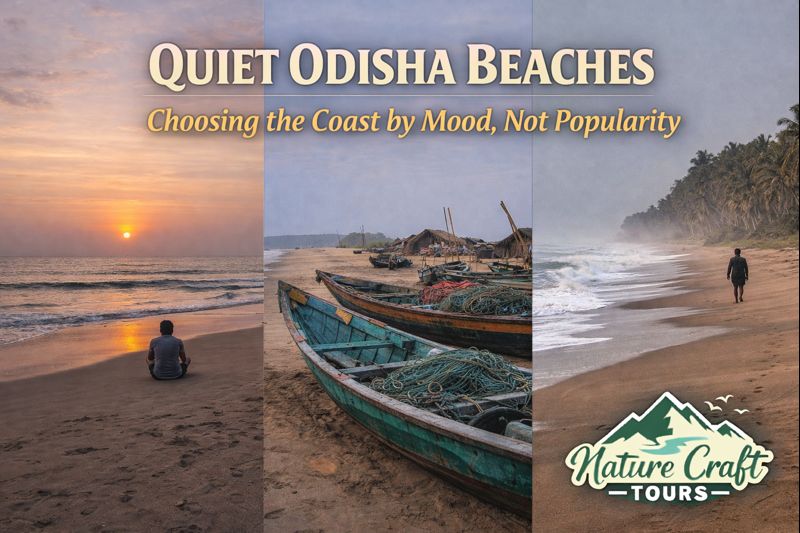
Best time: Sunrise and sunset
Beyond the most famous coasts, Odisha has several calm stretches where the best attraction is simply space—long walks, wind, and local sea-life routines.
Explorer Notes for a Responsible and Smooth Odisha Journey
- Temple etiquette: Dress modestly, keep voices low, and treat sacred spaces as living institutions, not only photo locations.
- Wildlife ethics: Never demand close encounters; keep distance, minimize noise, and avoid flash photography.
- Wetland patience: Birding and lagoons reward stillness—carry binoculars and allow time for observation.
- Highland travel: Koraput–Rayagada roads are scenic but slower; start early and keep buffer time.
- Season logic: Monsoon enhances waterfalls and forests; winter enhances comfort, heritage walks, and lake birdlife.