Port Blair (Sri Vijaya Puram):
The Strategic Gateway to the Andaman & Nicobar Islands
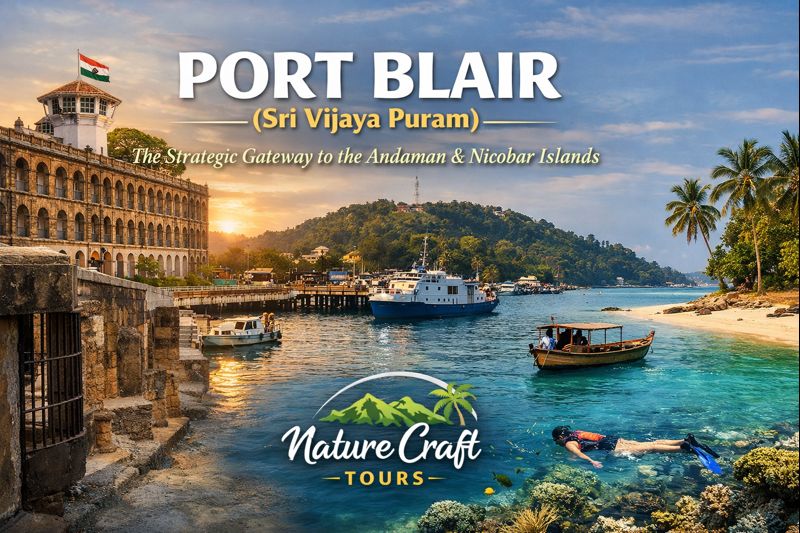
Port Blair, officially known as Sri Vijaya Puram, stands as the political, cultural, and logistical heart of the Andaman & Nicobar Islands. More than a tropical island capital, it is a place where strategic maritime importance, colonial history, indigenous cultures, and fragile marine ecosystems converge. Situated on the eastern edge of the Bay of Bengal, Port Blair functions as India’s foremost gateway to the remote island chains scattered across the Andaman Sea.
For the discerning explorer, Port Blair is not merely a transit point but an immersive destination in its own right—offering layered narratives of freedom struggle, naval significance, coral-rich waters, rainforest biodiversity, and island lifestyles shaped by isolation and resilience. This detailed travel guide presents Port Blair through the lens of exploration, research, and responsible tourism, while offering a comprehensive tour plan designed for meaningful engagement rather than hurried sightseeing.
Geographical Setting and Strategic Importance
Port Blair is located on South Andaman Island, forming the administrative nucleus of the Andaman & Nicobar archipelago. Its natural deep-water harbor, sheltered by forested hills and islands, has historically made it a vital maritime anchor. From the colonial era to contemporary times, the port has served strategic naval, commercial, and communication functions in the eastern Indian Ocean.
The city’s proximity to Southeast Asia places it along crucial sea lanes connecting India with Myanmar, Thailand, Indonesia, and beyond. This geographical advantage has elevated Port Blair’s role in maritime security, disaster response, and oceanographic research. Today, it also functions as the principal aviation and shipping hub for all inter-island movement.
Historical Evolution: From Penal Colony to Island Capital
Port Blair’s historical identity is inseparable from India’s freedom struggle. During the British colonial period, it was established as a penal settlement intended to isolate political prisoners far from the mainland. The city evolved around the infamous Cellular Jail, a structure that symbolizes both colonial oppression and the unyielding spirit of resistance.
Post-independence, Port Blair underwent a significant transformation. It emerged as the administrative center for the islands, gradually developing civic infrastructure, educational institutions, and port facilities. The renaming of the city to Sri Vijaya Puram reflects a conscious effort to reconnect with indigenous and regional heritage, shedding remnants of colonial nomenclature.
Cultural Fabric and Island Society
Port Blair presents a unique cultural mosaic shaped by migration, indigenous presence, and maritime life. Settlers from Bengal, Tamil Nadu, Andhra Pradesh, Kerala, Punjab, and mainland North India coexist alongside native communities, creating a pluralistic social environment.
Indigenous Influence
While most indigenous tribes reside in protected forest areas away from urban zones, their presence influences regional policies, conservation ethics, and cultural discourse. Port Blair acts as the administrative interface between the modern state and ancient island societies, emphasizing protection and minimal interference.
Festivals and Daily Life
Island festivals often combine mainland traditions with maritime symbolism. National celebrations, local fairs, and community gatherings are modest yet deeply participatory, reflecting the close-knit nature of island society. Markets, jetties, and seaside promenades offer insights into everyday island rhythms.
Natural Landscape and Marine Environment
Port Blair is framed by forested hills, mangrove-lined creeks, coral reefs, and sheltered bays. The surrounding ecosystems represent one of India’s most ecologically sensitive regions, hosting diverse marine species, tropical forests, and coastal habitats.
Marine Biodiversity
The waters around Port Blair support coral gardens, seagrass meadows, reef fish, mollusks, and crustaceans. These ecosystems not only sustain fisheries but also act as natural barriers against erosion and storms. Responsible tourism practices are essential to preserve these underwater environments.
Terrestrial Forests
The island’s interior is covered by evergreen and semi-evergreen forests, home to endemic birds, reptiles, and insects. These forests regulate climate, prevent soil erosion, and maintain freshwater systems vital to human settlements.
Best Time to Visit Port Blair
Understanding seasonal variations is essential for planning a meaningful journey to Port Blair.
October to April (Ideal Season)
This period offers calm seas, clear skies, and comfortable temperatures. It is ideal for sightseeing, water activities, and inter-island travel. Visibility for snorkeling and glass-bottom boat rides is particularly high during these months.
May to September (Monsoon Season)
The monsoon brings heavy rainfall and rough seas, limiting ferry operations and outdoor activities. However, the islands appear lush and dramatic, appealing to travelers interested in solitude, photography, and atmospheric landscapes.
Comprehensive Tour Plan: Exploring Port Blair and Its Surroundings
Day 1: Arrival and Coastal Orientation
Arrival at Port Blair marks the transition from mainland India to an island ecosystem. The first day is best reserved for acclimatization and gentle exploration. A visit to the historic Cellular Jail provides contextual grounding, followed by an evening light-and-sound presentation that narrates the freedom movement in an emotionally restrained yet powerful manner.
A quiet walk along the waterfront promenade allows travelers to observe the harbor’s daily operations, fishing vessels, and naval presence—an understated reminder of the city’s strategic role.
Day 2: Museums and Cultural Institutions
The second day focuses on intellectual exploration. Museums dedicated to anthropology, marine life, and regional history offer research-based insights into the islands’ geological formation, tribal heritage, and oceanic ecosystems.
This day complements physical sightseeing with deeper understanding, making it particularly valuable for students, researchers, and culturally inclined travelers.
Day 3: Island Excursion and Coral Encounters
Short boat journeys from Port Blair lead to nearby islands known for coral reefs and tranquil beaches. Activities such as snorkeling, shallow-water exploration, and guided reef observation introduce visitors to marine biodiversity without excessive environmental impact.
Strict adherence to conservation guidelines is essential, as coral ecosystems are highly sensitive to physical disturbance.
Day 4: Forest Trails and Coastal Ecology
Exploring inland forest trails reveals the island’s terrestrial ecology. Guided nature walks focus on plant diversity, birdlife, and watershed systems. This day balances marine experiences with forest-based learning.
Evenings can be spent sampling local cuisine influenced by seafood traditions and regional Indian flavors.
Day 5: Strategic and Contemporary Port Blair
The final day emphasizes modern Port Blair—its port facilities, civic institutions, and role in island administration. Observing ferry terminals and cargo docks highlights the logistical challenges of island governance.
Departure from Port Blair often leaves travelers with a heightened awareness of India’s maritime frontier and its complexities.
Key Attractions of Port Blair
Cellular Jail
An architectural and historical landmark, the Cellular Jail stands as a testament to colonial-era incarceration and resistance. Its radial design and solitary cells reveal the psychological dimensions of imprisonment.
Chatham and Marine Areas
The surrounding harbor zones demonstrate the city’s maritime importance. These areas illustrate ship repair, navigation logistics, and the everyday labor that sustains island connectivity.
Beaches and Coastal Points
Unlike resort-dominated beaches elsewhere, Port Blair’s shores retain a functional character. They serve as fishing zones, community spaces, and ecological buffers.
Responsible Travel and Conservation Ethics
Port Blair lies within one of India’s most environmentally sensitive regions. Travelers bear a shared responsibility to minimize waste, avoid single-use plastics, respect restricted zones, and follow local guidelines.
Responsible tourism ensures that fragile ecosystems and indigenous cultures remain protected while allowing visitors to gain authentic insights.
Why Port Blair Matters Beyond Tourism
Port Blair is not merely a holiday destination; it is a living frontier where ecology, security, history, and culture intersect. Its strategic value extends far beyond leisure travel, shaping national maritime policy and regional stability.
For explorers, scholars, and thoughtful travelers, Port Blair offers a rare opportunity to witness how geography influences history and how islands shape human resilience.
Port Blair as an Exploratory Experience
Port Blair (Sri Vijaya Puram) stands apart from conventional tourist cities. It invites patience, reflection, and informed curiosity. By approaching the city as an explorer rather than a consumer, visitors uncover layers of meaning embedded in its harbors, forests, institutions, and memories.
As India’s strategic gateway to the Andaman & Nicobar Islands, Port Blair remains a place where the ocean defines destiny—and where every journey carries the weight of history, responsibility, and discovery.