Rangat (Middle Andaman):
Mangroves, Long Beaches, and Slow Travel
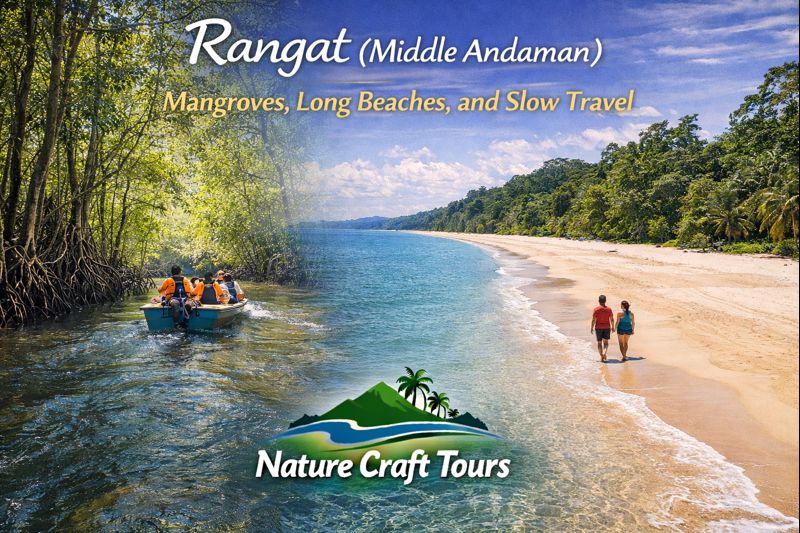
Rangat, Middle Andaman: Where Mangrove Waterways and Long Shores Redefine Slow Exploration
Between the dramatic geological frontiers of North Andaman and the well-charted leisure circuits of South Andaman lies Rangat, a region that quietly resists categorization. Rangat is neither hurried nor curated; it is expansive, layered, and deliberately slow. Defined by mangrove creeks, long undeveloped beaches, forest-lined roads, and modest settlements, Rangat represents a transitional Andaman—one that reveals itself only to travelers willing to decelerate.
Unlike destinations built around singular attractions, Rangat offers continuity. Landscapes do not change abruptly here; they unfold gradually. Mangroves blend into creeks, creeks open into estuaries, and estuaries lead toward wide beaches where time seems to stretch. This is Middle Andaman at its most honest—less photographed, less narrated, yet deeply instructive. The following detailed exploration presents Rangat as a destination for thoughtful travel, ecological awareness, and immersive observation.
Geographical Context: Rangat in the Andaman Continuum
Rangat is located in Middle Andaman, approximately 170 kilometers north of Port Blair. It sits along the Andaman Trunk Road, making it a natural pause point between South and North Andaman. Yet Rangat is far more than a transit stop. Its geography bridges two worlds: the coral-influenced coastal zones of the south and the forest-dominated, volcanic-influenced north.
The terrain around Rangat is relatively flat compared to North Andaman, with extensive mangrove belts, low-lying wetlands, freshwater streams, and long coastal stretches. This topography supports diverse ecosystems and encourages a style of travel that is horizontal rather than vertical—long walks, slow boat rides, and extended shoreline exploration.
Why Rangat Embodies the Idea of Slow Travel
Rangat does not demand attention through spectacle. Its appeal lies in duration rather than intensity. Distances are meant to be covered slowly, often on foot or by small boats. This rhythm aligns naturally with slow travel principles, where experience is shaped by immersion and repetition rather than checklist tourism.
Reaching Rangat: The Journey as Gradual Transition
Traveling to Rangat is itself an exercise in deceleration.
By Road via Andaman Trunk Road
The most common route is by road from Port Blair along the Andaman Trunk Road. The journey takes approximately 8 to 10 hours, depending on convoy schedules and ferry crossings. This route passes through forest corridors, creeks, and small settlements, gradually shifting the traveler’s perception from urban to ecological.
For travelers accustomed to ecosystem-driven journeys—such as navigating riverine landscapes during a Sundarban Tour—the Rangat journey feels familiar. Movement becomes part of the experience, not an inconvenience.
By Sea: Limited but Scenic
Occasional boat services connect Rangat with Port Blair. These journeys highlight coastal transitions and estuarine zones but are subject to weather conditions.
Mangrove Ecosystems: Rangat’s Defining Landscape
Mangroves dominate Rangat’s ecological identity. Extensive networks of creeks and tidal channels weave through dense mangrove forests, creating a living infrastructure that supports biodiversity and stabilizes coastlines.
Boat rides through these creeks are slow by necessity. Overhanging roots, narrow channels, and tidal fluctuations demand careful navigation. This enforced slowness encourages observation—of water texture, bird calls, root systems, and shifting light patterns.
Mangroves as Ecological Anchors
Mangroves in Rangat act as nurseries for fish, buffers against erosion, and filters for sediment. Their role mirrors that of larger mangrove deltas elsewhere in India, including those explored during a Sundarban Travel experience, though here the scale is quieter and more intimate.
Long Beaches: Space, Silence, and Shoreline Continuity
Rangat’s beaches differ fundamentally from those of South Andaman. They are not compact or activity-focused. Instead, they extend for long distances, often with minimal human presence. Beaches such as Amkunj Bay and other lesser-known shores offer uninterrupted walking space rather than designated viewing points.
The sand composition varies from fine sediment to mixed coral fragments, reflecting the region’s transitional geology. Wave action is moderate, and tidal shifts significantly alter the usable shoreline throughout the day.
Beaches Designed for Walking, Not Crowds
These beaches invite movement rather than settlement. Walking becomes the primary mode of engagement—slow, reflective, and uninterrupted by infrastructure.
Freshwater and Wetland Systems
Rangat is one of the few regions in the Andamans where freshwater systems are visibly integrated into the landscape. Seasonal streams, wetlands, and ponds support amphibians, insects, and birds.
These freshwater zones create ecological overlap with mangrove systems, forming complex gradients between saltwater and freshwater environments.
Birdlife and Quiet Observation
Birdwatching in Rangat is particularly rewarding due to low disturbance levels. Wetlands attract wading birds, while mangrove edges support kingfishers and other species adapted to brackish conditions.
Best Time to Visit Rangat
Seasonal considerations play a significant role in shaping the Rangat experience.
October to March: Ideal Slow-Travel Season
This period offers comfortable temperatures, lower humidity, and stable travel conditions. Mangrove creeks are navigable, and beaches remain accessible for long walks.
April to May: Warm but Accessible
These months are warmer, requiring adjusted activity schedules. Early mornings and late afternoons are best suited for exploration.
June to September: Monsoon Transformation
Monsoon rains limit travel but transform Rangat into a lush, water-rich landscape. This season suits travelers focused on ecological study rather than mobility.
Complete Tour Plan: A Rangat Slow-Travel Itinerary
Day 1: Arrival and Orientation
Arrive in Rangat after a long road journey. Spend the evening walking nearby coastal stretches to acclimatize to the region’s scale and silence.
Day 2: Mangrove Creek Exploration
Begin with a guided mangrove creek boat ride. Move slowly through tidal channels, observing root structures, birdlife, and water movement.
Day 3: Long Beach Walks
Dedicate a full day to beach exploration. Walk extended stretches, observe tidal changes, and note differences in sand texture and wave behavior.
Day 4: Wetlands and Village Interaction
Visit freshwater zones and nearby villages. Observe how local livelihoods align with seasonal cycles and ecological conditions.
Day 5: Reflection and Buffer Day
Use this day for unstructured exploration or rest. Slow travel benefits from unscheduled time.
Special Attractions of Rangat
Extensive Mangrove Networks
Among the most accessible and least disturbed mangrove systems in the Andamans.
Unbroken Shorelines
Long beaches free from intensive development offer rare spatial freedom.
Low Tourism Pressure
Rangat remains outside mass tourism circuits, preserving its natural rhythm.
Responsible Travel and Ethical Considerations
Travelers should minimize noise, avoid plastic use, respect tidal timings, and refrain from disturbing wildlife. Rangat’s ecosystems thrive on balance rather than intervention.
Who Should Visit Rangat?
Rangat is ideal for slow travelers, writers, photographers, naturalists, and those seeking immersion rather than entertainment. It suits travelers who measure journeys in hours walked rather than attractions visited.
Rangat as a Landscape of Patience
Rangat does not compete for attention. It offers continuity instead—of mangroves flowing into creeks, beaches stretching into distance, and days unfolding without urgency.
In a travel world increasingly defined by compression and acceleration, Rangat stands as a reminder that movement need not be fast to be meaningful. Here, the Andamans reveal their quieter intelligence—one that rewards patience, observation, and the willingness to slow down.
For explorers who believe that the truest journeys are measured not by distance covered but by depth experienced, Rangat remains one of Middle Andaman’s most honest and enduring landscapes.