Sundarbans: Mangroves, Tidal Rivers, and a Rare Ecosystem
— An Explorer’s Comprehensive Guide
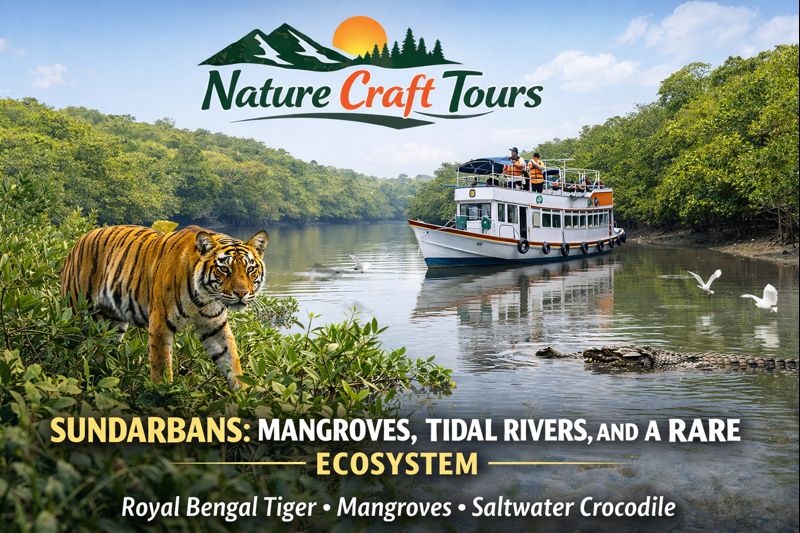
At the southern edge of West Bengal, where land gradually surrenders itself to water, lies one of the most complex and extraordinary natural systems on Earth—the Sundarbans. Neither fully land nor entirely sea, this vast deltaic wilderness is shaped by tides, rivers, salt, and sediment. It is a place where forests grow in brackish water, where villages exist on fragile embankments, and where wildlife has adapted to rhythms dictated by the moon itself.
This detailed exploration of the Sundarbans is written from the perspective of an explorer who approaches the region not as a checklist destination, but as a living laboratory of ecology, adaptation, and resilience. The Sundarbans is not merely famous for its tigers; it is globally significant for its mangrove forests, intricate tidal river networks, and rare ecosystem dynamics that exist nowhere else in the same form.
Geographical Identity of the Sundarbans Delta
The Sundarbans forms the world’s largest contiguous mangrove forest, spread across India and Bangladesh at the mouth of the Ganga–Brahmaputra–Meghna river system. On the Indian side, the forest occupies the southern districts of South 24 Parganas and North 24 Parganas. The region is crisscrossed by hundreds of tidal rivers, creeks, and estuaries that continuously reshape the land.
Unlike mountain or inland forests, the Sundarbans is defined by constant flux. Islands emerge and erode, river courses shift, and salinity levels vary daily with tidal cycles. This instability has created a rare ecological niche where only the most adaptable species survive. The landscape is flat, low-lying, and highly sensitive to sea-level changes, making it both ecologically precious and environmentally vulnerable.
Mangrove Forests: Architecture of Survival
Mangroves are the defining feature of the Sundarbans ecosystem. These salt-tolerant trees have evolved extraordinary physiological adaptations that allow them to survive in oxygen-poor, saline, and waterlogged soils. Stilt roots, pneumatophores, and salt-excreting leaves are not aesthetic features—they are survival mechanisms.
The mangrove forest acts as a biological shield, protecting inland areas from cyclones, storm surges, and coastal erosion. During extreme weather events, mangroves absorb wave energy and reduce the impact on human settlements. This protective function has made the Sundarbans globally significant in climate resilience studies.
Ecological Functions of Mangroves
Beyond protection, mangroves serve as nurseries for fish, crabs, prawns, and countless marine organisms. The complex root systems trap organic matter, forming the base of a highly productive food web. Nutrients carried from upstream rivers are filtered and recycled, supporting both forest and marine biodiversity.
Tidal Rivers and the Pulse of the Delta
The Sundarbans is governed by tides. Twice a day, seawater flows deep into the forest through wide rivers and narrow creeks, reversing the direction of freshwater flow. This constant mixing of saltwater and freshwater creates a brackish environment that is neither fully marine nor purely riverine.
Riverbanks are rarely stable. Mudflats appear and disappear, while channels deepen or silt up over time. For explorers, boat travel through these waterways offers the most authentic way to understand the region. The forest reveals itself gradually—through silent creeks, sudden openings, and unexpected encounters with wildlife along the banks.
Wildlife Adaptation in a Challenging Landscape
Life in the Sundarbans demands exceptional adaptability. Animals here contend with tidal floods, saline water, and limited freshwater sources. Terrestrial and aquatic ecosystems overlap, forcing species to develop unusual behaviors.
The Bengal tiger of the Sundarbans is perhaps the most well-known example of adaptation. Unlike its counterparts in mainland forests, this tiger is a strong swimmer, frequently crossing wide channels. Its territory is shaped by islands rather than fixed land boundaries, and prey availability changes with seasonal flooding.
Beyond the Tiger: Hidden Biodiversity
The Sundarbans supports a wide range of species including estuarine crocodiles, spotted deer, wild boar, fishing cats, otters, and numerous reptiles. Birdlife is equally rich, with kingfishers, herons, egrets, raptors, and migratory waterfowl frequenting the waterways and mudflats.
Aquatic biodiversity is immense, including dolphins, mudskippers, crabs, and mollusks that form the foundation of the delta’s food chain. Much of this biodiversity remains understudied due to the logistical challenges of research in tidal forests.
Human Presence and Cultural Landscape
Millions of people live in and around the Sundarbans, dependent on fishing, honey collection, crab harvesting, and agriculture. Life here is shaped by uncertainty—cyclones, embankment breaches, salinity intrusion, and wildlife conflicts are part of everyday reality.
Villages are often located on narrow embankments separating rivers from fields. Traditional knowledge plays a critical role in survival, from reading tidal patterns to understanding forest behavior. Any responsible exploration of the Sundarbans must acknowledge this human dimension alongside wildlife conservation.
Best Time to Visit the Sundarbans
Seasonal timing significantly influences travel conditions, wildlife visibility, and overall experience in the Sundarbans.
October to March: Prime Exploration Season
This period offers the most stable weather, with lower humidity and minimal rainfall. Water levels remain navigable, and wildlife sightings are relatively more frequent. Bird activity peaks during winter months due to migratory arrivals.
April to May: Heat and Intensity
Pre-monsoon months are hot and humid, but forest activity increases as animals move closer to water sources. Travelers must be prepared for high temperatures, especially during midday boat safaris.
June to September: Monsoon Restrictions
Heavy rainfall, rough rivers, and frequent storms make tourism risky during monsoon. Most forest areas remain officially closed, and travel is generally discouraged.
How to Reach the Sundarbans
The Sundarbans is accessed primarily from Kolkata, which serves as the main gateway.
By Road: Kolkata to gateway points such as Godkhali or Sonakhali takes approximately 3–4 hours by road.
By Boat: From these jetties, motorized boats navigate through rivers and creeks to reach forest lodges and islands.
Explorer-Style Tour Plan (2 Nights / 3 Days)
Day 1: Kolkata to Sundarbans Gateway
Early morning departure from Kolkata, followed by road transfer to the jetty. Boat journey begins through wide rivers and narrowing creeks. Arrival at accommodation by afternoon. Evening spent observing river life and attending an orientation on forest ecology and safety.
Day 2: Deep Forest Exploration
Early morning boat safari through core forest areas, covering multiple watchtowers and creek systems depending on tidal conditions. Observation focuses on mangrove ecology, birdlife, and animal tracks. Afternoon includes quieter creek exploration and interpretation sessions.
Day 3: Village Interface and Return
Morning visit to nearby villages to understand human–forest interactions, followed by return boat and road journey back to Kolkata.
Responsible Tourism in a Fragile Ecosystem
The Sundarbans cannot sustain mass tourism. Noise pollution, plastic waste, and irresponsible behavior directly threaten wildlife and local livelihoods. Visitors must follow forest regulations strictly, avoid littering, and respect both ecological and cultural sensitivities.
Travel here should be slow, educational, and low-impact—focused on understanding rather than entertainment.
Connecting Mangroves with Broader Travel Experiences
For travelers interested in immersive nature-based journeys, a curated Sundarban Tour offers structured access to this unique ecosystem while maintaining responsible travel standards.
Those seeking extended wildlife and river-delta exploration can also consider professionally designed itineraries through specialized operators offering comprehensive Sundarban Travel experiences that emphasize education and sustainability.
Why the Sundarbans Matters to the World
The Sundarbans is not only a regional treasure but a global ecological asset. It stands at the frontline of climate change, offering lessons in resilience, adaptation, and coexistence between humans and nature. To explore the Sundarbans is to witness a living system where every tide redraws the map and every species tells a story of survival.
For the explorer, the Sundarbans does not reveal itself easily. It requires patience, humility, and respect. In return, it offers insight into one of Earth’s rarest and most essential ecosystems—an experience that lingers long after the rivers fade from view.