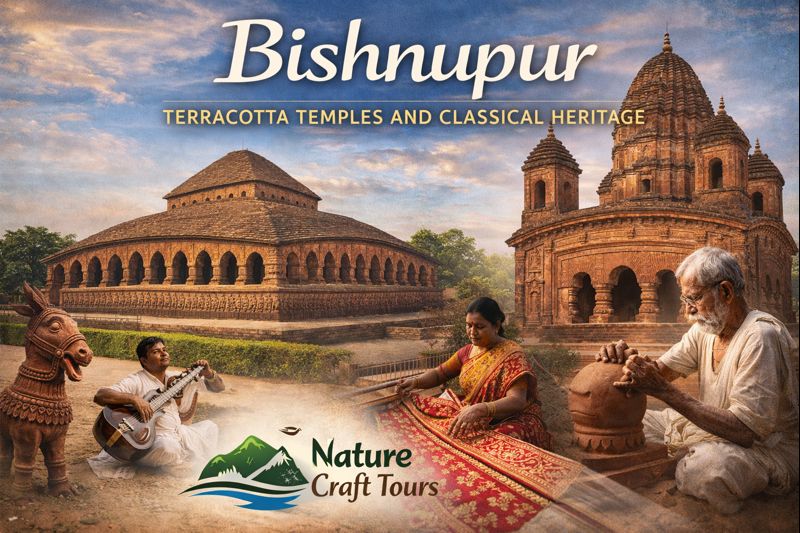
Certain landscapes speak not through grandeur alone, but through patience — patiently layered by centuries of faith, art, and disciplined creativity. Bishnupur, located in the Bankura district of West Bengal, is one such place. To walk through Bishnupur is to trace the evolution of Bengal’s temple architecture, to hear echoes of classical music traditions, and to understand how art flourished under royal patronage in a region far removed from riverine capitals and colonial ports.
As an explorer, Bishnupur feels less like a destination and more like an open archive. Every terracotta panel, every laterite pathway, and every temple courtyard narrates stories of devotion, craftsmanship, and cultural continuity. Unlike hurried tourist hubs, Bishnupur rewards slow travel — encouraging visitors to observe details, absorb symbolism, and appreciate the harmony between built heritage and its surrounding landscape.
Geographical Context and Landscape Character
Bishnupur lies on the transitional zone between the fertile Gangetic plains and the rugged lateritic uplands of western Bengal. The soil here is rich in iron content, giving the land its distinctive reddish hue. This very soil shaped Bishnupur’s architectural identity, as baked terracotta became the principal medium for temple ornamentation.
The terrain is gently undulating, dotted with sal forests, water bodies, and small agrarian settlements. The absence of large rivers influenced local building techniques, leading to compact temple forms rather than towering structures. This landscape fostered a self-contained cultural ecosystem, allowing art and music to develop with remarkable consistency over centuries.
Climate and Ideal Travel Season
Bishnupur experiences a tropical climate with hot summers, moderate monsoons, and pleasant winters. Summer months from April to June can be intense, with high temperatures and dry winds. The monsoon season, from July to September, refreshes the landscape but may limit extended outdoor exploration.
The best time to visit Bishnupur is between October and February. During winter, daytime temperatures remain comfortable, skies are clear, and the temples reveal their intricate terracotta details under soft sunlight. Cultural events and music recitals are also more frequent during this period, enriching the travel experience.
Historical Evolution: The Rise of Bishnupur as a Cultural Capital
Bishnupur rose to prominence under the Malla dynasty, which ruled the region for nearly a thousand years. Originally followers of Shaivism, the Malla kings later embraced Vaishnavism, leading to the construction of numerous temples dedicated to Krishna and Radha. This religious transition deeply influenced the town’s artistic vocabulary.
Royal patronage ensured that temple construction, music, sculpture, and craftsmanship flourished simultaneously. Bishnupur became not just a political center but a spiritual and cultural nucleus where devotion and aesthetics merged seamlessly.
Terracotta as an Architectural Language
The scarcity of stone in the region led architects and artisans to experiment with baked clay. Over time, terracotta evolved from a practical solution into a refined artistic medium. Temple walls were transformed into narrative surfaces, depicting scenes from epics, Puranic legends, royal processions, and everyday village life.
These panels are not merely decorative. They function as visual scriptures, accessible to a largely non-literate population. The durability of terracotta, when properly fired, ensured that these stories endured across centuries, surviving climate, conflict, and neglect.
Iconic Temples of Bishnupur
The temples of Bishnupur are united by material yet diverse in form. Each structure represents a specific architectural experiment, reflecting evolving religious practices and aesthetic preferences.
Rasmancha: A Singular Architectural Vision
The Rasmancha stands apart from all other structures in Bishnupur. Built as a platform for displaying deities during festivals, its pyramidal form and arched galleries demonstrate an innovative synthesis of Islamic and indigenous architectural elements. The structure symbolizes communal worship, where multiple traditions converged during ritual celebrations.
Jor Bangla and Shyam Rai Temples
The Jor Bangla Temple imitates traditional Bengali huts, with twin curved roofs joined together. This design bridges domestic architecture and sacred space, reinforcing the idea that devotion is rooted in everyday life. The Shyam Rai Temple, with its five towers, showcases some of the finest terracotta relief work in the region, illustrating mythological narratives with extraordinary precision.
Bishnupur Gharana: Classical Music Heritage
Beyond architecture, Bishnupur holds a revered place in Indian classical music. The Bishnupur Gharana of Hindustani classical music developed under royal patronage, emphasizing discipline, lyrical purity, and devotion. Musicians trained in this tradition contributed significantly to the evolution of dhrupad and khayal styles.
Even today, music schools and family lineages preserve this tradition. Attending a recital in Bishnupur offers travelers an intimate encounter with a living heritage that cannot be replicated in concert halls alone.
Craft Traditions and Local Economy
Terracotta craftsmanship extends beyond temples into domestic and ritual objects. Horses, elephants, plaques, and ritual items crafted by local artisans reflect continuity of skill passed down generations. Bishnupur is also known for its silk sarees, characterized by understated elegance and traditional motifs.
Supporting these crafts sustains the cultural economy of the region. Travelers engaging with artisans gain insight into sustainable production rooted in cultural identity rather than mass commercialization.
Complete Tour Plan: Exploring Bishnupur with Depth
An ideal Bishnupur itinerary spans three days, allowing sufficient time for heritage exploration, cultural engagement, and reflective travel.
Day One: Arrival and Architectural Orientation
Arrive in Bishnupur by morning and settle into your accommodation. Begin with a guided walk through the central temple cluster, starting with Rasmancha and moving towards Jor Bangla and Madan Mohan temples. Observe terracotta panels closely, noting recurring themes and stylistic differences. Evening is best spent watching the sunset over the temple skyline.
Day Two: Cultural Immersion and Craft Exploration
The second day focuses on deeper cultural engagement. Visit local museums and music schools to understand the Bishnupur Gharana tradition. Post-lunch, explore artisan neighborhoods where terracotta items and silk textiles are produced. Conversations with craftsmen provide valuable context to the objects displayed in museums.
Day Three: Reflection and Surrounding Landscapes
On the final day, revisit temples for photography and quiet observation. Explore nearby rural landscapes to understand how agrarian life shaped temple iconography. Depart by afternoon with a holistic understanding of Bishnupur’s cultural ecosystem.
Connectivity and Travel Access
Bishnupur is well connected by rail from Kolkata, making it accessible for short heritage trips. Road travel offers scenic views of rural Bengal, though rail remains the most efficient mode for most travelers.
Many culturally inclined travelers choose to combine heritage journeys with ecological experiences elsewhere in the state. Integrating a historical circuit with a nature-focused journey such as a Sundarban Tour provides a balanced understanding of Bengal’s architectural and ecological diversity.
Bishnupur in a Broader Travel Context
Bishnupur represents a model of cultural sustainability. Unlike destinations overwhelmed by commercialization, it remains rooted in authenticity. Its temples are not isolated monuments but components of a living town where rituals, crafts, and music continue organically.
Travelers interested in extending their exploration across Bengal often align cultural heritage with wetland and forest landscapes. Pairing Bishnupur with a thoughtfully curated Sundarban Travel experience allows one to witness how human creativity and natural systems coexist across different regions of the state.
Why Bishnupur Matters for the Thoughtful Explorer
Bishnupur is not a destination for hurried sightseeing. It invites patience, curiosity, and respect. Its terracotta temples stand as testaments to how local resources, spiritual vision, and artistic discipline can create enduring cultural landmarks.
For explorers seeking depth over spectacle, Bishnupur offers something rare — an unbroken dialogue between past and present. It reminds us that heritage is not merely preserved in stone or clay, but sustained through understanding, practice, and mindful travel.