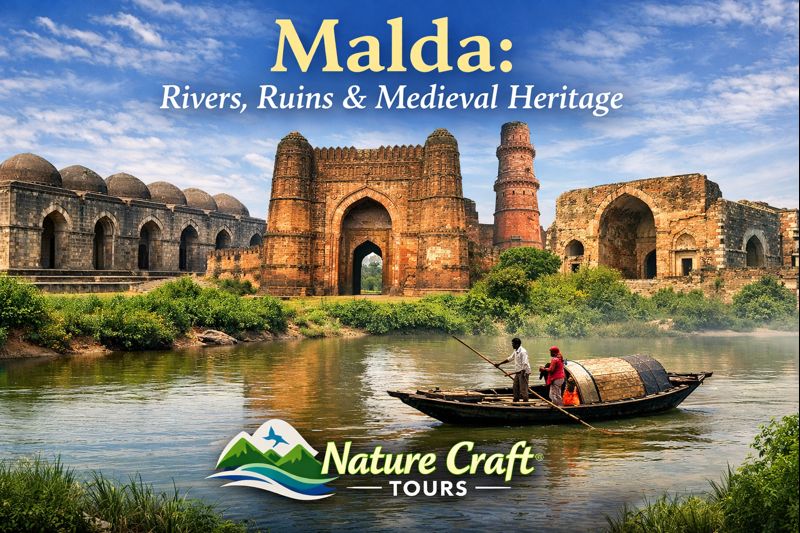
Malda is not merely a district of northern West Bengal; it is a palimpsest of civilizations shaped by mighty rivers, imperial ambitions, and mercantile brilliance. To journey through Malda is to walk along vanished capitals, crumbling mosques, and riverbanks that once carried the wealth of Bengal to distant lands. This article approaches Malda as an explorer would—slowly, attentively, and with respect for the deep historical layers embedded in its soil.
Situated at the confluence of history and geography, Malda occupies a strategic corridor between ancient Bengal and North India. The Ganga and the Mahananda have dictated its destiny—nourishing fertile plains, altering political centers, and sometimes destroying entire cities. What remains today is a landscape of ruins and memories, waiting to be understood rather than merely seen.
Geographical Setting: Land Between Two Rivers
Malda lies on the western edge of North Bengal, bordered by Bangladesh to the east. The district is defined by two dominant river systems—the Ganga (Padma) and the Mahananda. Over centuries, the shifting courses of these rivers have reshaped settlement patterns, agriculture, and trade routes. River erosion remains a living reality here, particularly along the Ganga, where entire villages have been swallowed and reborn elsewhere.
This riverine geography explains Malda’s historical importance. In medieval times, navigable waterways connected Malda to Gaur, Pandua, Rajmahal, and onward to the Bay of Bengal. Control over this corridor meant control over trade, taxation, and imperial authority.
Historical Overview: From Ancient Bengal to Sultanate Capitals
The earliest historical references to Malda appear in ancient texts describing the regions of Pundravardhana and Gauda. By the early medieval period, Gauda emerged as a powerful political and cultural center. The region reached its zenith between the 12th and 16th centuries, when it served as the capital of the Bengal Sultanate.
Two cities dominate Malda’s historical narrative: Gaur and Pandua. These were not minor towns but grand capitals adorned with mosques, madrasas, palaces, gateways, and fortified walls. Contemporary foreign travelers described Gaur as one of the richest cities in the Islamic world, its markets brimming with silk, spices, and gold.
Decline came not through conquest alone, but through environmental catastrophe. Epidemics, floods, and river course changes gradually rendered these capitals uninhabitable. The court moved, populations dispersed, and once-magnificent cities were reclaimed by vegetation.
Gaur: The Abandoned Imperial Capital
Baro Sona Masjid
The Baro Sona Masjid stands as the architectural jewel of Gaur. Constructed in the early 16th century, the mosque once featured gilded domes, giving rise to its name—“Twelve Golden Mosques.” Though the gold has vanished, the structure remains imposing, with massive stone pillars, elegant arches, and intricate terracotta ornamentation.
The mosque reflects a synthesis of Islamic design and local Bengali craftsmanship. Brick and stone construction, curved cornices, and floral motifs reveal how architecture adapted to climate and material availability.
Dakhil Darwaza and Fortifications
The Dakhil Darwaza served as the ceremonial eastern gateway to Gaur. Its sheer scale suggests the grandeur of the city it once guarded. Thick walls, bastions, and watchtowers indicate a capital prepared for both defense and spectacle.
Walking through this gateway today, one encounters silence broken only by wind and birds—a stark contrast to the bustling processions that once passed beneath its arches.
Pandua: Spiritual and Political Transition
Pandua briefly replaced Gaur as the capital during the 14th century. Though its tenure was short, Pandua left behind monuments of exceptional importance. The city illustrates how political centers in Bengal shifted rapidly in response to ecological and strategic pressures.
Adina Mosque
The Adina Mosque is among the largest mosques ever built in the Indian subcontinent. Inspired by Persian imperial architecture, it was conceived as a statement of sovereignty. Its vast courtyard, towering arches, and once-magnificent roof convey the ambition of its patrons.
Even in ruins, the mosque evokes awe. Fallen pillars and collapsed vaults tell a story of imperial overreach and the limits imposed by nature and time.
Rivers as Living History
In Malda, rivers are not background scenery; they are active historical agents. The Ganga’s gradual eastward shift directly contributed to the abandonment of Gaur. The Mahananda, meanwhile, supported agriculture and inland trade but also flooded unpredictably.
For the explorer, riverbanks offer insight into Malda’s past. Ancient bricks embedded in eroded banks, pottery fragments, and altered settlement lines all speak of a landscape in constant negotiation with water.
Cultural Landscape: Language, Faith, and Craft
Malda’s culture reflects centuries of coexistence between Hindu and Muslim communities. Temples stand near mosques; festivals overlap; folk traditions borrow freely across religious lines. This syncretism is not accidental but rooted in the region’s shared agrarian and mercantile life.
Mango cultivation deserves special mention. Malda is nationally renowned for varieties such as Fazli, Langra, and Himsagar. The mango orchards are both economic lifelines and cultural symbols, celebrated in local songs and seasonal rituals.
Best Time to Visit Malda
October to March
The ideal time to explore Malda is between October and March. During these months, temperatures remain moderate, and humidity is low, allowing for extended outdoor exploration of archaeological sites.
Seasonal Considerations
Summer months can be extremely hot, often exceeding comfort levels for site visits. Monsoon brings lush greenery but also risks flooding and restricted access to ruins. Winter mornings may be foggy, adding an atmospheric quality to the landscapes.
How to Reach Malda
Malda is well connected by rail, with Malda Town and Old Malda stations serving as major junctions on eastern railway routes. Road access from Kolkata and North Bengal is also reliable, passing through fertile countryside and river crossings.
The nearest airports are located in Bagdogra and Kolkata, from where onward travel by rail or road is feasible.
Suggested 3-Day Explorer’s Tour Plan
Day 1: Arrival and River Context
Arrive in Malda and begin with an orientation drive along the Mahananda riverbanks. Visit local museums to understand the historical timeline before moving to nearby mango orchards and rural settlements.
Day 2: Gaur Exploration
Dedicate a full day to Gaur. Explore Baro Sona Masjid, Dakhil Darwaza, Firoz Minar, and surrounding ruins at a slow pace. Allow time for sketching, photography, and quiet observation.
Day 3: Pandua and Cultural Immersion
Travel to Pandua to visit the Adina Mosque and other remnants. Conclude the journey with interactions in local markets, sampling regional cuisine, and reflecting on the interplay between history and daily life.
Malda in the Broader Travel Context
For travelers interested in heritage-based journeys across eastern India, Malda pairs naturally with riverine and ecological destinations. Many culturally inclined travelers combine historical exploration with nature-focused itineraries such as the Sundarban Tour, where rivers once again dictate rhythm and survival.
Those seeking a thematic continuation of Bengal’s water-centered civilization often extend their journeys through curated routes offered by platforms focused on heritage and ecology, including specialized Sundarban Travel experiences.
Why Malda Matters
Malda is not a destination for hurried sightseeing. It demands patience, curiosity, and respect for silence. Its ruins do not announce themselves loudly; they whisper through broken arches and grass-covered walls. For the explorer, Malda offers something rare—a chance to understand how geography, power, and culture intertwine, and how even the greatest capitals can vanish when rivers decide to change course.
In an age of instant travel and surface-level experiences, Malda stands as a reminder that history is best approached slowly. Here, rivers still write the final chapter, just as they have for centuries.