Interpreting the Cultural Memory of the Brahmaputra Valley
Assam State Museum & Heritage Stops
— An Explorer’s Guide to the Material History of the Northeast
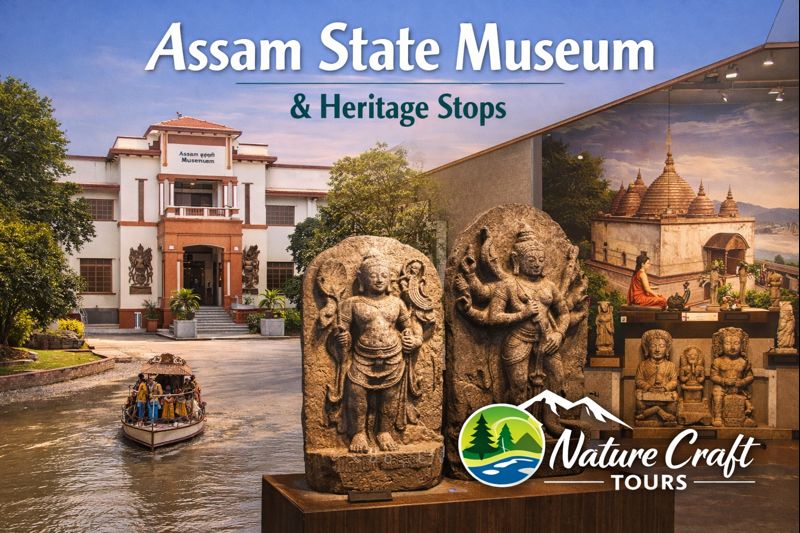
To explore Assam only through landscapes is to see half its truth. The other half rests quietly within museums, archives, monuments, and heritage precincts where time has been patiently preserved. At the heart of this intellectual and cultural preservation stands the Assam State Museum in Guwahati—an institution that functions not merely as a collection space, but as a key to understanding the historical consciousness of the Brahmaputra Valley.
For the serious explorer, Assam State Museum is not a brief halt between temple visits or river cruises. It is the interpretative anchor that allows one to decode the symbols, rituals, architecture, and social practices encountered across Assam. This article presents a deeply researched exploration of the Assam State Museum and its associated heritage stops, structured as a meaningful cultural journey rather than a checklist.
Why Museums Matter in Assam’s Travel Narrative
Assam’s history does not unfold through monumental ruins alone. Instead, it survives in manuscripts, textiles, ritual objects, weapons, sculptures, and everyday tools—many of which are fragile, perishable, and deeply contextual. Museums in Assam therefore perform a critical role: they stabilise memory in a land shaped by floods, migrations, and shifting political boundaries.
The Assam State Museum serves as the most comprehensive gateway into this layered history, bridging prehistoric settlements, ancient kingdoms, medieval dynasties, colonial encounters, and modern ethnographic identities.
Museums as Cultural Translators
Unlike open-air heritage sites, museums translate meaning. They explain why a textile pattern matters, how a weapon reflects political organisation, and where ritual objects fit within belief systems. For explorers seeking depth, this interpretative function is indispensable.
Assam State Museum: Location, Scope, and Significance
The Assam State Museum is located in the Ambari area of Guwahati, within close proximity to the city’s administrative and cultural zones. Established with the aim of preserving Assam’s tangible heritage, the museum has evolved into a multidisciplinary repository encompassing archaeology, anthropology, art history, numismatics, and ethnography.
The museum’s layout encourages chronological and thematic exploration, allowing visitors to move seamlessly from ancient artefacts to living traditions.
What Makes Assam State Museum Unique
Unlike many regional museums, Assam State Museum integrates hill and plains cultures within a single narrative. This inclusivity reflects Assam’s historical role as a corridor of cultural exchange rather than a closed civilisation.
Key Galleries and Their Interpretative Value
Archaeological Gallery: Tracing Early Assam
This section houses stone sculptures, inscriptions, terracotta objects, and relics from ancient sites across Assam. The iconography reveals strong links with early Shaivite, Vaishnavite, and Shakta traditions, offering context to temple landscapes such as Kamakhya and Umananda.
Epigraphy and Numismatics
Copper plates, seals, and coins provide insight into governance, land grants, and economic systems. These objects help reconstruct political geography long before modern boundaries existed.
Ethnographic Gallery: Living Cultures
This gallery documents the material culture of Assam’s diverse communities—Bodo, Mishing, Karbi, Dimasa, Tiwa, and others. Traditional attire, musical instruments, agricultural tools, and household objects are displayed not as curiosities, but as functional extensions of daily life.
Textiles and Handloom Section
Assam’s global recognition for silk traditions—particularly Muga, Eri, and Pat—is grounded in centuries of craftsmanship. This section explains weaving techniques, symbolic motifs, and socio-economic roles of handloom production.
Associated Heritage Stops Around Guwahati
A visit to the Assam State Museum is most effective when paired with nearby heritage sites, allowing theory to meet landscape.
Ambari Archaeological Zone
Located near the museum itself, Ambari represents remnants of ancient Pragjyotishpura. Sculptural fragments and structural remains reinforce museum narratives through spatial experience.
Uzan Bazaar Heritage Precinct
This historic riverfront area contains colonial-era buildings, old warehouses, and administrative structures that reflect Guwahati’s evolution during British rule.
Temple Heritage Circuit
Sites such as Kamakhya, Navagraha, and Umananda gain deeper meaning when approached after understanding their symbolic vocabulary within the museum.
Best Time to Visit Assam State Museum & Heritage Stops
October to March: Optimal Cultural Exploration
Pleasant weather allows comfortable movement between indoor museums and outdoor heritage sites. This period also aligns with festivals that enrich interpretative context.
April to May: Scholarly Quiet
Fewer visitors make this period suitable for researchers and serious explorers, despite warmer temperatures.
Suggested 3-Day Cultural Explorer Tour Plan
Day 1: Assam State Museum Deep Exploration
Spend a full day at the museum, moving systematically through galleries. Allocate time for note-taking and reflection.
Day 2: Archaeology and Riverfront Heritage
Visit Ambari archaeological remains followed by Uzan Bazaar and Brahmaputra riverfront walk.
Day 3: Temple Contextualisation
Visit key temples to observe how museum narratives translate into living ritual spaces.
Assam Museums in a Broader Indian Travel Context
Indian travel often prioritises spectacle over scholarship. Assam State Museum challenges this trend by rewarding slow, informed engagement. It complements nature-based journeys by providing intellectual grounding.
Travellers experienced with eco-cultural landscapes such as those encountered during a Sundarban Tour will recognise a similar relationship between environment, culture, and survival strategies.
Likewise, visitors planning layered journeys like a Sundarban Tour Package from Kolkata may view Assam’s museum-led exploration as a natural extension of interpretative travel.
Educational and Research Value
The Assam State Museum functions as an academic resource for historians, anthropologists, designers, and conservationists. Its collections support curriculum development, comparative studies, and heritage preservation planning.
For students and educators, the museum transforms abstract history into tangible evidence.
Responsible Heritage Engagement
Museums and heritage sites depend on visitor discipline. Photography restrictions, respectful behaviour, and avoidance of physical contact with artefacts ensure long-term preservation.
Heritage tourism succeeds only when curiosity is balanced with responsibility.
Reading Assam Through Objects and Spaces
Assam State Museum and its surrounding heritage stops offer more than information—they offer orientation. They teach travellers how to read landscapes, rituals, and architecture with informed sensitivity.
For the explorer who values understanding over consumption, these institutions transform Assam from a scenic destination into an intelligible civilisation. Within glass cases and quiet galleries lies the key to the Brahmaputra Valley’s enduring identity.
To walk out of the Assam State Museum is to walk back into the land with sharpened vision—aware that every temple, river, and textile carries a story patiently waiting to be recognised.