Hajo — Where Faiths Meet, Rivers Witness, and Pilgrimage Becomes Dialogue
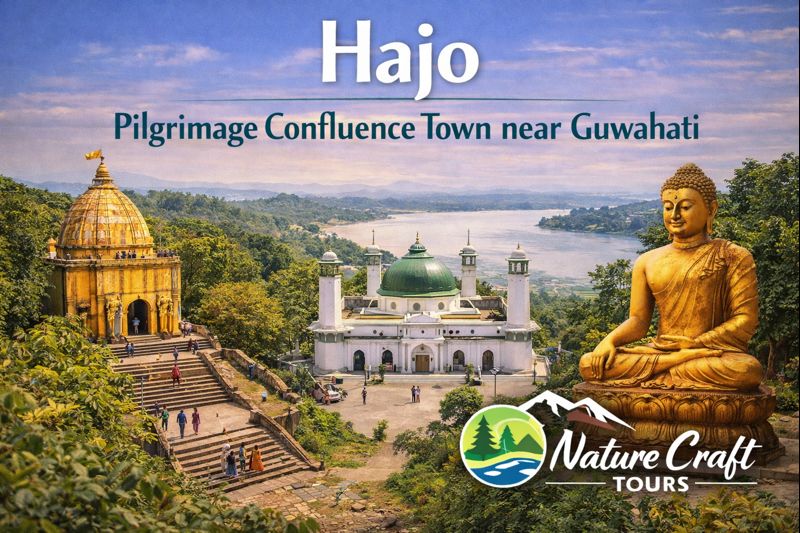
On the quiet north bank of the Brahmaputra, just beyond the urban pulse of Guwahati, lies Hajo—a town that does not announce itself loudly, yet carries a spiritual weight unmatched in eastern India. Hajo is not a single-faith pilgrimage centre, nor a destination defined by one dominant monument. It is, instead, a rare confluence town where Hindu, Muslim, and Buddhist traditions coexist spatially, ritually, and historically.
To approach Hajo as an explorer is to step into a layered sacred geography where belief systems do not collide but overlap gently. Hills rise softly, shrines appear unassuming, and the river flows as a silent witness to centuries of shared devotion. This article presents a deeply researched, immersive exploration of Hajo—its pilgrimage sites, historical evolution, cultural atmosphere, and a thoughtfully structured tour plan designed for travellers seeking understanding rather than checklist tourism.
Geographical Setting: Hajo and the Brahmaputra Landscape
Hajo is located approximately 35 kilometres northwest of Guwahati, situated along the northern bank of the Brahmaputra River. The town occupies gently undulating terrain, marked by low hills, fertile plains, and ancient pathways shaped by pilgrimage movement rather than commerce.
The proximity of the Brahmaputra is central to Hajo’s identity. Historically, pilgrims arrived by river, approaching sacred sites through water routes that reinforced ritual purification before worship. Even today, the river’s presence lends Hajo a contemplative stillness absent from more urban pilgrimage centres.
Why Geography Matters in Hajo
Hajo’s hillocks provide natural elevation for shrines, symbolically placing them closer to the divine while remaining accessible. The surrounding plains supported settlements of priests, caretakers, and travellers, creating a balanced sacred ecosystem.
Hajo as a Pilgrimage Confluence: An Exceptional Identity
Few towns in South Asia embody interfaith pilgrimage as organically as Hajo. Over centuries, sacred structures associated with Hinduism, Islam, and Buddhism emerged not in isolation but in dialogue with one another. This coexistence was not accidental; it evolved from Hajo’s position as a crossroads of trade routes, river networks, and cultural exchange.
Unlike modern notions of pluralism enforced through policy, Hajo’s harmony is spatial and lived. Shrines stand within walking distance, and pilgrim flows intersect naturally.
A Town Without Sectarian Boundaries
Hajo demonstrates how sacred landscapes can absorb diversity without dilution. Each tradition retains its integrity while acknowledging the presence of others.
Major Pilgrimage Sites of Hajo
Hayagriva Madhava Temple: The Vaishnavite Anchor
Perched atop a hill, the Hayagriva Madhava Temple is the most prominent Hindu shrine in Hajo. Dedicated to an incarnation of Vishnu, the temple attracts pilgrims from Assam, Bengal, and beyond. Its elevated location reinforces ritual ascent, both physical and spiritual.
The temple’s architecture reflects layers of reconstruction across centuries, echoing Assam’s broader temple-building traditions. The surrounding steps, water tanks, and viewing points frame the pilgrimage experience as a gradual approach rather than an abrupt arrival.
Poowa Mecca: Islamic Pilgrimage and Memory
Hajo is equally significant to Muslim pilgrims due to Poowa Mecca, a revered Islamic site believed to commemorate early Islamic presence in the region. The shrine’s name symbolically links it to Mecca, underscoring spiritual connectivity rather than geographical equivalence.
The site reflects Sufi-influenced devotion, emphasising humility, remembrance, and communal prayer. Its presence within a multi-faith pilgrimage town highlights Assam’s historical openness to spiritual exchange.
Buddhist Associations and Memory
Hajo is also revered by Buddhists, particularly due to traditions associating the Hayagriva Madhava site with the Mahaparinirvana of the Buddha. While physical Buddhist monuments are subtle, the site’s spiritual resonance extends beyond visible architecture.
Historical Evolution of Hajo
Hajo’s significance predates recorded history, with archaeological evidence suggesting early settlement and ritual activity. Over time, it became integrated into regional kingdoms, river trade networks, and pilgrimage circuits.
Medieval periods saw patronage from local rulers who recognised Hajo’s unifying spiritual role. Later, Islamic influences entered through trade and missionary activity, adding new layers without erasing older ones.
Continuity Without Monumentalisation
Unlike cities that monumentalised power through grand architecture, Hajo retained a modest scale. This restraint preserved its contemplative atmosphere and prevented dominance by any single tradition.
Walking Through Hajo: A Slow Pilgrimage Experience
Hajo is best explored on foot. Distances between sites are short, encouraging reflective movement rather than hurried transit. Narrow paths, shaded stretches, and occasional river views create a rhythm suited to pilgrimage.
The absence of aggressive commercialisation allows visitors to focus on observation, conversation, and silence.
Best Time to Visit Hajo
October to March: Ideal Pilgrimage Season
Cool temperatures and dry weather make this period most suitable for walking and extended site visits. Major festivals also occur during this season.
April to May: Intimate Exploration
While warmer, this period sees fewer visitors, offering quieter engagement with sites.
Monsoon Months: Restricted but Revealing
Heavy rains may limit access, yet the landscape turns lush, reinforcing the town’s riverine character.
Suggested 2-Day Pilgrimage & Cultural Tour Plan
Day 1: Arrival and Hindu–Buddhist Circuit
Arrive from Guwahati in the morning. Begin with Hayagriva Madhava Temple, allowing time for observation rather than hurried darshan. Explore surrounding areas and viewpoints.
Day 2: Islamic Heritage and River Context
Visit Poowa Mecca and engage with the site’s spiritual atmosphere. Spend time along the Brahmaputra riverbank to understand Hajo’s geographic role in pilgrimage movement.
Hajo in the Broader Sacred Geography of Eastern India
Hajo occupies a unique position within eastern India’s pilgrimage landscape. While many sacred towns align with single traditions, Hajo demonstrates layered sanctity.
Travellers familiar with water-centred sacred ecologies—such as those experienced during a Sundarban Tour—may recognise parallels in how rivers anchor spiritual life.
Similarly, visitors undertaking immersive journeys like a Sundarban Tour Package from Kolkata may find Hajo a cultural-spiritual complement to ecological pilgrimage routes.
Responsible Pilgrimage Practices in Hajo
Visitors should approach Hajo with humility. Respect for differing rituals, appropriate attire, and quiet conduct ensures the town’s harmony remains intact.
Photography should be discreet, and commercial transactions should not intrude upon worship.
Challenges and Preservation of Hajo’s Identity
Urban expansion, increased tourism, and infrastructural pressure pose challenges. However, Hajo’s restrained scale offers hope that careful planning can preserve its character.
Community-led stewardship remains key to sustaining the town’s spiritual equilibrium.
A Town That Teaches Coexistence
Hajo does not preach unity through declarations; it demonstrates it through space. Shrines rise quietly, paths intersect naturally, and the river flows without discrimination.
For the explorer, Hajo offers a rare lesson: that faiths need not compete to coexist, and that sacredness can deepen through proximity rather than separation.
As one leaves Hajo, the memory that lingers is not of grandeur, but of balance—a town where belief systems meet gently, and where the Brahmaputra continues its patient witness to centuries of shared devotion.