Kaziranga National Park: Assam’s Flagship Wildlife Landscape
Kaziranga National Park — Where the Brahmaputra Shapes Wilderness, and Conservation Becomes a Living Story
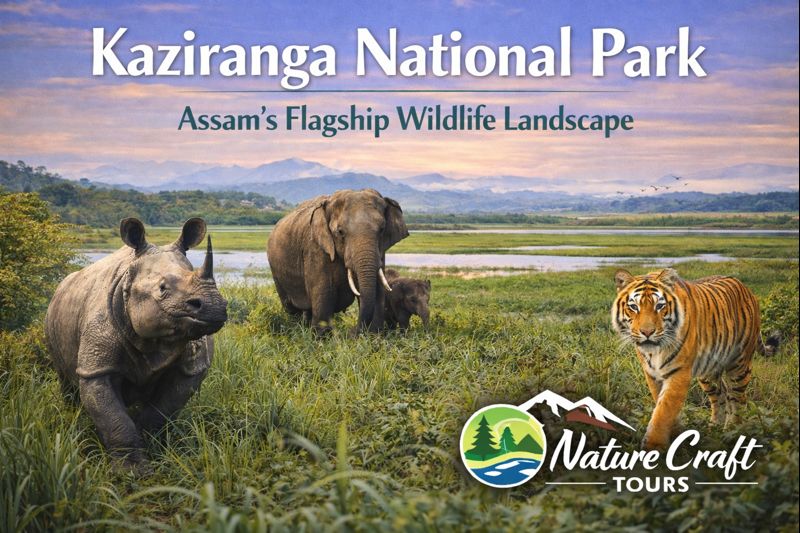
Stretching across the floodplains of the mighty Brahmaputra, Kaziranga National Park is not merely a protected forest—it is one of the most significant wildlife landscapes in Asia. Revered globally for its successful conservation of the Great Indian One-Horned Rhinoceros, Kaziranga represents a rare harmony between river dynamics, grassland ecology, wetland systems, and large mammal survival.
To explore Kaziranga is to understand how nature operates at scale. This is a land where annual floods are not disasters but ecological renewals; where grasslands shift, wetlands migrate, and wildlife adapts with instinctive precision. For the explorer, Kaziranga offers far more than safari sightings—it provides a masterclass in landscape-driven biodiversity.
Geographical Context: The Brahmaputra Floodplain Ecosystem
Kaziranga National Park lies in the heart of Assam, spanning the districts of Golaghat and Nagaon. The park is cradled between the Brahmaputra River to the north and the Karbi Anglong hills to the south, forming a unique ecological gradient.
This positioning is critical. The Brahmaputra’s annual floods deposit nutrient-rich silt, sustaining tall elephant grass, marshlands, and oxbow lakes. Meanwhile, the elevated Karbi Anglong plateau serves as a crucial wildlife refuge during extreme floods. This vertical connectivity is one of Kaziranga’s greatest ecological strengths.
Why Floods Are Kaziranga’s Lifeline
Unlike conventional conservation areas that resist flooding, Kaziranga depends on it. Seasonal inundation rejuvenates grasslands, controls invasive vegetation, and redistributes aquatic nutrients. Wildlife movement during floods maintains genetic diversity across landscapes.
A Brief History of Kaziranga’s Conservation Journey
Kaziranga’s story is inseparable from the history of conservation in India. Once a hunting ground during the colonial era, the alarming decline of rhinoceros populations in the early 20th century prompted decisive protection measures.
Declared a reserve forest and later elevated to national park status, Kaziranga became a pioneering example of species-focused conservation evolving into ecosystem-based management. Its designation as a UNESCO World Heritage Site recognised not only species richness but landscape integrity.
From Protection to Ecological Stewardship
Modern Kaziranga management extends beyond anti-poaching to include habitat management, corridor preservation, and community interface. The park’s success is built on adaptive strategies rather than rigid control.
Flagship Species of Kaziranga National Park
The Great Indian One-Horned Rhinoceros
Kaziranga is globally synonymous with the one-horned rhinoceros. Hosting the majority of the world’s population, the park stands as a conservation triumph. These prehistoric-looking animals are best observed grazing in open grasslands during early morning safaris.
Asian Elephants
Large elephant herds move seasonally across Kaziranga, especially during floods. Their migratory behaviour shapes grassland structure and seed dispersal.
Royal Bengal Tiger
Though elusive, Kaziranga supports a high density of tigers. The tall grass and wetland mosaic provide ideal ambush terrain, making sightings rare but ecologically significant.
Wild Water Buffalo
Kaziranga shelters the largest population of wild water buffalo in the world. Massive and formidable, these animals dominate wetland edges and floodplain meadows.
Swamp Deer and Hog Deer
These herbivores play a crucial role in maintaining grassland balance and supporting predator populations.
Avian Richness: A Wetland Bird Paradise
Kaziranga is also a haven for birdlife, with hundreds of resident and migratory species. Wetlands attract storks, pelicans, geese, and ducks, while grasslands host floricans and raptors.
Winter transforms the park into an avian corridor, making it a rewarding destination for bird-focused explorers.
Safari Zones and Exploration Areas
Central Range (Kohora)
The most accessible and popular zone, offering open grasslands and frequent rhino sightings.
Eastern Range (Agaratoli)
Renowned for birdlife and scenic wetlands, this zone is ideal for slow, observation-driven safaris.
Western Range (Bagori)
Known for high densities of rhinos and buffalo, with wide vistas across floodplains.
Burapahar Range
Hilly and forested, this lesser-visited area offers a contrasting ecological experience.
Best Time to Visit Kaziranga National Park
November to February: Prime Wildlife Viewing
Cool temperatures, open visibility, and high animal movement make this the best period for safaris.
March to April: Grassland Drama
Rising temperatures increase wildlife activity near water sources, offering intense viewing opportunities.
May to October: Monsoon Closure
The park remains largely closed due to flooding. While inaccessible, this period is vital for ecological renewal.
Suggested 3-Day Explorer-Style Tour Plan
Day 1: Arrival and Central Range Safari
Arrive at Kaziranga by afternoon. Evening safari in the Central Range to familiarise with grassland ecology.
Day 2: Eastern and Western Range Exploration
Early morning safari in the Eastern Range for birds and wetlands. Afternoon safari in the Western Range focusing on large mammals.
Day 3: Burapahar Landscape and Departure
Explore the Burapahar area to experience forested terrain and panoramic viewpoints before departure.
Kaziranga in the Context of Indian Wildlife Travel
Kaziranga represents a distinct ecological narrative compared to other Indian wildlife destinations. Unlike dry forests or dense jungles, its identity is shaped by water and movement.
Travellers familiar with deltaic wilderness experiences such as the Sundarban Tour will recognise parallels in how rivers dictate animal behaviour, vegetation cycles, and survival strategies.
Similarly, immersive wildlife journeys like a Sundarban Tour Package from Kolkata complement Kaziranga by offering contrasting riverine ecosystems within eastern India.
Human–Wildlife Interface and Conservation Challenges
Kaziranga’s success brings challenges: increasing human-wildlife interaction, flood-related displacement, and infrastructural pressure. Conservation here demands continuous adaptation.
Community engagement, wildlife corridors, and responsible tourism remain central to maintaining ecological balance.
Responsible Safari Practices
Visitors should adhere strictly to park guidelines. Silence, patience, and respect for animal space enhance both safety and experience.
Kaziranga rewards observation over pursuit.
Why Kaziranga Is Assam’s Flagship Landscape
Kaziranga is not defined by a single species but by its ability to sustain entire ecological processes. Its success lies in embracing natural forces rather than resisting them.
Here, conservation is dynamic, adaptive, and deeply rooted in landscape understanding.
Where the River Writes the Rulebook
Kaziranga National Park is a testament to what happens when conservation respects natural rhythms. The Brahmaputra floods, grasslands regenerate, animals migrate, and life continues—season after season.
For the explorer, Kaziranga offers more than wildlife encounters. It offers perspective: a reminder that nature does not require perfection, only space to function.
As mist lifts over the floodplains at dawn and rhinos emerge from tall grass, one realises that Kaziranga is not merely protected—it is alive, evolving, and profoundly instructive.