Tea Garden Experience (Kaziranga / Jorhat Belt):
Assam’s Iconic Plantation Story
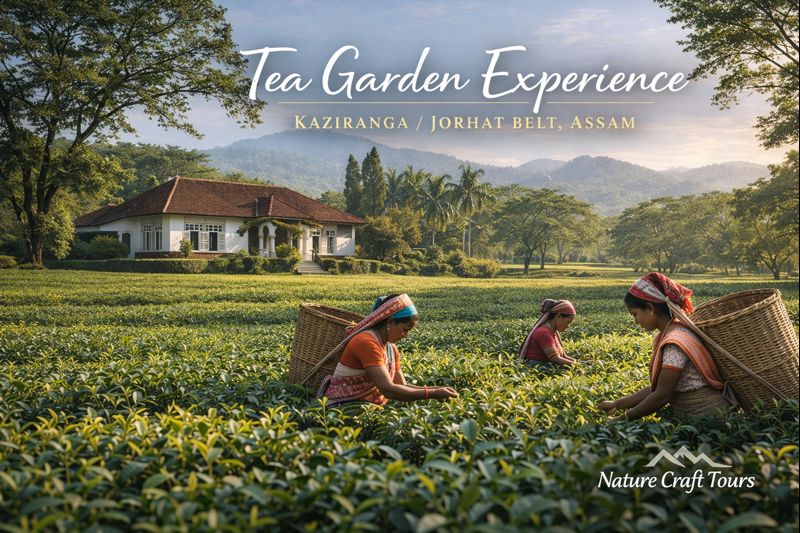
Beyond the celebrated wildlife corridors and riverine grasslands of Upper Assam lies a quieter, enduring landscape shaped not by seasonal floods or animal migrations, but by routine, patience, and time. The tea gardens of the Kaziranga–Jorhat belt unfold as a living archive of Assam’s plantation legacy, where daily life follows a rhythm dictated by sunlight, rainfall, and the careful hands that tend each leaf. A tea garden experience here is not an activity to be consumed quickly; it is an immersion into a cultural and ecological system refined over more than a century.
For the traveler who pauses between safaris or seeks a deeper understanding of Assam beyond its iconic national parks, the tea estates offer perspective. They reveal how land, labor, colonial history, and local resilience combined to create one of the world’s most influential tea-producing regions. This is Assam’s iconic plantation story—unhurried, layered, and inseparable from the identity of the region itself.
Destination Overview: The Kaziranga–Jorhat Tea Belt
The Kaziranga–Jorhat belt occupies a broad swathe of Upper Assam, stretching from the fringes of the Brahmaputra floodplains into gently undulating hinterlands. This region forms the historical heart of Assam tea, where expansive estates sit alongside villages, wetlands, and forest remnants. Unlike isolated plantations elsewhere, tea gardens here exist as part of a continuous cultural landscape rather than enclosed industrial zones.
Kaziranga’s eastern and southern buffer areas host several old tea estates that benefit from fertile alluvial soil and seasonal moisture. Moving eastward toward Jorhat, often referred to as the tea capital of Assam, plantations become more concentrated, with neatly aligned bushes extending toward the horizon. The visual language of this belt—endless green rows, shade trees, red-earth pathways, and colonial-era bungalows—creates a sense of place that remains remarkably consistent across districts.
Geography, Climate, and Soil
The success of tea cultivation in this belt is inseparable from its geography. Annual monsoon rainfall, warm temperatures, and high humidity create ideal growing conditions. Slightly acidic soil, replenished by river systems and seasonal flooding, supports vigorous tea bushes capable of multiple harvests each year.
Elevation remains modest, yet sufficient to ensure proper drainage. This balance prevents waterlogging while allowing roots to draw consistent moisture, a critical factor in defining the robust character associated with Assam tea.
Historical Foundations of Assam’s Tea Landscape
Tea cultivation in Assam emerged during the nineteenth century, reshaping both land use and social structures. What began as experimental plantations gradually expanded into an organized industry, drawing labor, infrastructure, and administrative systems into previously forested or sparsely settled areas.
The Kaziranga–Jorhat belt became central to this transformation due to its accessibility along the Brahmaputra and its suitability for large-scale estates. Over time, tea gardens evolved into self-contained worlds with housing lines, schools, temples, clubs, and medical facilities—many of which continue to function today in adapted forms.
Plantation Architecture and Spatial Order
Colonial-era bungalows, often elevated and surrounded by open lawns, remain visual anchors of many estates. Built to withstand heat and monsoon rains, these structures reflect an architectural response to climate rather than ornamental excess. Their presence today offers insight into how plantation management once operated and how spatial hierarchy was embedded into the landscape.
Understanding the Tea Garden Experience
A tea garden visit in the Kaziranga–Jorhat belt is defined less by spectacle and more by observation. Unlike theme-based attractions, estates function primarily as workplaces. Visitors are guests within an ongoing process, witnessing routines that change subtly with seasons and weather.
Daily Life in the Estates
Early mornings reveal rows of workers moving steadily through the bushes, baskets secured, hands trained to identify tender leaves. Plucking follows strict standards—typically two leaves and a bud—ensuring quality while maintaining bush health. This discipline is central to Assam tea’s consistency.
Midday brings quieter moments: sorting sheds, shade under large trees, and the gradual shift from fieldwork to processing. Evenings soften the landscape as light angles low across the gardens, creating long shadows that emphasize the geometry of plantation rows.
Complete Tour Plan for Tea Garden Exploration
Best Time and Season to Visit
The most suitable time to experience tea gardens in this region is between October and April. Post-monsoon months bring lush foliage and active plucking, while winter offers clearer skies and gentler temperatures. Spring, particularly March and April, coincides with the first flush, when bushes produce tender leaves that define the year’s initial harvest.
Monsoon months from June to September transform the landscape into a vivid green expanse, but heavy rainfall can limit accessibility and reduce visibility. Summer months, though productive, can be humid and physically demanding for extended outdoor exploration.
Ideal Travel Duration
A meaningful tea garden experience requires time. Travelers should allocate at least one full day to explore a single estate or cluster of nearby gardens. For those interested in comparative understanding, a two- to three-day stay across the Kaziranga–Jorhat belt allows observation of variations in scale, processing styles, and community life.
Route and Accessibility
Jorhat serves as the primary access point for the eastern section of the belt, with regular air and road connectivity. Kaziranga’s central zones connect easily to surrounding tea estates via regional highways and estate roads. Travel between gardens typically involves short drives through rural landscapes, offering contextual continuity rather than abrupt transitions.
Key Attractions and Special Highlights
Tea Processing Units
Factory visits, when permitted, reveal the transformation from leaf to finished tea. Withering troughs, rolling machines, oxidation rooms, and drying chambers illustrate how subtle variations in timing and technique influence flavor profiles. Observing this process clarifies why Assam teas are known for depth, maltiness, and strength.
Estate Walks and Viewing Points
Walking along internal paths provides perspective on scale and layout. Elevated points, often near bungalow grounds, offer panoramic views across uninterrupted green fields—a defining visual of Assam’s plantation regions.
Seasonal Color and Light
The gardens change character with light and season. Morning mist softens outlines, while afternoon sun reveals texture and contrast. These shifts make repeated visits rewarding rather than repetitive.
Cultural Dimensions of Tea Garden Communities
Tea estates are also social landscapes shaped by generations of workers whose lives are intertwined with plantation rhythms. Communities within the gardens maintain distinct cultural practices expressed through festivals, music, and cuisine. These traditions reflect both indigenous Assamese influences and cultural elements introduced through historical labor migrations.
Festivals and Seasonal Markers
Harvest-related celebrations and regional festivals punctuate the year, reinforcing collective identity. While visitors may not participate directly, observing preparations and rituals offers insight into how agricultural cycles shape social life.
Ecological Significance of Tea Landscapes
Although tea plantations are cultivated environments, they contribute to regional ecology in nuanced ways. Shade trees, water channels, and peripheral forests support birdlife, insects, and small mammals. In the Kaziranga belt, tea estates often function as transitional buffers between protected forests and human settlements.
This ecological role becomes evident through bird calls at dawn, the presence of amphibians near water channels, and seasonal flowering that attracts pollinators.
Practical Insights for Thoughtful Travelers
Respecting Working Environments
Tea gardens are active workplaces. Visitors should observe from designated paths, avoid interrupting workers, and seek permission before photography. Quiet observation ensures mutual respect and a more authentic experience.
What to Carry
Comfortable walking shoes, sun protection, and light rainwear are essential. Early mornings can be cool, while afternoons warm quickly. Hydration and insect protection contribute to comfort during estate walks.
Integrating Tea Gardens into Broader Assam Travel
Tea garden exploration complements wildlife and river-based experiences across eastern India. Travelers who appreciate landscapes shaped by water, labor, and time often find thematic continuity between Assam’s plantations and other nature-driven journeys, such as a reflective Sundarban Tour, where environment dictates pace and perspective.
Such integrations encourage a more holistic understanding of regional geography rather than isolated sightseeing.
Reading Assam Through Its Tea Gardens
The tea gardens of the Kaziranga–Jorhat belt offer more than visual beauty. They narrate a story of adaptation—of land shaped to purpose, communities shaped by continuity, and an industry that remains deeply rooted in place. Experiencing these estates allows travelers to read Assam not as a sequence of attractions, but as a living, working landscape.
In an era of accelerated travel, tea gardens reward patience. They align naturally with journeys designed for depth rather than speed, much like thoughtfully planned experiences such as a Sundarban Tour Package. Here, understanding emerges gradually, one leaf, one path, and one quiet moment at a time.