Jorhat: Practical Base for Majuli Exploration and Assam’s Tea Heritage
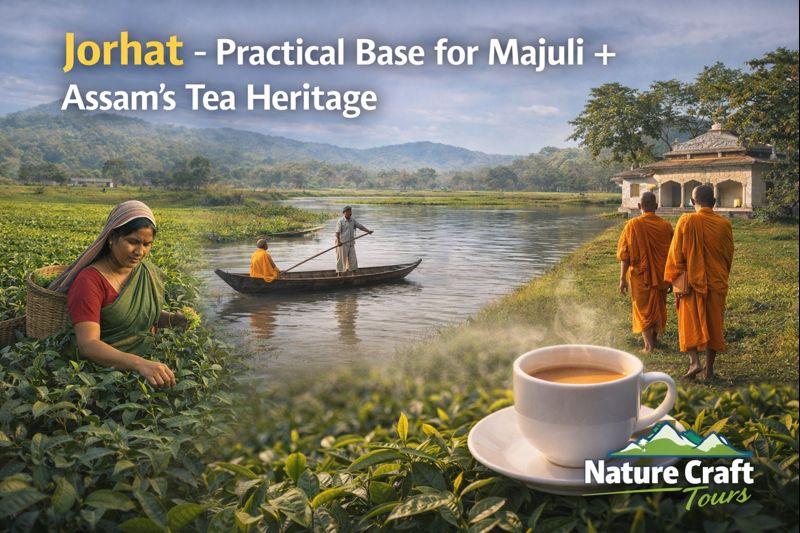
Jorhat occupies a quietly strategic position in Upper Assam—neither a flamboyant tourist city nor a remote cultural outpost, but a place of function, continuity, and understated depth. For travelers seeking to understand Majuli beyond a hurried ferry visit, and Assam’s tea heritage beyond plantation photographs, Jorhat serves as an indispensable base. It is a town shaped by administration, education, and agrarian economy, where colonial legacies intersect with Vaishnavite culture, riverine ecology, and the everyday rhythms of tea-growing life.
Unlike destinations defined by singular attractions, Jorhat’s value lies in its connective role. It is the most practical gateway to Majuli, the logistical anchor for Upper Assam travel, and the cultural threshold between the Brahmaputra’s monastic island world and the vast tea landscapes that have defined Assam’s global identity. Staying in Jorhat allows a traveler not merely to pass through, but to observe how geography, industry, and culture interlock across this region.
Understanding Jorhat’s Geographic and Cultural Position
Situated on the south bank of the Brahmaputra River, Jorhat developed historically as a river port, administrative hub, and educational center. Its location made it a natural point of convergence for trade routes, religious travel, and colonial governance. While the river no longer dominates commerce as it once did, its presence continues to shape the town’s climate, agriculture, and seasonal rhythms.
Culturally, Jorhat reflects a layered identity. Assamese Vaishnavite traditions coexist with colonial-era institutions, tea plantation communities, and migrant populations drawn by education and employment. This layered social fabric makes the town an effective interpretive space—one where travelers can contextualize Majuli’s monastic culture and the tea industry’s global reach within everyday Assamese life.
Jorhat as the Gateway to Majuli
Logistical Importance
Jorhat is the primary access point for Majuli, with ferry services operating from nearby river ghats. The town’s road, rail, and air connectivity make it the most reliable staging ground for island travel. Unlike direct approaches that compress Majuli into a day trip, using Jorhat as a base allows travelers to accommodate ferry schedules, weather variability, and cultural timing with greater flexibility.
Morning departures from Jorhat align well with ferry crossings, enabling arrivals on Majuli before midday—an important consideration for those intending to visit Satras, attend rehearsals, or observe daily monastic routines. Equally, returning to Jorhat in the evening offers stable infrastructure without detaching the traveler from the region’s cultural continuum.
Contextual Transition
Staying in Jorhat before or after visiting Majuli creates a meaningful transition between worlds. The town provides interpretive cues—through museums, academic institutions, and cultural spaces—that help visitors understand the philosophical and historical foundations of Majuli’s monastic life. Rather than treating the island as an isolated curiosity, Jorhat situates it within Assam’s broader cultural landscape.
Tea Heritage: The Other Identity of Jorhat
Origins of the Tea Economy
Jorhat lies at the heart of Assam’s tea belt, a region that transformed global tea consumption from the mid-19th century onward. The introduction of tea cultivation under colonial rule reshaped land use, labor systems, and settlement patterns across Upper Assam. Jorhat emerged as an administrative and logistical center for plantations spreading across the surrounding countryside.
While the tea industry is often reduced to picturesque imagery, its historical significance is complex—intertwined with migration, industrial discipline, and agrarian transformation. Jorhat offers an opportunity to observe this heritage not as a static legacy, but as a living economic system that continues to influence regional life.
Tea Gardens as Cultural Landscapes
The tea gardens around Jorhat are not isolated estates; they are cultural landscapes where work, community, and ecology intersect. Long rows of tea bushes define the physical environment, while worker settlements, schools, and temples shape social life. Walking through these landscapes reveals a rhythm governed by plucking cycles, weather patterns, and market demand.
For attentive travelers, tea gardens offer insights into labor histories, botanical adaptation, and the environmental cost of monoculture. Observing these spaces from Jorhat allows one to engage critically rather than romantically with Assam’s most famous export.
Key Attractions and Experiences in and Around Jorhat
Cultural and Historical Institutions
Jorhat hosts several institutions that reflect its role as an intellectual and cultural center. Museums preserve artifacts related to Assam’s royal, colonial, and agrarian past, while libraries and academic campuses contribute to the town’s scholarly atmosphere. These spaces are not crowded attractions but quiet repositories of regional memory.
Visits to such institutions complement Majuli exploration by offering historical frameworks that explain Vaishnavite movements, Ahom governance, and colonial intervention—elements that shaped the region’s cultural evolution.
Riverine Landscapes and Ghats
The Brahmaputra’s presence is felt most strongly along Jorhat’s riverbanks. Early mornings and late afternoons reveal local routines—fishing, ferry operations, and seasonal agriculture. These riverine landscapes help travelers understand why Majuli developed as it did, and why erosion, migration, and adaptation remain ongoing themes.
Markets and Everyday Life
Local markets in Jorhat provide a grounded perspective on Assamese daily life. Agricultural produce, tea-related goods, handwoven textiles, and everyday necessities circulate through these spaces, reflecting both rural connections and urban demands. Observing market activity offers insights into consumption patterns shaped by river ecology and plantation economies.
Complete Tour Planning Using Jorhat as a Base
Best Time and Season to Travel
The most favorable period to use Jorhat as a travel base is from October to March. Post-monsoon conditions stabilize ferry operations to Majuli, tea gardens remain accessible, and temperatures are moderate. Winter months also coincide with cultural festivals and agricultural cycles that enrich observational travel.
The monsoon season, while ecologically significant, presents challenges due to flooding, road disruptions, and ferry cancellations. Travelers interested in environmental study may find value in this period, but logistical flexibility becomes essential.
Ideal Travel Duration
An ideal itinerary centered on Jorhat spans four to six days. This allows one to allocate two to three days for Majuli exploration, one to two days for tea heritage and surrounding landscapes, and additional time to engage with Jorhat’s own cultural spaces. Such pacing prevents rushed transitions and supports deeper contextual understanding.
Route and Accessibility
Jorhat is well-connected by air to major cities within Assam and eastern India, while road and rail networks link it to Upper Assam towns. From Jorhat, Majuli is accessed via ferry crossings that are integral to the travel experience rather than mere transport segments.
Using Jorhat as a hub also facilitates onward travel to other parts of Upper Assam, allowing travelers to design regionally coherent itineraries rather than isolated destination visits.
Cultural and Ecological Significance
Jorhat’s significance extends beyond logistics. As a town shaped by river ecology, monastic traditions, and plantation economies, it embodies Assam’s historical negotiation between nature and culture. The Brahmaputra’s shifting channels influence settlement patterns, while tea cultivation demonstrates how global demand reshaped local landscapes.
This interplay mirrors broader riverine regions of eastern India, where ecological sensitivity and cultural resilience coexist. Travelers familiar with fragile delta environments through experiences such as a Sundarban Tour may recognize similar patterns of adaptation, resource dependence, and community continuity.
Practical Insights for Travelers
Using Jorhat as a base requires an understanding of regional rhythms. Ferry schedules to Majuli depend on river conditions, and delays are common. Planning buffer time is not a luxury but a necessity. Early starts are advisable for river crossings and tea estate visits.
Travelers should approach cultural spaces—whether Satras, tea communities, or river ghats—with sensitivity. Photography, especially in religious contexts, should be discreet and respectful. Conversations, when welcomed, offer deeper insight than visual documentation alone.
Jorhat in a Broader Travel Context
Jorhat demonstrates how a practical base can enhance, rather than dilute, cultural immersion. By providing infrastructure without overwhelming character, it allows travelers to engage with surrounding destinations on their own terms. This approach aligns with thoughtful travel philosophies that prioritize context and continuity.
Such regionally anchored exploration contrasts with checklist tourism and finds parallels in other ecosystems where a stable base supports deeper journeys, similar to structuring experiences through a Sundarban Tour Package that balances logistics with ecological and cultural understanding.
Why Jorhat Matters
Jorhat may not command immediate attention as a destination in itself, but its importance lies in what it enables. As a practical base for Majuli and a living archive of Assam’s tea heritage, it offers travelers a grounded perspective from which to explore one of India’s most culturally nuanced regions.
To stay in Jorhat is to observe Assam in motion—where monastic chants echo across river crossings, tea leaves move from bush to market, and everyday life unfolds against a backdrop of historical continuity. For travelers seeking understanding rather than spectacle, Jorhat is not merely a stopover; it is the lens through which Upper Assam comes into focus.