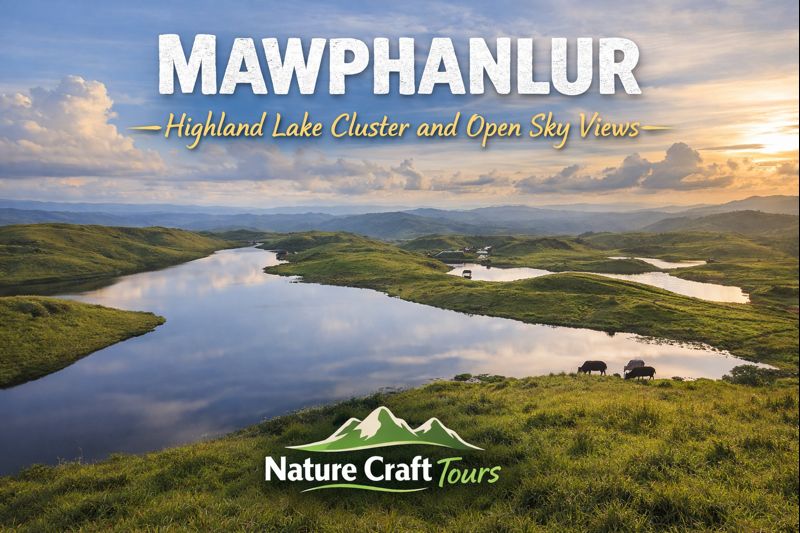
There are landscapes that impress through scale, and there are places that reveal their power through stillness. Mawphanlur belongs to the latter category. Perched on the high plateaus of Meghalaya’s West Khasi Hills, this quiet village is defined not by monuments or crowds, but by a constellation of natural lakes spread across rolling grasslands under an immense, uninterrupted sky. Mawphanlur is less a single destination and more a highland environment—one where water, wind, and horizon shape both scenery and experience.
Often described as a “highland lake cluster,” Mawphanlur offers an uncommon visual harmony: calm freshwater bodies reflecting cloud movements, low hills dissolving into distant ridgelines, and a sense of spatial openness rarely encountered in Northeast India. For the thoughtful traveler, Mawphanlur is not about activity-driven tourism. It is about perspective—geographical, ecological, and personal.
Geographical Setting and Landscape Character
Mawphanlur is situated in the West Khasi Hills district of Meghalaya at an elevation of approximately 1,800 meters above sea level. The village occupies a broad plateau where erosion and ancient geological processes have created shallow basins that collect rainwater, forming a series of interconnected lakes. Unlike river-fed systems, these lakes are sustained primarily by monsoon rainfall and underground seepage.
The surrounding terrain is composed of open grasslands punctuated by gentle slopes and rocky outcrops. Tree cover is sparse compared to the forested regions of eastern Meghalaya, allowing for expansive views that stretch uninterrupted for kilometers. The result is a landscape that feels more akin to a highland steppe than a tropical hill station.
This openness defines Mawphanlur’s visual identity. Sky dominates the field of vision, and weather patterns become a central part of the experience. Clouds move quickly, light changes frequently, and reflections across the lakes shift throughout the day.
The Lake System: Natural Design Without Ornamentation
Mawphanlur’s lakes are not singular landmarks but a collective presence. The most prominent among them include Mawphanlur Lake, Phankor Lake, and smaller unnamed water bodies scattered across the plateau. Each lake has a slightly different character—some broader and shallow, others narrow and elongated—yet all share a sense of quiet symmetry.
These lakes are not engineered for recreation. Their edges are irregular, shaped by grass, stone, and seasonal water levels. In calm conditions, the surface acts as a mirror, reflecting clouds and sky with striking clarity. During windy periods, ripples distort these reflections, emphasizing motion over stillness.
For travelers accustomed to curated viewpoints and fenced promenades, Mawphanlur’s lakes offer a contrasting experience. There is no defined vantage point; instead, perspective changes as one walks, pauses, and observes.
Open Sky Views and the Experience of Space
One of Mawphanlur’s most distinctive features is its open sky. The plateau’s elevation and lack of dense tree cover create a sense of vertical and horizontal expansion. Sunrise and sunset are particularly striking, with light traveling unobstructed across the landscape.
At dawn, low-lying mist often gathers near the lakes while higher ground remains clear, creating layered visual depth. By afternoon, clouds may build rapidly, casting moving shadows across grasslands. At night, when weather permits, the absence of urban lighting allows for clear views of stars and constellations.
This relationship with the sky gives Mawphanlur a contemplative quality. Time feels measured by light and weather rather than schedules.
Cultural Context of Mawphanlur Village
Mawphanlur is a Khasi village, and like much of the region, it follows a matrilineal social structure. While the village is modest in size, community life remains closely tied to land use, livestock grazing, and seasonal rhythms.
Agriculture here is largely subsistence-based, with an emphasis on crops suited to high-altitude conditions. Cattle and goats are commonly seen grazing near the lakes, reinforcing the pastoral character of the landscape. Cultural expression is understated, woven into daily routines rather than displayed for visitors.
For travelers, this means engagement is quiet and observational. The village does not present itself as a cultural showcase; instead, it invites respectful presence.
Ecological Significance and Environmental Sensitivity
The Mawphanlur plateau represents a fragile ecological system. The lakes depend on consistent rainfall patterns, and fluctuations in climate directly affect water levels. Grasslands support grazing but are vulnerable to overuse and erosion.
Birdlife is modest but varied, particularly during early mornings and post-monsoon months. Aquatic plants along lake edges contribute to water filtration and habitat stability. The relative absence of commercial activity has helped preserve this balance, though increased visibility brings new challenges.
Visitors should recognize that Mawphanlur’s appeal lies in its ecological restraint. Preservation depends on minimal disturbance rather than development.
Planning a Journey to Mawphanlur
Best Time to Visit
The most favorable period to visit Mawphanlur is from October to April. Post-monsoon months offer full lakes, clear skies, and comfortable temperatures. Winter brings crisp mornings and enhanced visibility, though nights can be cold.
The monsoon season, from June to September, transforms the plateau into a vivid green landscape, but heavy rainfall can make access roads difficult. Travelers during this period should be prepared for delays and limited mobility.
Ideal Travel Duration
A stay of two nights is sufficient to experience Mawphanlur’s core landscape and changing light conditions. Longer stays are beneficial for travelers interested in photography, ecological observation, or quiet retreat.
This is not a destination designed for packed itineraries. Time spent here is most rewarding when unstructured.
Route and Accessibility
Mawphanlur is typically accessed from Shillong, which serves as the primary transit hub for Meghalaya. The journey involves a drive through the West Khasi Hills, passing through rural settlements and gradually ascending to the plateau.
Road conditions vary, and the final stretch may be uneven. Travel planning should include buffer time, particularly during weather transitions.
Experiential Highlights of Mawphanlur
Walking along lake edges, observing shifting reflections, and watching cloud formations are among the most meaningful activities in Mawphanlur. There are no marked trails or designated viewpoints; exploration is intuitive rather than guided.
Evenings are particularly atmospheric, as light softens and the plateau quiets. The absence of urban noise enhances awareness of natural sounds—wind, distant livestock, and occasional bird calls.
For those interested in comparative landscapes, Mawphanlur’s openness contrasts strongly with forested or riverine environments elsewhere in India. Travelers who appreciate such diversity often find value in pairing highland destinations with ecosystems like the deltaic forests experienced during a Sundarban Tour, where water and land interact in a fundamentally different manner.
Practical Insights for Responsible Travel
Facilities in Mawphanlur are limited, and travelers should arrive with realistic expectations. Essential supplies should be arranged in advance. Respect for local customs, land use, and privacy is essential.
Waste management is a critical concern. Visitors should minimize waste generation and carry out non-biodegradable materials. The plateau’s ecological balance depends on low-impact behavior.
Mawphanlur in the Broader Context of Slow Travel
Mawphanlur exemplifies slow travel in its purest form. It encourages observation over activity, presence over consumption. In an era of itinerary-driven journeys, such destinations offer an alternative model of engagement.
Travelers who approach Mawphanlur with patience often find that its value extends beyond scenery. It fosters reflection, spatial awareness, and a renewed appreciation for subtle environmental interactions.
This sensibility resonates with travelers who seek depth rather than volume in their journeys, whether in highland plateaus or tidal forests explored through a carefully planned Sundarban Tour Package.
The Quiet Authority of Open Landscapes
Mawphanlur does not announce itself loudly. Its strength lies in restraint—in open skies, calm waters, and a landscape that invites contemplation rather than excitement. For travelers willing to slow down, the plateau offers clarity that extends beyond visual beauty.
In the highlands of Meghalaya, where lakes mirror the sky and horizons remain unbroken, Mawphanlur stands as a reminder that some of the most profound travel experiences are defined not by what is added, but by what is left untouched.