Rumtek Monastery (Near Gangtok)
— A Living Seat of Himalayan Buddhism and Spiritual Continuity
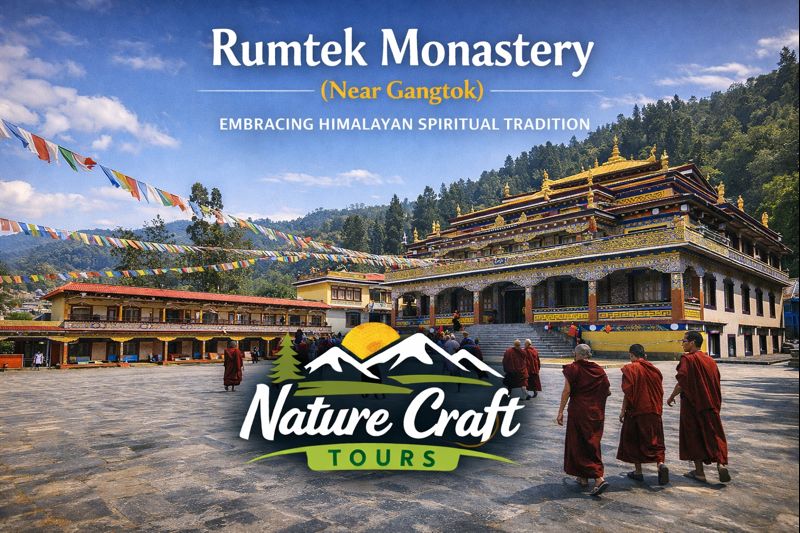
Where the Hills Learn the Language of Silence
On a forested ridge overlooking the undulating valleys of East Sikkim stands Rumtek Monastery, a place where architecture, philosophy, and landscape converge with measured dignity. Unlike destinations that announce themselves through spectacle, Rumtek reveals its significance gradually—through prayer flags moving with the wind, the rhythmic echo of chanting monks, and the quiet authority of stone walls shaped by belief rather than time alone. Situated approximately 23 kilometres from Gangtok, Rumtek Monastery is not merely a spiritual landmark; it is one of the most influential centres of Tibetan Buddhism outside Tibet.
For the observant traveller, Rumtek is less about arrival and more about orientation. The monastery compels visitors to slow down, to notice how the terrain modulates sound, how light filters across courtyards, and how ritual life continues uninterrupted by curiosity. This article approaches Rumtek Monastery not as a checklist destination, but as a living institution—one rooted in history, sustained by practice, and inseparable from the ecological and cultural fabric of Sikkim.
Destination Overview: Setting, Scale, and Spatial Presence
Geographical Location and Surroundings
Rumtek Monastery is located on a hill overlooking the Rangpo valley, east of Gangtok, at an elevation of roughly 1,500 metres above sea level. The monastery commands expansive views of forested slopes and distant ridgelines, situating it both physically and symbolically above everyday settlement patterns. Its placement reflects traditional Himalayan monastic planning, where elevation serves as a metaphor for spiritual ascent and contemplative distance.
The surrounding environment is characterised by subtropical and temperate vegetation, with dense forests of broadleaf trees, bamboo groves, and seasonal flowering plants. This ecological setting provides a sense of enclosure and calm, reinforcing the monastery’s role as a retreat for study and meditation.
Architectural Layout and Spatial Order
The monastery complex follows a structured layout centred around a main prayer hall, surrounded by monks’ quarters, ritual spaces, and open courtyards. The architecture draws heavily from traditional Tibetan design, with layered roofs, ornate window frames, and symbolic colour schemes. Each structural element carries philosophical meaning, aligning physical space with doctrinal principles.
Unlike monuments designed for visual dominance, Rumtek’s architecture encourages inward attention. Scale is balanced, proportions are deliberate, and ornamentation serves instruction rather than display.
Historical Background: From Tibet to Sikkim
Origins of the Kagyu Lineage
Rumtek Monastery is the principal seat of the Karma Kagyu lineage of Tibetan Buddhism outside Tibet. The Kagyu school emphasises oral transmission, meditation practice, and experiential understanding of Buddhist teachings. Its philosophical foundations trace back to Indian tantric masters and were later systematised in Tibet through successive generations of teachers.
This lineage places strong emphasis on continuity—both spiritual and institutional—which directly influenced the establishment of Rumtek as a major centre.
Establishment of Rumtek Monastery
The modern Rumtek Monastery was established in the mid-20th century under the guidance of the 16th Karmapa, one of the most influential figures in Tibetan Buddhism. Following political upheaval in Tibet, Sikkim offered a culturally compatible and geographically suitable refuge. Rumtek was chosen as the new seat of the Karmapa, ensuring the preservation of teachings, rituals, and monastic education.
The construction of the monastery was both a logistical and symbolic undertaking. Materials, artisans, and ritual objects were brought together to recreate not merely a structure, but an entire spiritual ecosystem displaced by history.
Rumtek in Contemporary Context
Today, Rumtek remains a focal point of religious study, ritual practice, and international pilgrimage. While its administrative history has experienced periods of dispute, its spiritual activities continue with disciplined regularity, reinforcing its enduring relevance.
Cultural and Spiritual Significance
Ritual Life and Monastic Practice
Daily life at Rumtek is structured around a rhythm of prayers, meditation sessions, scriptural study, and communal responsibilities. These activities are not staged for visitors; they continue regardless of external presence. This authenticity distinguishes Rumtek from sites where ritual has become performative.
Major religious festivals, particularly those associated with the Kagyu calendar, transform the monastery into a centre of collective devotion. Masked dances, ritual music, and symbolic reenactments serve both devotional and pedagogical purposes.
Symbolism Embedded in Space
Every element within the monastery—from murals to statues—functions as a teaching tool. Mandalas illustrate cosmological principles, while iconography encodes ethical and philosophical instruction. For informed observers, the visual language of Rumtek offers layers of meaning that unfold with time and study.
Ecological Context and Environmental Setting
Forest Landscape and Biodiversity
The monastery’s surroundings support a rich ecological system. The forested hills host bird species, insects, and small mammals, creating a soundscape of natural continuity. Seasonal changes bring shifts in foliage density, flower cycles, and atmospheric conditions, subtly altering the monastery’s visual and sensory character throughout the year.
Harmony Between Built and Natural Environments
Rumtek’s integration with its environment reflects Buddhist principles of balance and interdependence. Construction has respected natural contours, and open spaces allow light and air to circulate freely. This harmony contributes significantly to the contemplative atmosphere experienced by visitors.
Route and Accessibility
Access from Gangtok
Rumtek Monastery is accessible by road from Gangtok, with a journey time of approximately 45 minutes to one hour, depending on traffic and weather conditions. The route descends briefly before climbing through winding roads lined with forest cover and rural settlements.
Public and private transport options operate regularly, making Rumtek a feasible half-day excursion for those based in Gangtok.
Terrain and Travel Conditions
The road to Rumtek is generally well-maintained, though narrow in sections. During monsoon months, occasional fog and rain may reduce visibility, requiring cautious travel.
Best Time and Season to Visit
Spring (March to May)
Spring brings moderate temperatures, flowering vegetation, and clear conditions, making it an ideal period for exploration and extended observation within the monastery complex.
Autumn (September to November)
Post-monsoon months offer crisp air and excellent visibility. Religious festivals during this period provide insight into ritual life, though visitor numbers may increase.
Monsoon and Winter Considerations
Monsoon months introduce heavy rainfall and occasional travel disruptions, while winter brings cooler temperatures but fewer visitors. Both seasons offer quieter experiences for reflective travellers.
Ideal Travel Duration and Itinerary Integration
A visit to Rumtek Monastery typically requires three to four hours, allowing sufficient time to explore the complex, observe rituals respectfully, and absorb the surrounding landscape. When combined with nearby viewpoints and rural settlements, Rumtek fits well into a full-day itinerary from Gangtok.
Travellers interested in experiencing India’s diverse spiritual and ecological landscapes often juxtapose Himalayan monastic sites with other regions. For instance, those familiar with deltaic ecosystems through a Sundarban Tour frequently find Rumtek’s mountain-based spirituality a compelling contrast.
Key Attractions and Highlights
The Main Prayer Hall
The central prayer hall houses significant relics, statues, and ritual objects. Its interior design balances grandeur with restraint, guiding attention towards practice rather than spectacle.
Monastic Library and Artefacts
Rumtek preserves important manuscripts, ritual instruments, and symbolic artefacts associated with the Kagyu lineage. These collections underscore the monastery’s role as a custodian of knowledge.
Panoramic Views and Courtyards
Open courtyards provide views across the valley, offering moments of pause and reflection. These spaces reinforce the relationship between contemplation and environment.
Practical Insights for Travellers
Visitor Conduct and Etiquette
Visitors are expected to dress modestly, maintain silence within prayer areas, and refrain from intrusive photography. Respect for ongoing rituals is essential.
Timing and Crowd Awareness
Early morning or late afternoon visits tend to be quieter. Festival days attract larger gatherings and require additional patience and sensitivity.
Environmental Responsibility
Maintaining cleanliness and minimising disturbance aligns with both ecological preservation and monastic values. Visitors should carry out all non-biodegradable waste.
Rumtek Monastery in a Broader Travel Perspective
Rumtek occupies a distinctive place within India’s cultural geography. It is neither isolated nor commercialised, maintaining relevance through continuity rather than adaptation for tourism. Travellers seeking holistic understanding often combine such mountain-based spiritual centres with journeys into contrasting ecosystems, including riverine regions explored through options like a Sundarban Tour Package.
A Monastery That Teaches by Presence
Rumtek Monastery is not defined by singular moments or dramatic narratives. Its strength lies in consistency—in the daily repetition of practice, the unbroken transmission of knowledge, and the quiet integration of belief with landscape. For the thoughtful traveller, Rumtek offers an opportunity to observe how spirituality sustains itself beyond upheaval and geography.
Standing within its courtyards, one senses that Rumtek does not seek attention. It waits, grounded in its hillside, offering insight to those willing to approach with patience and respect. In doing so, it remains one of East Sikkim’s most profound and enduring destinations.