Namchi (South Sikkim) — Cultural Capital of the Southern Himalaya
Where the Southern Hills of Sikkim Find Their Voice
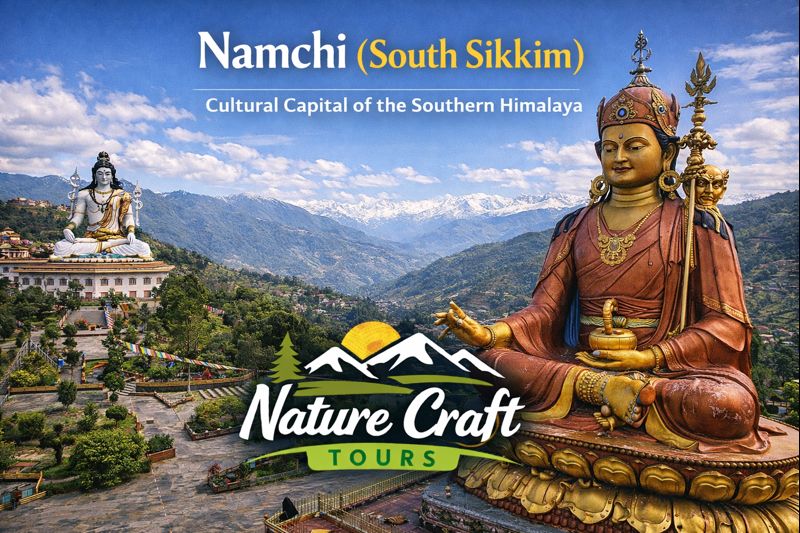
Namchi, the administrative headquarters of South Sikkim, occupies a distinctive position in the cultural and geographic landscape of the eastern Himalaya. Resting at an altitude of approximately 1,675 metres above sea level, this hill town does not rely on dramatic extremes of altitude or remoteness to define its character. Instead, Namchi reveals itself through layered meaning—where religious symbolism, civic life, ecological balance, and everyday Himalayan rhythms coexist in rare equilibrium.
Unlike destinations shaped primarily by colonial legacies or adventure narratives, Namchi reflects a consciously articulated modern Himalayan identity. It is a town where monumental religious complexes overlook working neighbourhoods, where terraced fields descend from sculpted hilltops, and where development has followed a distinctly Sikkimese ethic of cultural preservation. For travellers seeking to understand South Sikkim beyond transit routes and surface impressions, Namchi offers an anchoring perspective.
Destination Overview: Geography, Setting, and Urban Character
Geographical Position in South Sikkim
Namchi is situated on a prominent ridge in South Sikkim, overlooking expansive valleys carved by tributaries of the Teesta river system. The town enjoys panoramic views of the Greater Himalayan range, including distant glimpses of snow-clad peaks during clear weather. Its strategic placement makes it a natural junction between western districts, eastern corridors, and the lower elevations leading toward the plains of West Bengal.
The surrounding landscape is defined by gentle slopes rather than abrupt cliffs, creating an environment more hospitable to settlement and agriculture. This geographic moderation has allowed Namchi to evolve as both an administrative and cultural centre without compromising ecological stability.
Climate and Environmental Conditions
Namchi experiences a temperate mountain climate, with mild summers, cool winters, and a pronounced monsoon season. Summer temperatures remain comfortable, while winters are cool but rarely severe. The monsoon months bring substantial rainfall, nurturing dense vegetation but occasionally affecting road connectivity.
This climatic balance contributes to the town’s year-round livability and supports diverse agricultural activity in the surrounding countryside.
Historical Context: From Rural Settlement to Cultural Capital
Early Settlement Patterns
Historically, the Namchi region consisted of scattered rural settlements sustained by agriculture and trade along mountain paths connecting southern Sikkim with lower Himalayan routes. These early communities were shaped by Lepcha, Bhutia, and later Nepali influences, creating a plural cultural foundation that remains visible today.
Unlike towns that expanded under colonial administration, Namchi’s growth followed indigenous governance structures and later state-led planning after Sikkim’s integration into India.
Post-Integration Development
Following Sikkim’s accession to India in 1975, Namchi gradually assumed greater administrative responsibility. Government institutions, educational facilities, and cultural projects were established with a clear emphasis on maintaining local identity. This approach distinguishes Namchi from many hill towns where rapid urbanisation diluted traditional character.
Cultural and Spiritual Significance
A Centre of Religious Pluralism
Namchi is widely recognised as one of Sikkim’s most important spiritual centres. The town and its surroundings host major Buddhist, Hindu, and Christian landmarks, reflecting the state’s religious diversity. This coexistence is not merely symbolic; it informs daily life, festivals, and community relationships.
Religious architecture here serves both devotional and educational roles, offering insight into philosophical traditions rather than functioning solely as pilgrimage stops.
Char Dham and Siddhesvara Dham
One of Namchi’s most prominent landmarks is the Char Dham complex, also known as Siddhesvara Dham. Conceived as a unifying spiritual site, it features replicas of the four sacred Hindu dhams alongside a towering statue of Lord Shiva. Set against open mountain vistas, the complex reflects an effort to situate pan-Indian religious symbolism within a distinctly Himalayan context.
The site also functions as a cultural viewpoint, offering expansive perspectives on the surrounding terrain and reinforcing Namchi’s role as a place of convergence.
Buddhist Institutions and Heritage
Equally significant are Namchi’s Buddhist institutions, including monasteries and meditation centres affiliated with various Tibetan Buddhist lineages. These spaces contribute to the town’s contemplative atmosphere and attract practitioners and scholars throughout the year.
Ecological Landscape and Agricultural Foundations
Terraced Farming and Rural Hinterland
The slopes surrounding Namchi are shaped by terraced agriculture, producing crops such as cardamom, maize, vegetables, and seasonal fruits. These agricultural systems represent generations of adaptation to mountain terrain, balancing productivity with soil conservation.
Walking through nearby villages reveals how cultivation patterns align with natural contours, maintaining ecological integrity while supporting livelihoods.
Biodiversity and Forest Cover
South Sikkim’s forests support a range of flora and fauna, including bird species, medicinal plants, and subtropical vegetation. While Namchi itself is urbanised, green corridors and surrounding forests remain integral to the region’s environmental health.
Route and Accessibility
Access from Gangtok and Siliguri
Namchi is accessible by road from Gangtok, with a travel time of approximately 2.5 to 3 hours, depending on traffic and weather. The route descends through river valleys before ascending toward the town, offering varied landscapes along the way.
From the plains, travellers typically reach Namchi via Siliguri and Rangpo, following well-established mountain roads. Connectivity has improved steadily, making Namchi a practical base for South Sikkim exploration.
Local Transport and Movement
Within Namchi, distances are manageable, and local transport options connect major sites. Walking through central areas provides the most direct engagement with daily life and local commerce.
Best Time and Season to Visit
Spring (March to May)
Spring is one of the most favourable seasons to visit Namchi. Clear skies, flowering vegetation, and moderate temperatures create ideal conditions for sightseeing and short excursions.
Autumn (September to November)
Post-monsoon months offer crisp air and excellent visibility. Cultural festivals during this period add depth to the travel experience, though visitor numbers may increase slightly.
Monsoon and Winter Considerations
The monsoon season brings lush landscapes but also heavy rainfall and occasional travel disruptions. Winter remains relatively mild, with fewer visitors and quieter surroundings.
Ideal Travel Duration and Itinerary Planning
Namchi merits a minimum stay of two days to appreciate both its cultural landmarks and surrounding rural landscapes. When integrated into a broader South Sikkim itinerary, it serves as an effective base for exploring nearby towns, monasteries, and natural viewpoints.
Travellers interested in understanding India’s ecological contrasts often combine Himalayan destinations like Namchi with lowland wilderness regions. For instance, those who have explored mangrove ecosystems through a Sundarban Tour often find South Sikkim’s agricultural mountain landscapes to be a revealing counterpoint.
Key Attractions and Highlights
Samdruptse Hill and Guru Padmasambhava Statue
Samdruptse Hill hosts a monumental statue of Guru Padmasambhava, one of the most significant figures in Himalayan Buddhism. The site is both a pilgrimage destination and a vantage point, offering expansive views across South Sikkim.
Namchi Rock Garden
The Namchi Rock Garden demonstrates landscape design adapted to mountain terrain. Terraced pathways, water features, and carefully curated vegetation create a tranquil environment for visitors.
Local Markets and Civic Spaces
Namchi’s markets provide insight into daily life, with stalls selling local produce, handicrafts, and household goods. These spaces reflect the town’s role as a service centre for surrounding villages.
Practical Insights for Travellers
Cultural Sensitivity and Conduct
Visitors should dress modestly when visiting religious sites and remain respectful during rituals. Photography should be discreet and guided by local norms.
Weather Preparedness
Layered clothing is advisable year-round, particularly during mornings and evenings. Monsoon travel requires flexibility and attention to road conditions.
Environmental Responsibility
Maintaining cleanliness and minimising waste aligns with Sikkim’s strong environmental ethic. Visitors are encouraged to support local practices that prioritise sustainability.
Namchi in a Broader Travel Perspective
Namchi represents a model of Himalayan urban development rooted in cultural confidence rather than external imitation. It offers an instructive example of how tradition, governance, and environment can coexist productively. Travellers seeking comprehensive understanding often balance such mountain experiences with journeys into entirely different ecosystems, including deltaic regions explored through itineraries like a Sundarban Tour Package.
Conclusion: Namchi as the Quiet Heart of South Sikkim
Namchi does not seek attention through spectacle or extremity. Its significance emerges through continuity—of belief, community, and landscape. As South Sikkim’s cultural capital, it offers a grounded understanding of Himalayan life shaped by intention rather than accident.
For the thoughtful traveller, Namchi provides more than landmarks. It offers context—a sense of how modern Himalayan society negotiates change while remaining anchored to place. In doing so, Namchi stands as one of Sikkim’s most meaningful and enduring destinations.