Ravangla (South Sikkim)
— Himalayan Vantage of Faith, Forests, and Slow Mountain Living
Where the Southern Himalaya Opens Its Quietest Window
Ravangla occupies a rare emotional latitude in the geography of Sikkim. Neither a bustling town nor a secluded hamlet, it rests calmly on a forested ridge of South Sikkim, offering uninterrupted views of some of the eastern Himalaya’s most revered peaks. At an altitude of approximately 2,100 metres, Ravangla is elevated enough to command sweeping mountain panoramas, yet grounded enough to remain intimately connected with agrarian life, monastic traditions, and everyday Himalayan rhythms.
Unlike destinations shaped by colonial nostalgia or mass tourism infrastructure, Ravangla has grown organically—its identity rooted in spiritual heritage, ecological balance, and a pace of life defined by seasons rather than schedules. To approach Ravangla is to step into a landscape where monasteries coexist with cardamom fields, where forest trails begin behind village homes, and where the horizon is framed by snow peaks that appear and disappear with the weather’s temperament. This article explores Ravangla not as a stopover, but as a destination that rewards patience, observation, and contextual understanding.
Destination Overview: Geography, Setting, and Sense of Place
Geographical Location in South Sikkim
Ravangla is situated in the southern district of Sikkim, positioned strategically between Gangtok and Namchi. The town sits on a high ridge that overlooks deep valleys carved by tributaries of the Teesta river system. Its geographic placement grants it one of the most comprehensive viewpoints in South Sikkim, particularly toward the Kanchenjunga range and its satellite peaks.
This ridge-top location has historically made Ravangla both a natural lookout and a place of retreat. While connected by road, it retains a sense of separation from major urban centres, reinforcing its tranquil character.
Altitude, Climate, and Seasonal Patterns
At around 2,100 metres above sea level, Ravangla enjoys a cool, temperate climate. Summers remain mild, with daytime temperatures rarely becoming uncomfortable. Winters are cool and crisp, occasionally bringing frost but seldom severe snowfall. The monsoon season, spanning roughly from June to September, transforms the landscape into a dense green expanse, though it can also bring fog and intermittent road disruptions.
This moderate altitude makes Ravangla suitable for extended stays, particularly for travellers who wish to acclimatise gently while exploring South Sikkim.
Historical Context: From Trade Paths to Spiritual Ridge
Early Settlement and Cultural Layers
The Ravangla region has long been inhabited by Lepcha, Bhutia, and later Nepali communities, each contributing to its cultural texture. Historically, the ridge served as part of local movement routes connecting interior villages with larger administrative centres. Agriculture, pastoralism, and monastic life formed the economic and social backbone of the area.
Unlike towns that expanded rapidly under external influence, Ravangla’s growth remained gradual, shaped by local needs and religious institutions rather than trade or colonial administration.
Ravangla in Modern Sikkim
In recent decades, Ravangla has emerged as a focal point for spiritual tourism and ecological awareness. Government-supported cultural projects and improved connectivity have increased visibility, yet the town has largely avoided overdevelopment. This balance reflects Sikkim’s broader development philosophy, which prioritises sustainability and cultural continuity.
Cultural and Spiritual Significance
A Landscape Shaped by Buddhism
Ravangla is deeply embedded within the Buddhist cultural landscape of South Sikkim. Monasteries, prayer flags, chortens, and meditation centres punctuate the hillsides, serving both religious and educational functions. Daily life here unfolds alongside ritual practice rather than apart from it.
The presence of monks, students, and pilgrims lends the town a contemplative atmosphere that influences even secular spaces. Silence is not enforced, but it is naturally respected.
Buddha Park and Tathagata Tsal
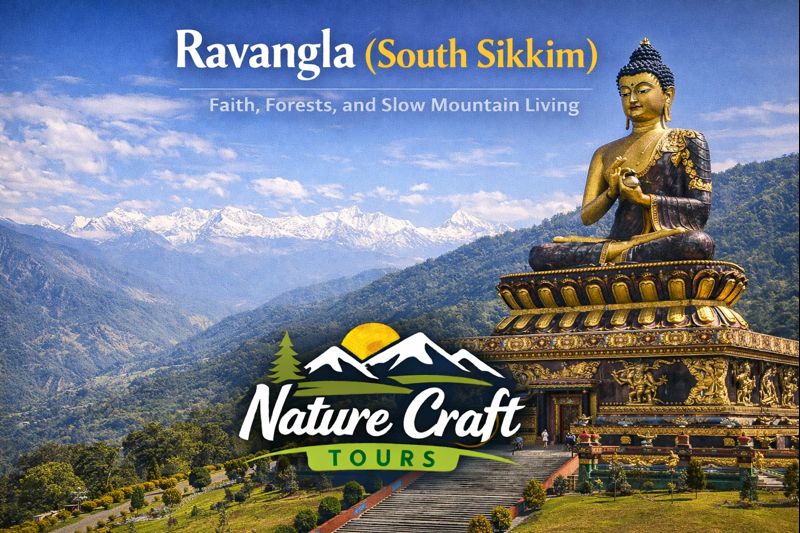
One of Ravangla’s most prominent landmarks is Tathagata Tsal, commonly known as Buddha Park. Established to commemorate the 2550th birth anniversary of Gautama Buddha, the complex features a towering statue set against open mountain vistas. The park is designed not merely as a viewing platform, but as a space for reflection, walking meditation, and philosophical orientation.
From this vantage point, the surrounding peaks and valleys appear almost symbolic, reinforcing Buddhist ideas of impermanence and interconnection.
Ecological Landscape and Natural Environment
Forest Cover and Biodiversity
Ravangla is surrounded by dense forests comprising broadleaf species, bamboo groves, and temperate vegetation. These forests support a range of birdlife, insects, and small mammals, contributing to the region’s ecological richness. Seasonal changes bring variations in foliage density, flowering cycles, and wildlife activity.
The proximity of forest trails to residential areas highlights the close relationship between human settlement and natural systems.
Agricultural Practices and Rural Hinterland
The slopes below Ravangla are characterised by terraced fields cultivating cardamom, maize, vegetables, and seasonal fruits. These practices reflect generations of adaptation to mountain terrain, balancing productivity with soil conservation and water management.
Short walks into nearby villages reveal how agricultural life continues largely unchanged, offering insight into South Sikkim’s rural resilience.
Route and Accessibility
Access from Gangtok and Namchi
Ravangla is accessible by road from Gangtok, with travel time ranging between four and five hours depending on road conditions and weather. The route typically passes through Namchi, making it possible to combine both destinations within a single itinerary.
From Namchi, Ravangla is approximately 25 kilometres away, connected by winding mountain roads that ascend gradually through forested terrain and rural settlements.
Local Mobility and Terrain
Within Ravangla, most attractions are reachable by short drives or walks. The terrain is undulating but manageable, encouraging slow exploration rather than hurried sightseeing.
Best Time and Season to Visit
Spring (March to May)
Spring is among the most favourable seasons to visit Ravangla. Clear skies, blooming rhododendrons, and moderate temperatures create ideal conditions for mountain views and outdoor exploration.
Autumn (September to November)
Post-monsoon months offer exceptional visibility of the Himalayan range. The air is crisp, and the landscape retains monsoon-fed greenery, making this period especially rewarding for photographers and nature enthusiasts.
Monsoon and Winter Considerations
The monsoon season brings lush scenery but also fog, rain, and occasional travel delays. Winter months are quieter, with fewer visitors and a more introspective atmosphere, though temperatures can drop significantly at night.
Ideal Travel Duration and Itinerary Planning
Ravangla rewards unhurried exploration. A stay of two to three days allows sufficient time to visit major landmarks, walk forest trails, and observe daily life without compression. When integrated into a South Sikkim circuit, Ravangla pairs naturally with Namchi and nearby villages.
Travellers who enjoy contrasting ecological experiences often balance Himalayan destinations like Ravangla with lowland ecosystems elsewhere in India. For instance, journeys into forested mountains can be meaningfully contrasted with mangrove landscapes explored through a Sundarban Tour, highlighting the country’s environmental diversity.
Key Attractions and Special Highlights
Buddha Park (Tathagata Tsal)
The park remains Ravangla’s most recognisable site, combining spiritual symbolism with panoramic views. Its open design encourages extended stays rather than brief visits.
Ralang Monasteries (Upper and Lower)
Located a short distance from Ravangla, the Ralang monasteries are among South Sikkim’s most important Buddhist institutions. They offer insight into monastic education, ritual practice, and architectural continuity.
Forest Walks and Viewpoints
Numerous informal trails lead from Ravangla into surrounding forests and viewpoints. These walks provide opportunities for birdwatching, photography, and quiet observation.
Practical Insights for Travellers
Cultural Conduct and Sensitivity
Visitors should dress modestly when entering monasteries and religious spaces. Silence and respectful behaviour are expected, particularly during prayers and teaching sessions.
Clothing and Preparation
Layered clothing is advisable throughout the year. Weather can shift quickly, especially in the evenings, and rain protection is essential during monsoon months.
Environmental Responsibility
Ravangla’s appeal lies in its unspoiled environment. Visitors should minimise waste, avoid disturbing wildlife, and respect local conservation practices.
Ravangla in a Broader Travel Perspective
Ravangla represents a quieter, more reflective dimension of Himalayan travel. It does not compete with high-altitude adventure or urban energy; instead, it complements them by offering stillness and context. Travellers seeking comprehensive understanding often integrate such mountain retreats with journeys into entirely different ecological zones, including deltaic regions accessed through options like a Sundarban Tour Package.
Ravangla as a Place of Perspective
Ravangla is not defined by a single monument or event. Its significance emerges through accumulation—of views observed over time, of conversations overheard in markets, of rituals witnessed without interruption. It is a place where South Sikkim’s spiritual, ecological, and social narratives converge without urgency.
For travellers willing to slow down, Ravangla offers perspective rather than spectacle. In its forests, monasteries, and ridgelines, one finds not an escape from the world, but a clearer understanding of how life unfolds when landscape, belief, and community remain in balance.