Rabdentse Ruins (West Sikkim):
Walking Through the Lost Capital of a Himalayan Kingdom
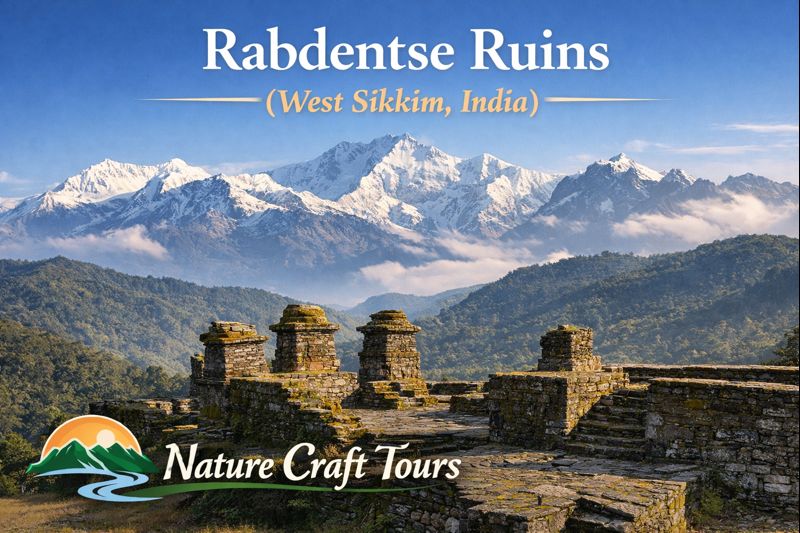
Hidden beneath dense Himalayan forests and veiled in an almost monastic silence, the Rabdentse Ruins stand as one of the most evocative historical landscapes in Eastern India. Perched on a forested ridge near Pelling in West Sikkim, Rabdentse was once the proud capital of the former Kingdom of Sikkim. Today, it exists as a quiet archaeological site where stone foundations, moss-covered walls, and sacred pathways narrate the rise, governance, and eventual decline of a Himalayan monarchy.
Unlike monumental ruins shaped by imperial ambition, Rabdentse communicates its history subtly. It invites visitors to slow their pace, listen to the wind passing through ancient trees, and imagine courtly processions, royal deliberations, and ritual ceremonies that once defined this secluded hilltop city. For travelers who seek meaning beyond surface-level sightseeing, Rabdentse offers an encounter with memory, landscape, and silence intertwined.
Destination Overview: A Forgotten Capital Above the Valleys
Rabdentse Ruins are located approximately 2 kilometers from Pelling town in West Sikkim, at an elevation of around 2,000 meters above sea level. The site occupies a strategic ridge overlooking deep valleys and distant Himalayan ranges, including commanding views of the Kanchenjunga massif on clear days.
Established in the late 17th century, Rabdentse served as the second capital of the Kingdom of Sikkim after Yuksom. It remained the political and administrative center of the kingdom for nearly two centuries until its abandonment in the early 19th century following repeated invasions and internal instability.
Today, Rabdentse is protected as an archaeological site and forms part of a larger cultural landscape that includes monasteries, sacred forests, and royal pathways. The ruins are modest in scale but immense in historical resonance, reflecting a governance system deeply intertwined with religious authority and ecological awareness.
Historical Background: Rise and Fall of a Himalayan Seat of Power
Rabdentse was founded around 1670 by Chogyal Tensung Namgyal, the second ruler of Sikkim. The location was carefully chosen for its natural defensibility, spiritual significance, and access to trade routes linking Tibet, Bhutan, and the plains of Bengal.
From Rabdentse, the Namgyal dynasty governed a culturally diverse kingdom composed of Lepcha, Bhutia, and later Nepali communities. The capital was not merely a political center; it was a ceremonial space where Buddhist rituals legitimized royal authority and reinforced social order.
The decline of Rabdentse began in the late 18th century due to repeated attacks by Gurkha forces from Nepal. These invasions weakened the kingdom economically and militarily, eventually forcing the royal court to relocate to Tumlong in North Sikkim. Rabdentse was gradually abandoned, reclaimed by forest growth, and left to history.
Exploring the Ruins: Architecture in Fragments
The Royal Palace Complex
The remains of the royal palace form the central feature of Rabdentse. Stone platforms, foundation outlines, and stairways indicate the former presence of multi-level structures built using local materials. Though no standing buildings remain, the layout suggests a carefully organized administrative and residential space.
From the palace area, one can trace pathways leading toward ceremonial courtyards and vantage points. The absence of grand ornamentation reflects the kingdom’s emphasis on functional governance rather than architectural display.
The Chorten and Sacred Grounds
Several chortens (stupas) within the Rabdentse complex mark spaces of spiritual importance. These structures were integral to royal rituals and daily worship, reinforcing the inseparability of religion and governance in Sikkimese society.
The placement of these chortens aligns with traditional Buddhist geomantic principles, suggesting that Rabdentse was designed as a spiritually balanced city rather than a purely defensive stronghold.
Ruins Trail and Viewing Platforms
A well-maintained forest trail guides visitors through the ruins. Along the path, interpretive signage provides historical context, while strategically positioned viewpoints offer sweeping views of the surrounding valleys and snow peaks. These viewing platforms likely served both defensive and ceremonial purposes in the past.
Cultural and Historical Significance
Rabdentse occupies a central place in Sikkim’s historical narrative. It represents a period when the kingdom functioned as an independent Himalayan state, balancing diplomacy, spiritual authority, and regional trade.
The ruins also reflect the cultural synthesis that defines Sikkim. Lepcha animistic beliefs, Tibetan Buddhist practices, and later influences from neighboring regions coexisted within the capital’s social fabric. This pluralism remains visible in Sikkim’s contemporary cultural identity.
For historians and cultural researchers, Rabdentse offers valuable insight into non-imperial governance systems in the Himalayas—systems that emphasized ritual legitimacy, ecological harmony, and decentralized administration.
Ecological Setting: Ruins Within a Living Forest
One of Rabdentse’s most striking aspects is its ecological context. The ruins are enveloped by temperate forests dominated by oak, chestnut, magnolia, and rhododendron species. Over centuries, nature has softened the outlines of stone walls, creating a seamless blend between architecture and environment.
Birdsong, shifting light, and seasonal changes define the visitor experience as much as the ruins themselves. This natural setting is not incidental; traditional Buddhist philosophy encouraged settlement patterns that minimized environmental disruption.
Travelers familiar with dramatically different ecosystems—such as the tidal mangrove landscapes encountered during a Sundarban Tour—often find Rabdentse especially revealing, as it highlights how culture adapts uniquely to geography.
Complete Tour Planning Guide
Best Time and Season to Visit
The most favorable period to visit Rabdentse Ruins is from March to May and from September to November. Spring brings mild temperatures and blooming forests, while autumn offers crisp air and clear mountain views. The monsoon season, from June to August, makes trails slippery and limits visibility.
Ideal Travel Duration
A half-day is sufficient for exploring Rabdentse itself, but allocating two to three days in the Pelling region allows for deeper engagement with nearby historical and spiritual sites. Travelers interested in slow exploration and photography may prefer a longer stay.
Route and Accessibility
Rabdentse is accessible by road from Gangtok, with an average travel time of five to six hours. The nearest major railhead is New Jalpaiguri, and the closest airport is Bagdogra. From Pelling town, the ruins can be reached by a short drive followed by a forest walk.
This ease of access makes Rabdentse a natural inclusion in broader Himalayan itineraries, much like travelers who integrate highland heritage sites with contrasting lowland experiences such as a thoughtfully planned Sundarban Tour Package.
Key Attractions Near Rabdentse
The Rabdentse Ruins are closely linked with other sites of historical importance in West Sikkim. Nearby monasteries, forest trails, and viewpoints provide additional layers of context, helping visitors understand the spiritual and political geography of the former kingdom.
Together, these sites form a coherent cultural landscape rather than isolated attractions, encouraging visitors to approach the region as an interconnected historical environment.
Practical Insights for Visitors
Visitors should wear comfortable walking shoes, as the forest trail includes uneven stone paths. Weather can change rapidly, so carrying light rain protection is advisable even during dry seasons.
Maintaining silence and respecting the sanctity of the site enhances both personal experience and preservation efforts. Rabdentse is best explored at an unhurried pace, allowing time for observation and reflection rather than hurried documentation.
Rabdentse as a Landscape of Memory
Rabdentse Ruins are not defined by grand architecture or dramatic reconstructions. Their power lies in restraint—stone foundations quietly marking where a kingdom once governed, worshipped, and negotiated its place in the Himalayas.
For the thoughtful traveler, Rabdentse offers more than historical information. It provides perspective on impermanence, on how power yields to time, and on how landscapes preserve memory long after human presence recedes. In the stillness of its forested ridge, Rabdentse continues to speak—not loudly, but with enduring clarity.