Gurudongmar Lake (North Sikkim):
A High-Altitude Testament of Geography, Faith, and Silence
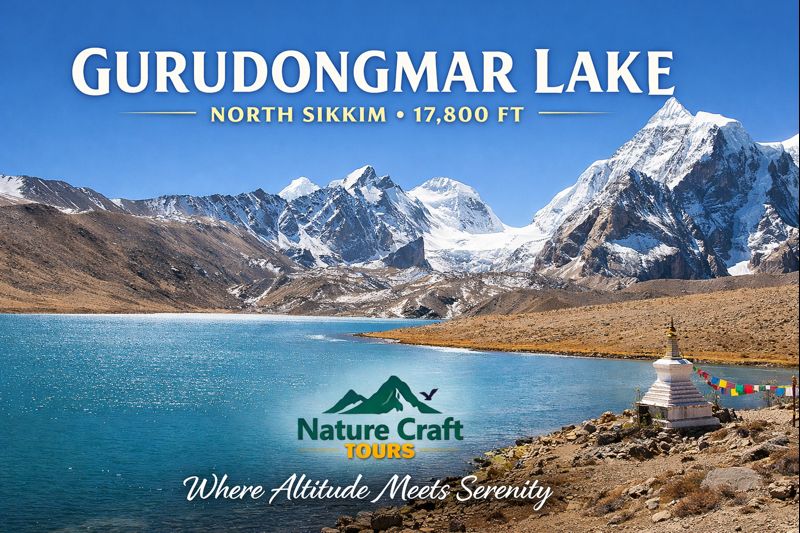
Where Altitude Becomes Experience
At an elevation where the air thins, sound dissolves, and thought slows into contemplation, Gurudongmar Lake stands as one of the most profound high-altitude landscapes of the Eastern Himalaya. Located in the remote northern reaches of Sikkim, this glacial lake is not merely a scenic destination; it is an encounter with geography in its rawest form. The journey to Gurudongmar is as defining as the destination itself—marked by stark mountain valleys, wind-sculpted plains, and a gradual surrender of human comfort to elemental forces.
Unlike conventional hill-station tourism, the experience of Gurudongmar Lake demands physical resilience, cultural sensitivity, and a willingness to accept discomfort as part of discovery. For the serious traveler, explorer, or researcher of Himalayan landscapes, Gurudongmar is not a checklist attraction but a study in altitude ecology, Tibetan-Buddhist cosmology, and frontier geography.
Geographical and Environmental Overview
Gurudongmar Lake is situated at an approximate altitude of 5,430 meters (17,800 feet) above sea level, making it one of the highest lakes accessible by motorable road in the world. It lies in North Sikkim district, close to the Indo–China (Tibet Autonomous Region) border, within a cold desert zone shaped by glacial activity and permafrost.
The lake is primarily fed by melting glaciers originating from the Khangchendzonga massif. Despite extreme winter temperatures that can plunge well below freezing for extended periods, a section of the lake traditionally remains unfrozen—an occurrence attributed both to geological factors and deeply embedded local belief systems.
The surrounding terrain is characterized by moraine fields, high-altitude pastures, and barren rock faces devoid of tree cover. Oxygen levels here are significantly reduced, often below 50% of what is available at sea level, placing Gurudongmar within the physiological threshold zone for most visitors.
Cultural and Religious Significance
Gurudongmar Lake holds profound spiritual importance for multiple religious traditions. Tibetan Buddhists associate the lake with Guru Padmasambhava (Guru Rinpoche), who is believed to have blessed the waters during his journey through the region in the 8th century. According to oral tradition, the unfrozen portion of the lake is considered sacred, and local communities refrain from disturbing it.
Sikh tradition also recognizes the lake due to its association with Guru Nanak Dev Ji, who is believed to have visited the region during his Himalayan travels. A small Sikh shrine near the lake commemorates this belief, making Gurudongmar one of the rare high-altitude sites revered across faiths.
For the indigenous Lachenpa community, the lake is part of a larger cosmological landscape where mountains, rivers, and high pastures are considered sentient and spiritually potent. Travel here is traditionally undertaken with restraint and reverence rather than conquest or recreation.
Ecological Characteristics and High-Altitude Adaptation
Despite its harsh conditions, the Gurudongmar region supports a fragile and specialized ecosystem. Vegetation is limited to alpine grasses, lichens, and mosses capable of surviving short growing seasons and intense ultraviolet radiation. During brief summer months, the surrounding meadows support grazing yaks and sheep belonging to nomadic herders.
Wildlife sightings are rare but notable. Species such as the Tibetan wolf, Himalayan blue sheep (bharal), and migratory high-altitude birds have been recorded in the broader region. Ecological balance here is particularly sensitive, as even minimal human interference can cause long-term degradation.
The lake itself plays a critical hydrological role, contributing to downstream river systems that eventually support human settlements far below. Preservation of its water quality is therefore not only a cultural concern but an environmental imperative.
Best Time and Season to Visit
Late Spring to Early Autumn (May to October)
The most viable period to visit Gurudongmar Lake is between late May and early October. During these months, snow clearance operations allow limited vehicular access, and temperatures, while still severe, remain within manageable limits for short stays.
June to September offers relatively clearer skies and a more stable road network, though monsoon weather can occasionally disrupt travel due to landslides in lower elevations. October marks the onset of early winter, with sharply dropping temperatures and reduced accessibility.
Winter travel (November to April) is generally not feasible for civilian visitors due to heavy snowfall, extreme cold, and military restrictions.
Ideal Travel Duration and Acclimatization Strategy
A responsible itinerary to Gurudongmar Lake requires a minimum of 3 to 4 days in North Sikkim, excluding travel from major transit hubs. Acclimatization is not optional but essential.
An ideal sequence involves overnight halts at lower altitudes such as Lachen before attempting the ascent. Rapid ascent without adequate acclimatization significantly increases the risk of Acute Mountain Sickness (AMS), which can be life-threatening at this elevation.
Travelers should plan for minimal time at the lake itself—usually not exceeding 20 to 30 minutes—allowing the body to limit exposure while still absorbing the visual and experiential impact of the site.
Route and Accessibility
Access to Gurudongmar Lake is strictly regulated and requires special permits due to its proximity to international borders. The standard route begins from Gangtok, the capital of Sikkim, proceeding northward through Chungthang to Lachen.
From Lachen, the journey to Gurudongmar begins early in the morning, traversing high-altitude military roads passing through Thangu Valley and the sparse plateau beyond. Road conditions vary significantly depending on weather and military movement.
Travel is typically undertaken in sturdy, high-clearance vehicles capable of navigating snow, ice, and unpaved terrain. Independent travel is not permitted; all visits must comply with local administrative guidelines.
Key Attractions and Experiential Highlights
The Lake Itself
The visual impact of Gurudongmar Lake is immediate and arresting. Its pale turquoise waters contrast starkly against the barren, mineral-toned landscape, creating a composition that feels almost abstract. There is no vegetation to soften the scene, no sound beyond the wind, and no human structure to dominate the view.
Thangu Valley
Often encountered en route, Thangu Valley serves as a transitional ecological zone. During summer, its meadows briefly bloom, offering a striking contrast to the starkness of higher altitudes. Historically used as a grazing ground, it provides insight into traditional high-altitude livelihoods.
High-Altitude Silence
One of the most understated yet powerful aspects of Gurudongmar is the profound silence. At this elevation, even internal bodily sounds become noticeable, creating an introspective environment rarely encountered elsewhere.
Practical Insights for Responsible Travelers
Preparation for Gurudongmar Lake should prioritize health, environmental responsibility, and cultural respect. Travelers must carry appropriate cold-weather gear, hydration supplies, and altitude medication as advised by medical professionals.
Consumption of alcohol or tobacco prior to ascent is strongly discouraged. Physical exertion at the lake should be minimized, and symptoms such as headache, nausea, or dizziness should be taken seriously.
The region follows a strict leave-no-trace ethic. Waste disposal facilities are nonexistent at higher elevations, making it essential to carry all non-biodegradable material back.
Contextual Perspective: Himalayan Travel Beyond the Obvious
For travelers accustomed to India’s varied ecological landscapes—from mangrove forests to coastal deltas—the experience of Gurudongmar offers a striking counterpoint. Just as a Sundarban Tour reveals life thriving in tidal uncertainty, Gurudongmar illustrates survival at the edge of atmospheric possibility.
Both environments demand humility from visitors and reward patience with insight rather than spectacle.
Broader Travel Integration and Comparative Geography
Gurudongmar Lake fits naturally into a larger understanding of India’s geographic extremities. When contrasted with lowland wetlands, deserts, or forested hills, it highlights the country’s remarkable environmental range. Travelers exploring multiple biomes—whether through Himalayan expeditions or journeys such as a thoughtfully planned Sundarban Tour Package—gain a more holistic appreciation of ecological diversity and conservation challenges.
The Value of Restraint in High-Altitude Travel
Gurudongmar Lake does not offer comfort, entertainment, or leisure in conventional terms. What it provides instead is perspective—on scale, endurance, belief, and the limits of human presence. It is a destination best approached not with expectation, but with preparedness and respect.
For those willing to accept its demands, Gurudongmar rewards with an experience that is at once austere and profound. Long after the thin air has thickened and the cold has receded from memory, the image of that silent, glacial lake remains—a reminder of landscapes that exist not for us, but alongside us.