Dzongu (Lepcha Reserve Belt):
Cultural Landscape Travel in the Sacred Highlands of North Sikkim
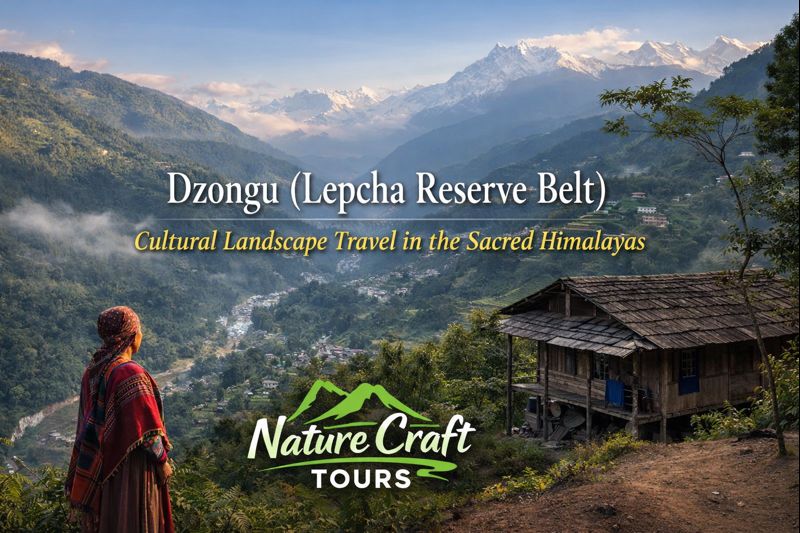
Dzongu is not a destination that reveals itself easily. Tucked away in the northern reaches of Sikkim, beyond the familiar circuits of monasteries and mountain viewpoints, Dzongu exists as a protected cultural landscape rather than a conventional tourist region. Recognised as the Lepcha Reserve Belt, it is one of the few remaining homelands in the Eastern Himalaya where an indigenous community continues to live largely on its own terms, guided by ancestral customs, sacred geography, and an intimate relationship with the land.
To travel through Dzongu is to step into a living continuum of culture and ecology. This is not a place defined by grand monuments or dramatic itineraries, but by subtler forms of significance—river confluences regarded as sacred, forest paths shaped by centuries of footfall, and villages where oral memory still holds authority. For the traveller willing to slow down and observe with humility, Dzongu offers one of the most profound cultural journeys available in the Himalayan region.
Destination Overview: Understanding Dzongu as a Cultural Landscape
Geographical Setting and Boundaries
Dzongu lies in North Sikkim, bordered by the Teesta River to the south and west, and enclosed by forested ridges that rise steadily toward the higher Himalayan ranges. Unlike open-access tourist zones, Dzongu is officially designated as a Lepcha reserve, meaning that land ownership, settlement patterns, and development are strictly regulated to preserve cultural integrity.
The terrain is characterised by deep river valleys, terraced slopes, cardamom plantations, bamboo groves, and dense subtropical forests. Altitudes vary significantly within short distances, resulting in diverse microclimates and vegetation zones. Roads are limited and often narrow, reinforcing Dzongu’s relative isolation even within Sikkim.
What Makes Dzongu Different
Dzongu is not promoted as a conventional tourist destination, and this distinction is deliberate. The region functions as a cultural sanctuary for the Lepcha people, Sikkim’s earliest known inhabitants. Entry is regulated, and visitors are expected to respect local norms rather than seek entertainment or spectacle.
As a result, Dzongu offers something increasingly rare: a landscape where cultural continuity has not been entirely reshaped by external demand. The value of the region lies not in individual attractions, but in the coherence of its way of life.
The Lepcha People: Culture, Identity, and Worldview
Indigenous Roots and Oral Tradition
The Lepchas consider themselves the original inhabitants of Sikkim, with a cultural history deeply embedded in the mountains, rivers, and forests of the region. Their traditions are transmitted primarily through oral narratives, ritual practice, and everyday customs rather than written texts.
Nature is not viewed as a resource to be exploited, but as a living system inhabited by protective and sometimes unpredictable spirits. Mountains, caves, lakes, and rivers are woven into mythological narratives that continue to guide behaviour and land use.
Language, Ritual, and Daily Life
The Lepcha language remains actively spoken in Dzongu, particularly among older generations. Rituals marking agricultural cycles, life events, and seasonal transitions continue to be observed, often within the household rather than in public spaces.
Daily life revolves around subsistence agriculture, forest produce, and community cooperation. Cardamom cultivation, traditional weaving, and small-scale farming dominate the local economy, reinforcing a rhythm of life closely aligned with the natural environment.
Ecological Significance of the Dzongu Landscape
Forest Systems and Biodiversity
Dzongu lies within a biologically rich zone of the Eastern Himalaya, where subtropical and temperate forests support a wide range of plant and animal species. Large sections of forest remain intact due to restricted access and traditional conservation practices.
Bamboo, cane, medicinal plants, and wild edibles form an integral part of local livelihoods. Knowledge of forest ecology is transmitted informally, through practice rather than instruction, and continues to guide sustainable harvesting methods.
Rivers, Sacred Sites, and Environmental Ethics
Rivers flowing through Dzongu are not merely water sources but sacred entities. Certain confluences and riverbanks are associated with ancestral narratives and ritual significance. These beliefs have historically discouraged large-scale alteration of river systems.
This ecological ethic stands in contrast to many development-driven landscapes and offers travellers an opportunity to observe conservation rooted in belief rather than regulation.
Best Time and Season to Visit Dzongu
Spring (March to May)
Spring is one of the most favourable periods to visit Dzongu. Temperatures remain moderate, forest paths are accessible, and agricultural activity resumes across villages. This season allows visitors to observe daily life without the challenges posed by heavy rainfall.
Monsoon (June to September)
The monsoon transforms Dzongu into a lush, vibrant landscape, but travel becomes challenging. Roads may be affected by landslides, and movement within villages slows. This period is best avoided unless one is prepared for limited mobility and flexible plans.
Autumn (October to November)
Post-monsoon months offer clear skies, stable road conditions, and heightened cultural activity. Many consider this the ideal season for Dzongu travel, as the landscape is refreshed and visibility improves across valleys and ridges.
Winter (December to February)
Winters are cool and quiet. While higher areas may experience cold nights, lower villages remain accessible. This season appeals to travellers seeking solitude and deeper engagement rather than visual abundance.
Ideal Travel Duration and Pace
Dzongu is not suited to hurried itineraries. A minimum of three to four days is recommended to experience the region meaningfully. This allows time for acclimatisation, village interaction, and unstructured exploration.
Travellers accustomed to varied Indian landscapes often find Dzongu particularly insightful when placed alongside contrasting ecosystems. Those who have explored deltaic environments through a Sundarban Tour frequently note how Dzongu presents a Himalayan counterpart—where cultural preservation replaces biodiversity tourism as the central theme.
Route and Accessibility
Reaching Dzongu
Dzongu is accessed via Gangtok, followed by a drive toward North Sikkim. Entry permits are required, reflecting the region’s protected status. Roads beyond the main access points narrow considerably, and travel times may be longer than distances suggest.
Public transport options are limited, making private or arranged transport the most practical choice. Visitors should plan daylight travel and avoid tight schedules.
Internal Movement
Movement within Dzongu is largely on foot or by short vehicle transfers between villages. Walking remains the most immersive way to experience the landscape, allowing engagement with local residents and natural features that are easily missed from vehicles.
Key Attractions and Highlights
Village Life and Homestead Architecture
Traditional Lepcha homes reflect functional design adapted to climate and terrain. Elevated structures, sloped roofs, and open verandas facilitate airflow and social interaction. Observing village life offers deeper insight than visiting any single landmark.
Forest Trails and River Valleys
Trails connecting villages often follow ancient routes used for trade, pilgrimage, and seasonal migration. Walking these paths reveals a landscape shaped by continuity rather than modern planning.
Cultural Gatherings and Seasonal Practices
Depending on timing, visitors may witness agricultural rituals or community gatherings. These events are not staged and should be approached with discretion and respect.
Practical Insights for Responsible Travellers
Dzongu requires a mindset shift from consumption to participation. Photography should be limited and always preceded by consent. Loud behaviour, intrusive questioning, or attempts to commodify culture are strongly discouraged.
Basic facilities are available but should not be compared to urban standards. Preparedness, adaptability, and cultural sensitivity are essential. Travellers who approach Dzongu with the same humility applied in ecologically sensitive regions—such as those visited through a Sundarban Tour Package—tend to find the experience far more rewarding.
Historical and Contemporary Challenges
Dzongu has faced pressures from infrastructure projects, changing aspirations among younger generations, and external economic influences. Community resistance and dialogue have played a crucial role in negotiating development while safeguarding cultural autonomy.
For travellers, understanding these dynamics adds depth to the journey, transforming Dzongu from a scenic location into a lived cultural landscape shaped by ongoing negotiation.
Dzongu as a Journey of Understanding
Dzongu is not a destination to be collected, photographed, or summarised easily. It is a place that demands attention, patience, and ethical awareness. Its value lies not in what it offers the visitor, but in what it teaches about coexistence between culture and environment.
For those willing to travel thoughtfully, Dzongu offers one of the most meaningful cultural experiences in the Himalaya—a reminder that some landscapes endure not through exposure, but through restraint.