Uttarey and the Varsey Rhododendron Belt (West Sikkim):
A Field Explorer’s Chronicle of High Ridges, Sacred Forests, and Seasonal Bloom
Introduction: At the Western Edge of Sikkim’s Alpine World
Uttarey and the Varsey Rhododendron Belt occupy a distinctive place in the geography of West Sikkim. Situated close to the Indo–Nepal border and rising steadily toward alpine elevations, this region marks a transition—from settled agrarian valleys to protected high-altitude forests shaped by climate, conservation, and centuries of cultural adaptation. For travelers who seek depth rather than display, Uttarey and Varsey present an immersive landscape where ecology, folklore, and mountain livelihoods intersect with remarkable clarity.
Unlike more frequented Himalayan destinations, this belt reveals itself gradually. Roads narrow, settlements thin out, and forests begin to dominate the horizon. Seasonal rhythms define the experience here, most famously during spring when rhododendrons transform entire ridgelines into living botanical galleries. Yet even beyond the bloom, Uttarey and Varsey remain compelling for their silence, their ecological integrity, and their sense of being a threshold zone between human habitation and wilderness.
Destination Overview: Uttarey and the Varsey Landscape
Uttarey is a small mountain settlement located at approximately 2,000 meters above sea level, forming one of the westernmost inhabited points of Sikkim. Beyond Uttarey lies the protected forest corridor of the Varsey Rhododendron Sanctuary, which ascends toward Singalila Ridge and the broader Eastern Himalayan alpine system.
The region is defined by long ridgelines, deep forest cover, and dramatic seasonal variation. Human habitation is sparse beyond Uttarey village, lending the area a sense of remoteness that is increasingly rare in accessible Himalayan regions.
Geographical Setting and Terrain
The terrain consists of undulating ridges, forested slopes, and high meadows interspersed with steep gradients. Snowfall during winter months is not uncommon at higher elevations, while spring and summer bring rapid vegetative growth. The Singalila range, visible from several vantage points, forms a natural boundary between India and Nepal.
Cultural and Historical Context of Uttarey
Uttarey has historically functioned as a frontier settlement, shaped by cross-border movement, subsistence agriculture, and seasonal pastoralism. The village population is predominantly Nepali-speaking, with cultural practices closely tied to the land and climate.
Village Life and Social Structure
Agriculture remains the foundation of daily life, with households cultivating maize, potatoes, and seasonal vegetables. Livestock rearing supplements income and food security. Social organization emphasizes cooperation, particularly during sowing and harvest seasons, and oral traditions continue to transmit local history and environmental knowledge.
Varsey Rhododendron Sanctuary: Ecological Significance
The :contentReference[oaicite:0]{index=0} is one of Sikkim’s most ecologically important protected areas. Established to conserve high-altitude forest ecosystems, the sanctuary spans elevations from approximately 2,200 meters to over 3,500 meters.
Rhododendron Diversity and Seasonal Bloom
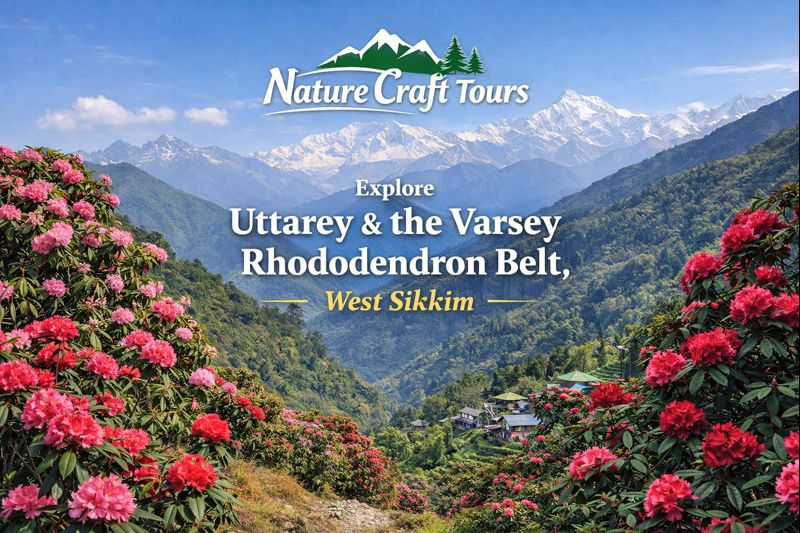
The sanctuary is home to more than 40 species of rhododendron, ranging from tree-sized varieties to dwarf alpine shrubs. Flowering typically occurs between late March and early May, depending on altitude and weather patterns. During peak bloom, entire forest corridors are transformed into vivid gradients of red, pink, white, and purple.
Associated Flora and Fauna
Beyond rhododendrons, the sanctuary supports magnolia, oak, fir, and bamboo species. Faunal diversity includes Himalayan black bear, red panda, barking deer, and a rich assemblage of birdlife such as blood pheasant, Himalayan monal, and various warblers. Wildlife sightings are infrequent but ecologically significant.
Route and Accessibility
Access to Uttarey begins from Gyalshing (Geyzing), the administrative hub of West Sikkim. From Gyalshing, a mountain road ascends through forested terrain and scattered settlements before reaching Uttarey. Road conditions are generally stable but narrow, requiring cautious driving.
The nearest railhead is New Jalpaiguri, and Bagdogra Airport serves as the closest air link. From either location, travelers typically reach Gyalshing in 6–7 hours, followed by a further 2–3 hour drive to Uttarey.
Ideal Travel Duration
A minimum stay of three nights is recommended to experience Uttarey and the lower reaches of the Varsey belt. Travelers intending to explore deeper forest trails, observe seasonal flora, or engage in extended photography should consider four to five nights.
Best Time and Season to Travel
Spring (March to May) is the most celebrated season due to rhododendron flowering. Autumn (October to November) offers clear skies, stable weather, and long-distance mountain views. Winter travel is possible but limited by cold temperatures and occasional snowfall, while monsoon months require flexibility due to heavy rainfall.
Key Attractions and Experiential Highlights
- Forest walks through blooming rhododendron corridors
- Ridge-top viewpoints overlooking Singalila Range
- Village walks and interaction with Uttarey’s farming community
- Birdwatching in early morning forest clearings
- Seasonal observation of alpine vegetation changes
Cultural and Spiritual Dimensions of the Landscape
Local belief systems attribute spiritual significance to forests, ridges, and specific natural features. Certain areas within the sanctuary are traditionally approached with respect, reflecting a worldview that emphasizes coexistence rather than domination of nature.
Practical Insights for Travelers
Travelers should prepare for limited infrastructure beyond Uttarey. Electricity and mobile connectivity can be inconsistent, and medical facilities are basic. Layered clothing, sturdy footwear, and respect for local customs are essential for a safe and meaningful journey.
For travelers interested in understanding India’s ecological diversity across contrasting terrains, Himalayan journeys often pair well with lowland explorations. Some choose to complement mountain travel with experiences such as a Sundarban Tour, which highlights mangrove ecosystems shaped by entirely different environmental forces.
Responsible Travel and Conservation Awareness
The Varsey belt is a fragile ecosystem. Visitors are expected to minimize waste, avoid disturbing wildlife, and adhere to designated trails. Conservation efforts rely heavily on community cooperation and responsible visitor behavior.
Comparative Ecological Perspective
Experiencing Uttarey and Varsey deepens an understanding of how altitude, temperature, and isolation influence biodiversity. When compared with deltaic regions or coastal forests, the contrasts are striking. Some seasoned travelers intentionally broaden their ecological perspective by combining alpine travel with journeys such as a Sundarban Tour Package from Kolkata, allowing them to observe how human cultures adapt to vastly different natural systems.
Why Uttarey and Varsey Endure
Uttarey and the Varsey Rhododendron Belt represent more than a seasonal spectacle. They embody a living relationship between people and high-altitude landscapes, where conservation, tradition, and environmental awareness coexist.
For travelers willing to engage patiently and thoughtfully, this region offers insight into the quieter truths of the Himalayas—truths revealed not through monuments or crowds, but through forests in bloom, villages at rest, and ridgelines that define both borders and belonging.