Namphok and Remote Monastery Corners:
Exploring Less-Frequented Monastic Stops of the Eastern Himalayas
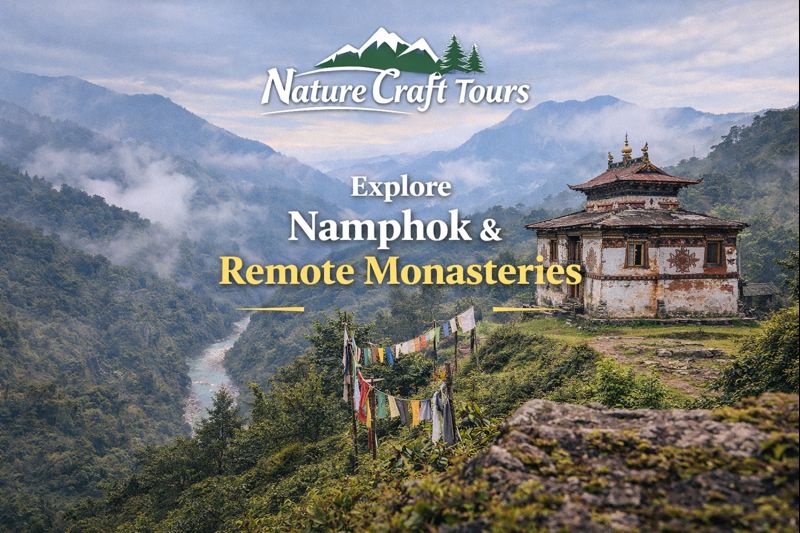
In Search of the Quiet Monasteries
Across the Eastern Himalayas, monasteries are often perceived through the lens of grand complexes and established pilgrimage circuits. Beyond these familiar landmarks, however, exists a quieter monastic geography—small, remote, and deeply contemplative spaces that remain largely absent from mainstream itineraries. Namphok and similar remote monastery corners represent this understated spiritual landscape, where faith is practiced away from crowds and ritual life remains closely aligned with nature.
Travel to Namphok is not defined by visual spectacle or architectural grandeur. Instead, it is an exercise in attentiveness—toward landscape, silence, and the rhythms of monastic life that once flourished in isolation. These lesser-frequented monastic stops provide insight into how Himalayan Buddhism adapted to terrain, climate, and limited accessibility, creating sacred spaces that functioned as both spiritual retreats and ecological sanctuaries.
Destination Overview: Namphok and Its Monastic Setting
Namphok is a small, sparsely populated mountain hamlet located in East Sikkim, close to the historic Silk Route belt. The area is best known for the remains of Namphok Monastery—an old Buddhist monastic site that once served as a spiritual waypoint for monks, traders, and pilgrims moving through high-altitude routes.
Unlike active monasteries that continue to draw devotees, Namphok’s significance lies in its partial ruins and preserved silence. The site reflects an earlier phase of Himalayan monastic history when religious institutions were deliberately established in remote locations, prioritizing solitude, meditation, and withdrawal from worldly life.
Geographical Position and Landscape
Namphok sits at a moderate-to-high elevation, surrounded by forested slopes, seasonal streams, and wind-swept ridgelines. Mist frequently envelopes the area, punctuated by sudden clearings that reveal expansive mountain views. The terrain itself explains why the monastery never developed into a large complex; access has always been difficult, reinforcing its contemplative and retreat-oriented character.
Historical Context: Traditions of Remote Monasticism
Remote monasteries such as Namphok emerged during periods when Himalayan Buddhist practice emphasized retreat, ascetic discipline, and prolonged meditation. These institutions often existed independently, sustained by subsistence agriculture, forest resources, and modest patronage from traders using nearby routes.
As trade patterns shifted and political boundaries hardened, many such monasteries were gradually abandoned. Namphok followed this trajectory, fading from active monastic use without losing its cultural relevance. Local memory, oral history, and occasional ritual visits have preserved its spiritual presence despite physical decline.
Architecture and Material Simplicity
The remaining structures at Namphok reveal pragmatic Himalayan construction methods. Stone foundations, timber frameworks, and minimal decorative elements dominate. This architectural restraint was intentional, reflecting Buddhist ideals of impermanence and detachment while ensuring harmony with the surrounding environment.
Cultural and Spiritual Significance
For nearby communities, Namphok is more than an archaeological remnant. It functions as a spiritual landmark embedded in collective consciousness. Local narratives describe monks who selected the site for its isolation and proximity to natural elements believed to support meditation—wind corridors, forest silence, and uninterrupted sky.
Living Belief Systems
Even today, subtle signs of reverence can be found at the site. Prayer flags, stone offerings, and traces of incense indicate that Namphok continues to serve as a place of respect and reflection rather than a tourist attraction. Such gestures affirm the continuity of belief beyond formal religious institutions.
Ecology Around Remote Monastery Corners
Remote monasteries often function as inadvertent conservation zones. Limited human intervention around Namphok has allowed surrounding forests to regenerate naturally, creating ecologically stable pockets within the broader Himalayan landscape.
Forest Composition and Vegetation
The region supports mixed temperate forests dominated by oak, rhododendron, and seasonal alpine shrubs at higher elevations. Thick moss cover, old-growth trees, and undisturbed leaf litter indicate long periods without intensive land use.
Wildlife Presence
Birdlife is especially prominent, with frequent sightings of Himalayan thrushes, finches, and raptors. Larger mammals remain elusive but are occasionally reported by locals, underscoring the ecological continuity maintained through minimal disturbance.
Route and Accessibility
Access to Namphok requires careful planning and local knowledge. Travel typically involves mountain roads followed by short forest walks along paths that echo historic Silk Route alignments. Road conditions vary significantly by season, and weather can change rapidly.
Most travelers approach the area from established East Sikkim bases before diverting onto lesser-used roads. Because signage is limited, first-time visitors are advised to rely on local guidance rather than digital navigation alone.
Ideal Travel Duration
Namphok and similar remote monastic corners can be explored meaningfully within one to two days when included as part of a larger itinerary. Travelers seeking deeper engagement—through extended walking, observation, or contemplative travel—may choose to allocate additional time.
Best Time and Season to Travel
Late spring (April to June) and early autumn (September to October) offer the most balanced conditions. These seasons provide manageable weather and clearer access routes. Monsoon months enhance vegetation but complicate travel, while winter introduces cold winds and occasional snowfall.
Key Attractions and Experiential Highlights
- Exploration of Namphok Monastery remains
- Silent forest walks along historic monastic paths
- Observation of Himalayan cloud, light, and wind patterns
- Understanding monastic site placement in relation to terrain
- Periods of uninterrupted solitude and reflection
Practical Insights for Travelers
Travel in remote monastic landscapes requires preparation and restraint. Facilities are minimal, emergency services are distant, and mobile connectivity is unreliable. Visitors should carry essential supplies, dress for sudden weather changes, and treat all structures and artifacts with respect.
Explorers interested in broader ecological and cultural contrasts often contextualize Himalayan journeys alongside very different environments. Some balance high-altitude solitude with lowland wilderness experiences such as a Sundarban Tour, reflecting on how spirituality and survival adapt across diverse landscapes.
Responsible Engagement with Sacred Spaces
Remote monasteries are particularly vulnerable to unintentional damage. Responsible travel practices—quiet movement, minimal photography, and strict leave-no-trace principles—are essential. These places are living cultural landscapes, not curated heritage exhibits.
Remote Monasteries within a Broader Travel Philosophy
Namphok exemplifies destinations whose value lies in atmosphere and continuity rather than visibility. Including such places within travel narratives encourages slower, more reflective exploration and deeper regional understanding.
Some travelers intentionally design journeys that move between extreme environments, extending reflective Himalayan travel with later engagement in riverine and deltaic cultures through options such as a Sundarban Tour Package from Kolkata, completing a wide ecological and cultural spectrum.
The Enduring Meaning of Quiet Monastic Landscapes
Namphok and other remote monastery corners demonstrate that spiritual landscapes need not be monumental to be meaningful. Their strength lies in restraint, environmental alignment, and the persistence of belief beyond physical structures.
For travelers willing to listen rather than seek spectacle, these lesser-frequented monastic stops offer rare clarity. They reveal how faith, geography, and ecology converge in the Himalayas—quietly, patiently, and without invitation to hurry.