Rambha Sector (Chilika) — Hill-Backed Lake Vistas:
Where Eastern Ghats Meet the Lagoon
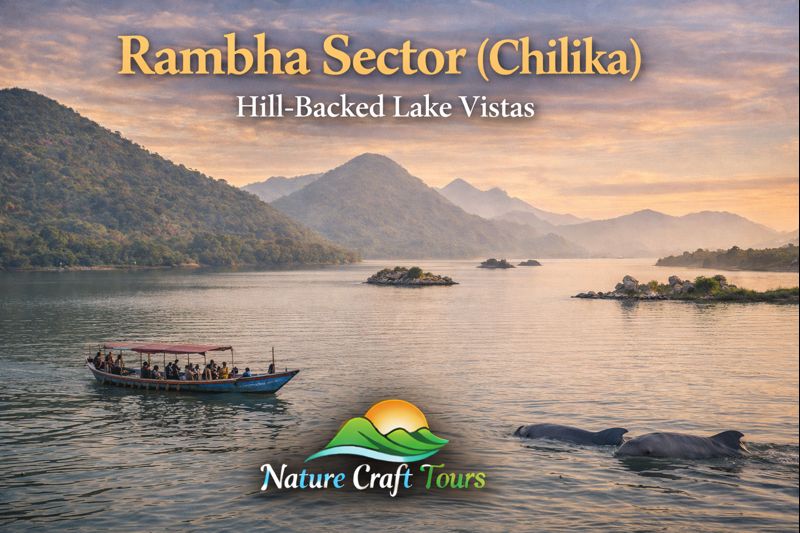
The Rambha sector of Chilika Lake presents a markedly different face of India’s largest brackish water lagoon. Here, the vast openness of water is framed not by flat horizons but by low, forested hills of the Eastern Ghats that descend gently toward the lake’s edge. This meeting of upland and lagoon creates a layered landscape—water, islands, slopes, and sky—imbued with a sense of depth and quiet grandeur. Rambha is not a zone of dramatic wildlife encounters or heavy tourist activity; rather, it is a place of slow observation, scenic immersion, and historical resonance.
For the experienced traveler, Rambha offers a perspective on Chilika that is often overlooked. While northern sectors are celebrated for winter birdlife and southern reaches for dynamic channels and dolphins, Rambha stands apart as the lagoon’s contemplative heart. It is a sector where geology, history, and human settlement have shaped a stable, visually rich environment that rewards time and attention. This article explores Rambha as a hill-backed lake landscape—its physical character, cultural memory, ecological context, and practical travel considerations—through a research-driven and field-informed lens.
Destination Overview: Rambha and the Central Chilika Landscape
Rambha is situated along the western-central edge of Chilika Lake, where the lagoon’s waters meet the foothills of the Eastern Ghats. Unlike the shallow, marsh-dominated northern stretches or the tidal southern channels, Rambha occupies a relatively stable zone with moderate depths and reduced salinity fluctuation. This stability has supported continuous human settlement and maritime activity over centuries.
The town of Rambha itself developed historically as a port and transit point, benefiting from its sheltered waters and proximity to hill routes. Today, it serves as a gateway to some of Chilika’s most scenic island clusters and offers expansive lake views backed by green slopes. The overall atmosphere is calm and spacious, with fewer boats and less noise than other sectors, making it particularly suitable for travelers seeking visual and cultural immersion.
Geographical Setting: Hills, Islands, and Open Water
Eastern Ghats as a Backdrop
The defining feature of the Rambha sector is the presence of the Eastern Ghats along the lake’s western margin. These ancient hills, composed primarily of hard crystalline rocks, descend gradually toward the lagoon, creating a natural amphitheater around the water. Their slopes are covered with mixed vegetation, which changes subtly with season, adding texture and color to the landscape.
This hill-backed setting influences wind patterns and wave behavior, often resulting in calmer water conditions compared to more exposed sectors of Chilika. The visual contrast between still water and solid landform gives Rambha a sense of permanence rarely associated with lagoon environments.
Island Clusters and Lake Morphology
Several small islands and rocky outcrops dot the waters off Rambha, some rising sharply from the lake with minimal vegetation, others softened by shrubs and trees. These islands break the expanse of water into layered planes, enhancing depth perception and scenic variety.
From a geomorphological perspective, these features reflect long-term interactions between rising and falling water levels, sediment deposition, and bedrock exposure. For travelers, they provide visual anchors that change character with light, weather, and season.
Historical Significance of Rambha
Rambha as a Colonial-Era Port
Rambha’s importance predates modern tourism. During the colonial period, it functioned as a significant port town, facilitating trade and movement between inland Odisha and coastal routes. Its sheltered waters made it an ideal anchorage, while hill routes connected it to hinterland settlements.
Remnants of this era remain visible in the town’s layout, older buildings, and place names. Although large-scale maritime trade has long since declined, Rambha retains a sense of historical continuity shaped by its past role as a node of exchange.
Cultural Memory and Local Identity
Local communities around Rambha maintain strong connections to the lake, not only as a source of livelihood but as a defining element of identity. Oral histories, rituals, and seasonal practices reflect long-standing engagement with both water and hills, distinguishing Rambha culturally from other Chilika settlements.
Ecological Character of the Rambha Sector
Water Conditions and Biodiversity
Rambha’s waters tend to be less saline than the southern sectors of Chilika, particularly during and after the monsoon when freshwater inflow increases. This creates favorable conditions for certain fish species and aquatic plants, supporting a balanced food web.
Birdlife is present throughout the year, though not in the dense congregations seen in northern Chilika during winter. Instead, Rambha offers scattered sightings—cormorants, egrets, and waterfowl moving between islands and shoreline—best appreciated through quiet observation rather than targeted viewing.
Vegetation and Hill Ecology
The adjacent hills contribute organic matter and shelter, influencing nearshore ecology. Leaf litter, runoff, and shade affect nutrient availability and microhabitats along the lake edge. This hill–lake interaction adds ecological complexity absent in flatter lagoon sectors.
Travelers familiar with forest–water interfaces in deltaic regions, such as those explored during a Sundarban Tour, may recognize similar themes here, though expressed through rocky hills rather than mangrove forests.
Scenic Experience: Light, Water, and Perspective
Morning and Evening Lake Views
Rambha is particularly rewarding during early morning and late afternoon. At dawn, mist often lingers over the water, softening island outlines and hill contours. The lake surface reflects muted tones of grey, blue, and green, creating a layered visual field.
In the evening, the sun’s low angle illuminates hill slopes and islands, casting long shadows across the water. These moments emphasize Rambha’s three-dimensional landscape, making it one of the most photogenic sectors of Chilika without relying on dramatic wildlife events.
Boat-Based Vistas
Short boat excursions from Rambha reveal shifting perspectives as islands align and separate, hills appear and recede, and water color changes with depth. Movement across the lake transforms static views into a sequence of evolving compositions, best appreciated at a slow pace.
Best Time to Visit Rambha
Seasonal Conditions
The most comfortable and visually rewarding time to visit Rambha is between October and February. During these months, temperatures are moderate, humidity is lower, and water conditions are generally calm. Clear skies enhance long-distance visibility of hills and islands.
The monsoon season brings lush greenery and dramatic skies but may limit boat movement due to weather conditions. Summer months can be warm, though early mornings and evenings remain pleasant.
Ideal Travel Duration
A stay of one to two days is sufficient to experience Rambha meaningfully. One day allows for lake views, a short boat excursion, and exploration of the town. An additional day enables slower observation, repeat visits at different times of day, and integration with nearby Chilika sectors.
Route and Accessibility
Reaching Rambha
Rambha is well connected by rail and road, located along major transport routes in southern Odisha. Its accessibility makes it a practical entry point to Chilika’s central region, especially for travelers approaching from inland areas.
Local Movement
The town and lakeshore areas are easily explored on foot, while boats are used for island visits and open-water exploration. Movement is generally unhurried, aligning with Rambha’s overall atmosphere.
Key Attractions and Highlights
- Hill-backed panoramic views of Chilika Lake
- Island clusters creating layered water landscapes
- Colonial-era port town heritage
- Calm, scenic boat routes ideal for slow exploration
Practical Insights for Travelers
Rambha is best approached with an appreciation for scenery and history rather than expectations of high-energy activity. Comfortable walking footwear, sun protection, and time flexibility enhance the experience. Travelers should prioritize respectful interaction with local communities and minimal environmental impact.
Those planning broader explorations of eastern India’s water landscapes may find meaningful contrast by combining Rambha’s hill-backed lagoon views with forested delta environments through a Sundarban Tour Package, gaining a more complete understanding of how different geographies shape human–water relationships.
Rambha as Chilika’s Scenic Anchor
Rambha does not compete with other Chilika sectors for spectacle. Its value lies in balance—between land and water, history and ecology, stillness and movement. The presence of hills lends the lagoon a sense of structure and permanence, anchoring the fluidity of water in solid form.
For travelers seeking depth, perspective, and visual harmony, Rambha offers an enduring encounter with Chilika Lake as a landscape shaped as much by geology and time as by tides and seasons. It stands as a reminder that some of the most meaningful travel experiences emerge not from intensity, but from attentive observation and quiet continuity.