Udayagiri & Khandagiri Caves (Bhubaneswar):
Rock-Cut Monasteries, Ascetic Life, and the Sacred Geography of Ancient Kalinga
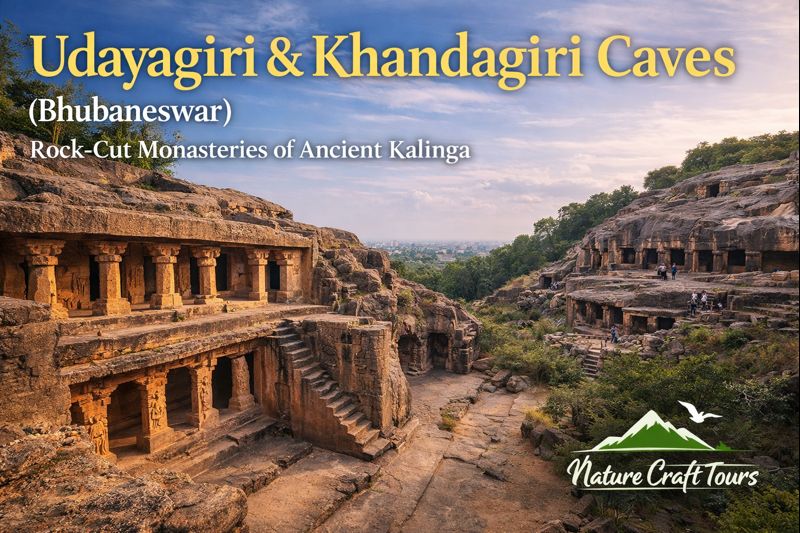
The twin hills of Udayagiri and Khandagiri rise quietly on the western edge of Bhubaneswar, far removed from the noise of modern traffic yet deeply embedded in the intellectual and spiritual history of eastern India. These ancient rock-cut caves are not monuments of imperial arrogance or architectural extravagance. They are, instead, landscapes of restraint—carved by human hands to serve the needs of monks, thinkers, and ascetics who chose withdrawal over display, discipline over dominance.
To explore the Udayagiri and Khandagiri Caves is to step into a period when Odisha—then known as Kalinga—was a thriving center of Jain philosophy, political patronage, and artistic experimentation. Unlike many cave complexes associated with royal leisure or ritual spectacle, these caves were designed for lived spirituality. Their walls preserve not only inscriptions and sculptures, but also the rhythm of daily monastic life that unfolded here more than two thousand years ago.
Geographical Setting and Landscape Context
Udayagiri and Khandagiri are twin hillocks located approximately six kilometers west of Bhubaneswar’s historic core. Separated by a shallow valley, the hills face each other in quiet symmetry, their rocky slopes softened by vegetation and time. The setting is neither dramatic nor forbidding, yet it offers a natural seclusion that would have appealed to ascetic communities seeking distance from urban centers without complete isolation.
The surrounding plains once formed part of ancient trade and pilgrimage routes that connected coastal Odisha with the interior regions of the subcontinent. This strategic yet secluded position allowed monastic communities to remain accessible to patrons and lay followers while preserving the contemplative environment necessary for rigorous spiritual practice.
Historical Background: Jainism in Ancient Kalinga
The Udayagiri and Khandagiri Caves date primarily to the 1st century BCE, a period marked by the resurgence of regional powers in eastern India following the decline of Mauryan dominance. During this time, Jainism enjoyed strong royal patronage in Kalinga, particularly under King Kharavela, whose reign represents a significant chapter in Odisha’s early history.
Jainism, with its emphasis on non-violence, ascetic discipline, and liberation through self-control, found fertile ground in Kalinga’s intellectual climate. The caves were excavated to serve as residential and meditative spaces for monks, especially during the monsoon months when wandering ascetics traditionally settled in one place.
Inscriptions found within the caves provide valuable insight into this era, recording acts of patronage, monastic activities, and historical events. These records transform the caves from silent ruins into articulate witnesses of a vibrant religious culture.
Udayagiri Hill: The Sunrise of Monastic Life
Udayagiri, meaning “Hill of the Rising Sun,” is the larger and more elaborate of the two hills. It contains eighteen caves, each differing in scale, complexity, and artistic detail. The caves are arranged along the slope, connected by pathways that encourage slow, deliberate movement—an experience that mirrors the disciplined pace of monastic life.
Rani Gumpha: The Queen’s Cave
The most prominent cave at Udayagiri is Rani Gumpha, often referred to as the Queen’s Cave. Despite its name, the cave was not a royal residence but a richly adorned monastic complex. Its two-storeyed structure, carved entirely from rock, features sculpted panels depicting scenes of courtly life, processions, musicians, and mythological narratives.
The artistic detail here is remarkable not for opulence, but for narrative clarity. These reliefs offer rare visual documentation of social life in ancient Kalinga, bridging the worlds of ascetic withdrawal and lay society.
Other Significant Caves of Udayagiri
Ganesh Gumpha, named after a later addition of a Ganesh image, contains important inscriptions that shed light on royal patronage. Vyaghra Gumpha, with its tiger-mouth entrance, demonstrates symbolic creativity, while Hathi Gumpha holds the famous Hathigumpha inscription, a crucial historical record detailing King Kharavela’s achievements.
These caves collectively reveal a complex relationship between spiritual communities and political authority, where support did not translate into control, and patronage coexisted with philosophical independence.
Khandagiri Hill: Austerity and Solitude
Khandagiri, meaning “Broken Hill,” is smaller and less ornate, containing fifteen caves. Its atmosphere is noticeably quieter, its spaces more austere. The caves here emphasize functionality over decoration, reinforcing the ascetic ideals central to Jain monastic life.
Cave Architecture and Monastic Design
The caves of Khandagiri consist largely of single-cell dwellings with stone benches and minimal ornamentation. These were designed for meditation, rest, and study. The simplicity of these spaces is striking, offering a powerful contrast to the elaborate reliefs seen at Udayagiri.
Khandagiri provides insight into the daily discipline of monks—the physical conditions under which philosophical inquiry and spiritual rigor were pursued.
Artistic and Architectural Significance
The caves represent one of the earliest surviving examples of rock-cut architecture in eastern India. Unlike later cave complexes influenced by imperial aesthetics, Udayagiri and Khandagiri reflect localized artistic traditions shaped by religious need rather than imperial ambition.
The carvings demonstrate a sophisticated understanding of spatial planning, natural light, and rock stability. Sculptors worked with the contours of the hills rather than imposing rigid geometric designs, resulting in spaces that feel organic and balanced.
Cultural and Philosophical Importance
Beyond their archaeological value, the caves embody a philosophical worldview centered on restraint, ethical discipline, and inner liberation. Jain teachings emphasize the conquest of desire and ego, principles reflected in the physical environment of the caves themselves.
These sites remind visitors that ancient Indian spirituality was not monolithic. Alongside grand temples and ritual centers existed quieter traditions that valued introspection over spectacle.
Ecological Setting and Sensory Experience
The hills are covered with seasonal vegetation that changes character throughout the year. During winter, the air is crisp and clear, allowing panoramic views of Bhubaneswar’s outskirts. Birdsong and wind replace urban noise, reinforcing the sense of retreat.
This ecological calm enhances the contemplative nature of the site, making it ideal for slow exploration.
Planning a Visit to Udayagiri & Khandagiri
Best Time to Visit
The most suitable time to visit is between October and February, when temperatures are moderate and walking conditions are comfortable. Early mornings offer the quietest atmosphere.
Ideal Travel Duration
A thorough visit requires three to four hours, allowing sufficient time to explore both hills without haste.
Route and Accessibility
The caves are easily accessible by road from central Bhubaneswar. The approach roads are well maintained, and pathways within the site are clearly defined.
Experiential Context for Thoughtful Travelers
For travelers accustomed to immersive nature experiences such as a Sundarban Tour, the caves offer a different form of immersion—one rooted in intellectual history and ethical inquiry rather than ecological drama.
The experience is most rewarding when approached slowly, with attention to inscriptions, spatial design, and silence.
Practical Insights for Visitors
Comfortable walking footwear is essential due to uneven rock surfaces. Visitors should carry water, particularly during warmer months. Touching carvings or inscriptions should be avoided to preserve the fragile surfaces.
Reading about Jain philosophy and ancient Kalinga before visiting significantly enriches understanding.
Udayagiri & Khandagiri in the Broader Eastern India Travel Narrative
Eastern India offers a spectrum of travel experiences—from sacred landscapes and historical cities to wilderness regions explored through journeys like a Sundarban Tour Package from Kolkata. Udayagiri and Khandagiri add intellectual and philosophical depth to this mosaic, highlighting traditions that valued withdrawal, ethics, and self-discipline.
Hills That Preserve Thought
Udayagiri and Khandagiri are not destinations for hurried sightseeing. They are landscapes meant to be read, walked, and contemplated. Their caves preserve more than stone—they preserve a way of thinking that continues to resonate in a world often driven by excess.
For travelers seeking historical depth, philosophical insight, and quiet engagement with the past, these twin hills remain among Bhubaneswar’s most profound and enduring treasures.