Similipal Region — Forest Scale and Biodiversity
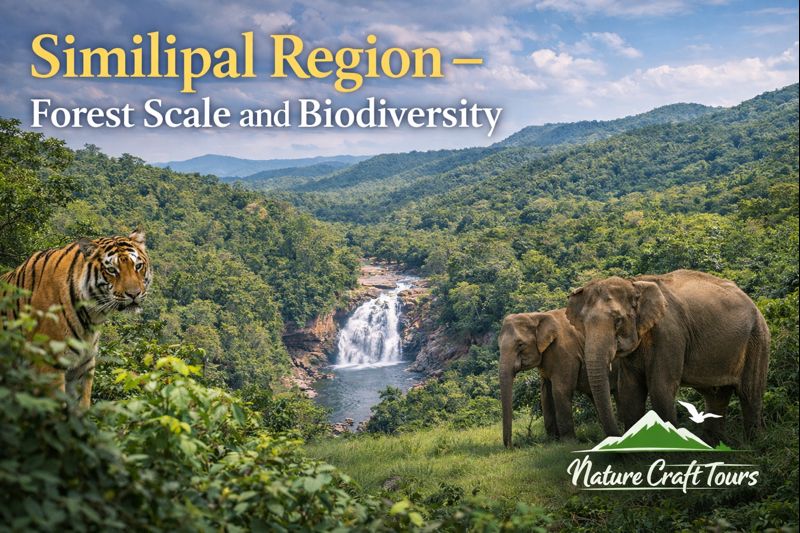
The Similipal region is not a forest that reveals itself quickly. It is vast, layered, and deliberately slow in the way it allows understanding. Spread across the northern highlands of Odisha, Similipal is a living archive of geological time, evolutionary processes, and human coexistence with wilderness. Here, scale is not measured merely in square kilometers, but in gradients of forest type, altitude, rainfall, and biodiversity that shift subtly from one valley to the next.
To travel through Similipal is to encounter one of eastern India’s last remaining large forest landscapes where ecological continuity still holds. Unlike smaller reserves that offer curated wildlife encounters, Similipal demands patience, attentiveness, and respect for distance. It is a region where forests dominate human presence, not the other way around.
Geographical Extent and Forest Scale
The Similipal region occupies a substantial portion of Mayurbhanj district in northern Odisha and forms part of the wider Eastern Ghats highland system. Its terrain is defined by rolling plateaus, forested hills, deep river valleys, and isolated grasslands. Elevations range from low foothills to peaks rising above 1,100 meters, creating diverse microclimates within a single forest complex.
What distinguishes Similipal from many other protected landscapes is its sheer continuity. Forest cover extends uninterrupted across vast distances, allowing natural processes such as animal migration, seed dispersal, and predator–prey dynamics to operate with minimal fragmentation. This large-scale integrity is increasingly rare in the Indian subcontinent.
Evolution of Similipal as a Protected Landscape
Similipal’s recognition as an ecologically significant region predates modern conservation frameworks. Historically managed as royal hunting grounds under the Mayurbhanj princely state, the forests remained relatively undisturbed compared to surrounding regions subjected to intensive agriculture.
In the post-independence period, Similipal was gradually brought under formal protection, eventually becoming a wildlife sanctuary, a national park, and later a biosphere reserve. Each designation reflected a growing understanding that Similipal’s value lay not only in individual species, but in the integrity of the entire forest system.
Forest Types and Vegetation Zones
Similipal supports one of the most diverse forest mosaics in eastern India. Moist deciduous forests dominate much of the landscape, characterized by tall sal, asan, and piyasal trees forming dense canopies during the monsoon months. In drier zones, dry deciduous forests appear, with more open structure and seasonal leaf fall.
Higher elevations and sheltered valleys support semi-evergreen patches, where humidity remains high year-round. Grasslands emerge naturally in plateau areas and around old forest clearings, creating essential grazing zones for herbivores. This variation in vegetation is a direct consequence of Similipal’s scale and topographic diversity.
Biodiversity Richness and Species Diversity
Similipal is among the most biologically diverse forest regions in India. Its vast area allows populations of large mammals to maintain genetic viability, while its varied habitats support countless smaller species that often go unnoticed.
Mammalian Fauna
The region supports a full spectrum of forest mammals, from apex predators to small insectivores. Large herbivores such as deer and gaur shape forest regeneration through grazing and browsing, while predators regulate population balance. The forest’s size ensures that animals can move freely across territories without being forced into constant proximity with human settlements.
Avifauna and Birdlife
Bird diversity in Similipal is particularly striking. Forest specialists, riverine species, and migratory birds all find suitable habitats here. Seasonal changes bring shifts in bird activity, with winter months offering clearer visibility and higher species counts along forest edges and watercourses.
Reptiles, Amphibians, and Invertebrates
Beyond charismatic fauna, Similipal’s ecological strength lies in its lesser-known species. Amphibians thrive in seasonal streams and forest pools, acting as indicators of water quality. Reptiles occupy niches across rocky outcrops, forest floors, and riverbanks. Invertebrates, including pollinators and decomposers, underpin the forest’s nutrient cycles.
Hydrology: Rivers, Waterfalls, and Watersheds
Similipal functions as a critical watershed for northern Odisha. Numerous rivers originate within its forests, feeding agricultural plains far beyond the reserve boundaries. Waterfalls cascade down escarpments during the monsoon, while perennial streams sustain wildlife through drier months.
This hydrological role adds another dimension to Similipal’s importance. The health of distant human communities is directly linked to the forest’s ability to regulate rainfall runoff, prevent erosion, and maintain groundwater recharge.
Indigenous Communities and Cultural Landscape
Human presence in the Similipal region predates modern conservation by centuries. Indigenous communities have traditionally lived within and around the forest, developing livelihoods closely aligned with seasonal rhythms. Their knowledge of plants, animals, and terrain represents an intangible heritage inseparable from the landscape itself.
Contemporary conservation efforts increasingly recognize the importance of involving these communities in forest stewardship. Sustainable coexistence, rather than exclusion, remains central to Similipal’s long-term ecological stability.
Experiencing Similipal as a Traveler
Travel in the Similipal region is defined by restraint. The forest is not designed for rapid consumption or casual sightseeing. Instead, it rewards those willing to slow down, observe quietly, and accept that wildlife encounters are never guaranteed.
For travelers accustomed to deltaic ecosystems explored through journeys such as a Sundarban Tour, Similipal offers a contrasting perspective on forest ecology—upland rather than tidal, continuous rather than fragmented, silent rather than fluid.
Key Attractions and Natural Highlights
Similipal’s highlights are not isolated landmarks but integrated components of a broader ecological system. Forest trails, river crossings, waterfalls, and elevated viewpoints collectively reveal the region’s scale and diversity.
Different zones offer different experiences: open plateaus provide expansive views, dense valleys immerse visitors in layered vegetation, and river corridors showcase animal movement and bird activity.
Best Time and Season to Visit
Seasonal Considerations
The most suitable period to visit Similipal is between October and February. During these months, temperatures remain moderate, roads are accessible, and wildlife visibility improves as vegetation thins.
Monsoon months bring dramatic greenery and flowing waterfalls but also restrict access due to heavy rainfall and safety considerations. Summer months are hot, though they offer increased chances of observing animals near water sources.
Ideal Travel Duration
A meaningful visit to Similipal requires time. A minimum of three days allows for exploration of multiple forest zones without rushing. Longer stays provide deeper immersion and greater appreciation of ecological variation.
Route and Accessibility
Similipal is accessible via road networks connecting major towns in northern Odisha. Entry points are regulated, and movement within the forest follows designated routes to minimize ecological disturbance.
Travel planning should account for limited infrastructure within forest zones. This limitation is intentional, preserving Similipal’s wilderness character.
Practical Insights for Responsible Travel
Visitors should approach Similipal with preparation and humility. Quiet movement, adherence to forest regulations, and respect for wildlife distance are essential. Littering, noise, and off-route exploration undermine both safety and conservation goals.
Understanding forest ecology before arrival enhances the experience. Similipal is not a place of spectacle, but of process—growth, decay, interaction, and balance.
Similipal in the Broader Context of Indian Forests
India’s forest landscapes vary widely, from mangrove deltas to alpine zones. Just as coastal travelers seek depth through journeys like a Sundarban Tour Package from Kolkata, Similipal offers an inland counterpart—one defined by elevation, rainfall gradients, and uninterrupted forest mass.
Together, such regions illustrate the ecological breadth of the subcontinent and the need for diverse conservation strategies.
Similipal as a Living System
Similipal is not simply a destination; it is a functioning forest system operating on a scale that demands respect. Its value lies in continuity—of habitat, of water, of species interactions, and of cultural memory.
For travelers seeking to understand forests beyond surface encounters, Similipal offers a rare opportunity. It teaches patience, perspective, and the importance of scale in sustaining life. In a rapidly fragmented world, Similipal stands as a reminder that true wilderness still exists, quietly shaping the future through its enduring presence.