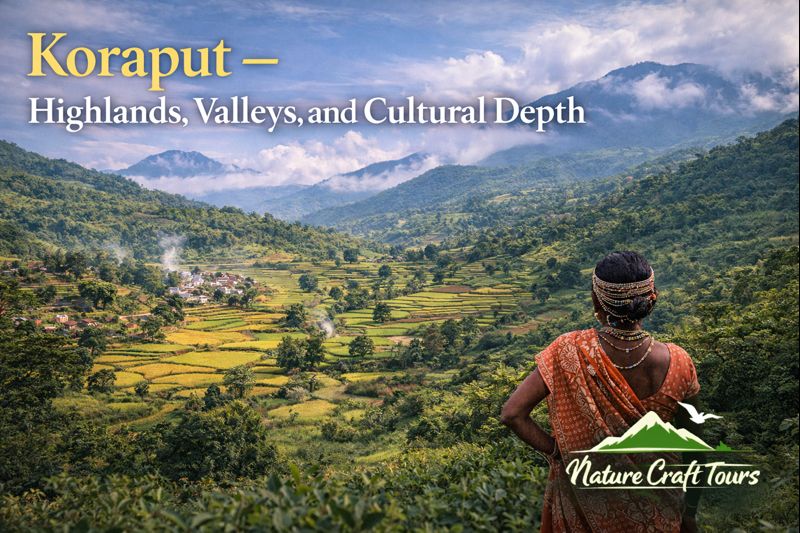
Koraput is not a destination that reveals itself through a single landmark or a neatly defined attraction. It is a region experienced through movement—along ridgelines and into valleys, through forests that thin and thicken with altitude, and across villages where cultural memory remains a lived reality rather than a museum artifact. Located in southern Odisha, Koraput represents one of eastern India’s most complex landscapes, where geography and human history are deeply interwoven.
The appeal of Koraput lies in its depth. The highlands offer sweeping views and cool air, the valleys hold rivers and agricultural terraces, and the cultural fabric is shaped by indigenous communities whose relationship with the land extends far beyond modern administrative boundaries. For the attentive traveler, Koraput is not simply visited; it is gradually understood.
Geographical Overview: The Eastern Ghats Highland Zone
Koraput district occupies a significant portion of the Eastern Ghats, a discontinuous mountain range that stretches across eastern India. Unlike the sharply rising Himalayas or the Western Ghats’ steep escarpments, the Eastern Ghats are older, weathered, and complex in structure. In Koraput, this translates into a landscape of rolling plateaus, forested hills, and deep, fertile valleys.
Elevations vary considerably, creating microclimates within short distances. Higher reaches remain cool and misty for much of the year, while lower valleys experience warmer temperatures and support diverse agricultural systems. Rivers originating in these highlands feed into larger river basins, making Koraput a crucial watershed region.
Koraput as a Cultural Landscape
Koraput is one of India’s most culturally rich regions, home to numerous indigenous communities whose traditions, languages, and livelihoods are closely tied to the land. These communities have shaped the region’s identity through sustainable farming practices, forest stewardship, and distinctive social structures.
Village life here follows seasonal rhythms rather than urban schedules. Agricultural cycles, forest produce collection, and local festivals define the calendar. This cultural continuity gives Koraput a sense of depth that cannot be replicated through surface-level tourism.
For visitors, engaging respectfully with this living culture requires patience and humility. Observation often reveals more than inquiry, and understanding grows slowly, much like the region itself.
Ecological Diversity and Natural Systems
Koraput’s ecological diversity is a direct result of its varied terrain. Dense forests cover many hill slopes, while valleys support mixed agriculture and grasslands. Seasonal streams carve through the landscape, feeding rivers that sustain both human settlements and wildlife.
Forest composition changes with elevation. Lower areas support mixed deciduous forests, while higher altitudes retain cooler, moisture-loving vegetation. This diversity allows a wide range of plant and animal species to coexist, often within short distances of one another.
Unlike heavily regulated wildlife reserves, much of Koraput’s ecology exists alongside human habitation. This coexistence has shaped a landscape where conservation is embedded in everyday practices rather than imposed externally.
Historical Layers and Regional Identity
Koraput’s history is not dominated by large empires or monumental architecture. Instead, it reflects localized governance, trade routes, and cultural exchange across the Eastern Ghats. The region has long served as a corridor between coastal Odisha and the Deccan plateau.
Colonial-era records often described Koraput as remote, yet this perceived isolation allowed many indigenous systems to remain intact. Post-independence development introduced roads and administrative structures, but much of the region’s traditional fabric endured.
This layered history gives Koraput a quiet resilience, evident in both landscape and people.
Experiencing Koraput: A Journey Through Space and Time
Travel in Koraput is experiential rather than itinerary-driven. Roads wind through hills and descend into valleys, offering changing perspectives at every turn. Views are expansive but never overwhelming, encouraging pauses rather than hurried movement.
For travelers familiar with environments shaped by water and tide—such as those explored during a Sundarban Tour—Koraput offers a contrasting inland narrative. Here, elevation and forest structure replace channels and mangroves, yet both landscapes demand attentiveness to natural rhythm.
Key Attractions and Regional Highlights
Koraput’s attractions are dispersed rather than concentrated. Scenic viewpoints appear unexpectedly along hill roads, while valleys reveal patchwork fields shaped by generations of cultivation. Weekly markets serve as cultural crossroads, bringing together communities from surrounding villages.
Waterfalls emerge during monsoon months, adding movement to the landscape. In drier seasons, rivers become accessible corridors for walking and observation. Each element contributes to a sense of layered discovery rather than checklist sightseeing.
Agricultural Systems and Indigenous Knowledge
Agriculture in Koraput reflects centuries of adaptation to terrain and climate. Terraced fields, mixed cropping, and seed diversity are common, supporting resilience against environmental variability.
Traditional crop varieties, some unique to the region, are cultivated alongside modern strains. This biodiversity has global significance, offering insights into sustainable food systems rooted in local knowledge.
For visitors, observing these practices provides a deeper understanding of how culture and ecology function as an integrated system.
Best Time and Season to Visit
Climate and Seasonal Experience
The most favorable time to visit Koraput is between October and February. During this period, temperatures remain moderate, skies are clear, and road conditions are reliable. The post-monsoon landscape retains greenery without excessive humidity.
Monsoon months bring dramatic transformation, with lush vegetation and flowing streams, but travel can be challenging due to rainfall. Summer months are warmer, particularly in lower valleys, though higher elevations remain relatively cool.
Ideal Travel Duration
Koraput rewards time investment. A minimum of three to four days allows for meaningful engagement with different landscapes and communities. Longer stays enable deeper immersion and reduce the temptation to rush between locations.
This is a region best explored slowly, allowing patterns and connections to emerge naturally.
Route and Accessibility
Koraput is accessible by road and rail, with connections from major cities in Odisha and neighboring states. The final approach often involves mountain roads that are scenic but require attentive driving.
Public transport options exist, though private travel provides greater flexibility for exploring remote areas and adjusting schedules based on weather and interest.
Practical Insights for Thoughtful Travel
Visitors should approach Koraput with respect for local customs and environmental limits. Photography should be undertaken with sensitivity, especially in village settings. Simple gestures of courtesy go a long way in fostering positive interactions.
Travelers should be prepared for limited urban amenities in rural areas. This limitation is part of Koraput’s character and contributes to its sense of authenticity.
Koraput in the Broader Context of Eastern India
Eastern India encompasses a wide range of landscapes, from coastal deltas to inland highlands. Koraput represents the elevated interior, where forests and valleys dominate. When viewed alongside journeys such as a Sundarban Tour Package from Kolkata, Koraput highlights the geographic and cultural diversity contained within the region.
These contrasts underscore the importance of understanding place-specific dynamics rather than applying uniform travel expectations.
Koraput as a Landscape of Continuity
Koraput is not defined by spectacle or rapid consumption. Its strength lies in continuity—of landforms shaped over geological time, of cultures rooted in ancestral knowledge, and of ecological systems that persist through careful coexistence.
For travelers seeking depth rather than distraction, Koraput offers a rare opportunity. It invites engagement with landscape as process and culture as living practice. In doing so, it stands as one of eastern India’s most quietly compelling regions, revealing its richness only to those willing to look beyond the surface.