Nalabana Bird Sanctuary Zone (Chilika)
— Seasonal Birding Focus
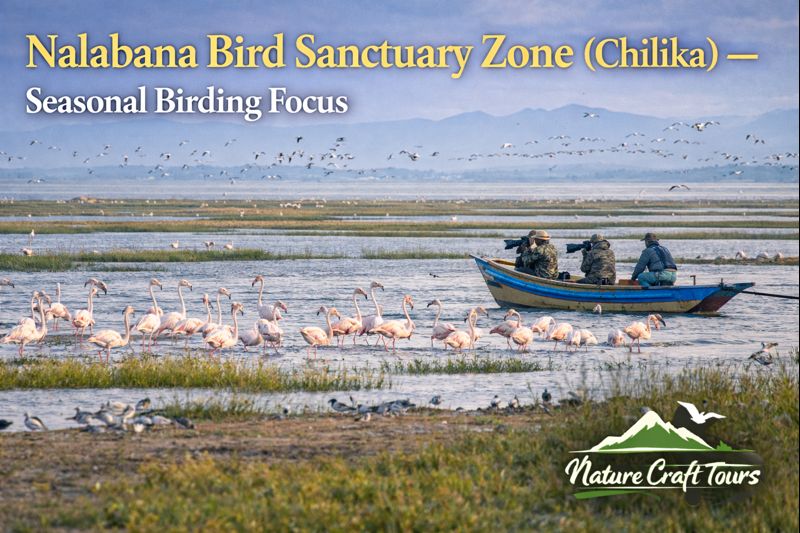
Nalabana is not merely a location within Chilika Lake; it is a seasonal phenomenon shaped by water, wind, and migration. Designated as a protected bird sanctuary at the heart of Asia’s largest brackish water lagoon, Nalabana functions as a living calendar of avian movement. Its character changes dramatically through the year—submerged during monsoon months, emergent and vibrant in winter, and gradually quietening as summer advances.
To understand Nalabana is to understand seasonality itself. This is not a destination defined by permanent structures or fixed landscapes, but by timing, hydrology, and ecological rhythm. For birdwatchers, naturalists, and reflective travelers, Nalabana offers one of eastern India’s most concentrated and disciplined birding experiences, where observation depends as much on patience and knowledge as on presence.
Geographical Context within Chilika Lagoon
Nalabana lies within the central sector of Chilika Lake, Odisha, occupying a low-lying island zone that becomes clearly visible only during certain months of the year. The name “Nalabana” itself refers to reed-covered land, a description that reflects both its vegetation and its transient nature.
Chilika Lake, spread across multiple districts, functions as a complex estuarine system where freshwater inflow from rivers meets saline water from the Bay of Bengal. Nalabana sits within this hydrological balance zone, receiving nutrients, sediments, and water level fluctuations that make it especially suitable for waterbirds.
Unlike the open lagoon or the outer channel near the sea mouth, Nalabana remains relatively sheltered, allowing shallow water, mudflats, and emergent vegetation to form critical feeding and roosting habitats.
Nalabana as a Seasonal Landscape
The most striking feature of Nalabana is its seasonal transformation. During the monsoon, the sanctuary is largely submerged, appearing as part of the open lagoon. As water levels recede post-monsoon, vast mudflats and reed beds emerge, creating ideal conditions for migratory birds arriving from Central Asia, Siberia, and parts of Europe.
This cyclical emergence and submergence prevent permanent human encroachment and agricultural use, preserving Nalabana’s ecological role. The landscape itself dictates behavior—of birds, of boats, and of visitors—making timing the single most important factor in planning a visit.
Bird Migration and Seasonal Arrival Patterns
Nalabana’s global importance lies in its role as a wintering ground. From late October onward, the sanctuary begins to receive migratory birds escaping harsh northern winters. These arrivals peak between December and January, when bird density reaches its highest.
Species diversity is remarkable, ranging from ducks and geese to waders, raptors, and shorebirds. Large congregations form on exposed mudflats, while reed beds offer shelter and nesting support for resident species.
As temperatures rise toward March, migratory populations gradually decline. By early summer, Nalabana transitions into a quieter phase, dominated by a smaller number of resident birds adapted to warmer conditions.
Ecological Importance of the Sanctuary Zone
Nalabana functions as a critical node in the Central Asian Flyway, supporting thousands of birds annually. Its shallow waters provide abundant plankton, mollusks, crustaceans, and aquatic vegetation, forming a reliable food base during the energetically demanding winter months.
The sanctuary also plays a role in regulating Chilika’s broader ecological health. By hosting large bird populations, it supports nutrient cycling and biological balance. Predatory birds help regulate fish and invertebrate populations, while grazing waterfowl influence vegetation structure.
This interconnectedness means Nalabana cannot be viewed in isolation; its health reflects the condition of the entire lagoon system.
Birdwatching Experience: Observation over Movement
Birding at Nalabana differs from forest or grassland birdwatching. Observation typically occurs from boats, with movement kept minimal to avoid disturbance. The experience is less about chasing species and more about positioning, waiting, and reading patterns of flight and feeding.
Early mornings offer the most rewarding conditions. Light is soft, water remains calm, and birds are actively feeding. Midday brings increased glare and reduced activity, while late afternoons may again see movement as birds regroup.
For travelers accustomed to dynamic wildlife encounters in tidal mangrove systems—such as those experienced during a Sundarban Tour—Nalabana offers a contrasting discipline. Here, stillness replaces motion, and distance replaces proximity.
Key Bird Groups and Seasonal Highlights
Nalabana is known for large congregations of waterfowl, particularly during peak winter months. Ducks, geese, and coots dominate open water zones, while waders occupy exposed flats.
Raptors are frequently observed patrolling the periphery, using thermal currents over the lagoon. Smaller birds inhabit reed margins, often overlooked by casual visitors but rewarding for attentive observers.
Rather than focusing on individual species, experienced birders often track behavior—flight formations, feeding strategies, and interspecies interactions—which reveal deeper ecological stories.
Cultural and Historical Relationship with Chilika
Local fishing communities have coexisted with Chilika’s seasonal rhythms for generations. Their traditional knowledge of water levels, bird behavior, and fish movement contributes indirectly to the sanctuary’s sustainability.
Nalabana’s protected status required careful negotiation to balance conservation with livelihood needs. Today, regulated access ensures minimal disturbance while allowing controlled tourism.
This coexistence underscores a broader truth: Nalabana’s success as a sanctuary depends as much on social understanding as on legal protection.
Best Time and Season for Birding
Peak Observation Window
The optimal period to visit Nalabana is between November and February. December and January represent peak density, with maximum species diversity and favorable weather conditions.
October may see early arrivals but limited visibility, while March marks the beginning of departure. Monsoon months are unsuitable for birding due to submergence and restricted access.
Ideal Travel Duration
A focused Nalabana birding visit typically requires half a day, ideally during early morning hours. However, travelers with deeper interest may benefit from a two-day stay in the Chilika region, allowing observation under varying light and weather conditions.
Extended stays also enable exploration of other lagoon sectors, offering comparative ecological perspectives.
Route and Accessibility
Nalabana is accessed by boat from designated Chilika entry points, most commonly near Barkul and surrounding jetties. Road connectivity from Bhubaneswar and other Odisha towns is reliable.
Boat travel is regulated within the sanctuary zone, with designated routes and observation distances maintained to protect bird populations.
Practical Insights for Responsible Birding
Visitors should maintain silence, avoid sudden movement, and respect viewing distances. Binoculars are essential; telephoto lenses should be used discreetly.
Bright clothing, loud conversation, or attempts to approach birds closely undermine the experience and disrupt ecological balance.
Nalabana rewards discipline. The more quietly one observes, the more the sanctuary reveals.
Nalabana in the Broader Wetland Context of India
India’s wetlands vary widely—from high-altitude lakes to mangrove deltas. Nalabana represents the lagoon-based wetland system, where salinity gradients and seasonal exposure define habitat.
When compared with mangrove-dominated ecosystems explored through experiences like a Sundarban Tour Package, Nalabana highlights how different hydrological regimes shape bird behavior and observation styles.
Both landscapes emphasize timing, patience, and respect for ecological limits.
Nalabana as a Discipline of Seasonality
Nalabana is not a place to be consumed quickly. It exists on nature’s schedule, not the visitor’s. Its birds arrive, gather, feed, and depart according to ancient migratory logic, indifferent to convenience or expectation.
For those willing to align with this rhythm, Nalabana offers clarity—about movement across continents, about the fragility of wetlands, and about the value of restraint in travel. It stands as one of India’s most precise birding landscapes, defined not by spectacle, but by seasonal focus and ecological integrity.