Baisipalli / Forest Buffer Experiences
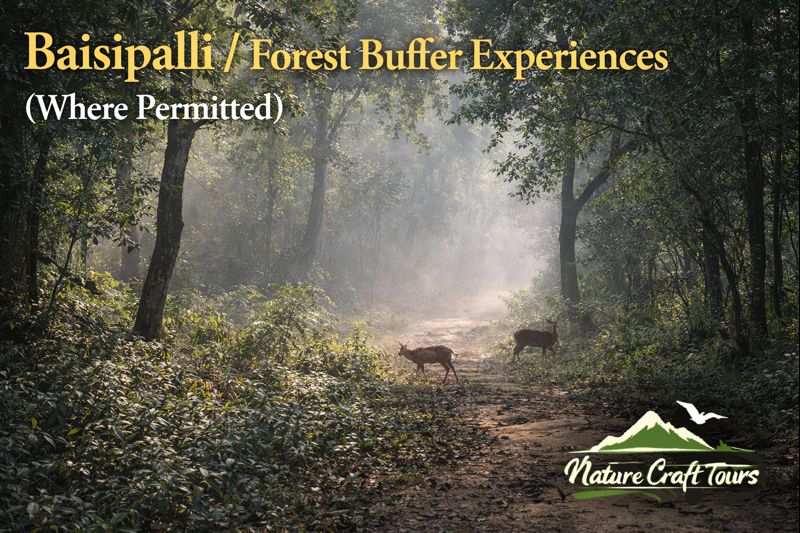
Baisipalli is not a destination defined by entry gates, safari circuits, or predictable wildlife encounters. It exists in the quieter margins of Odisha’s forest geography, functioning as a transitional landscape between strictly protected wilderness and lived human terrain. Known primarily as a forest buffer zone adjoining larger conservation areas, Baisipalli represents a form of travel that is conditional, regulated, and deeply contextual.
To explore Baisipalli is to understand what lies between protection and presence. These forests are not untouched, yet they are not exhausted. Paths are shaped by forest use rather than tourism design, and experiences depend heavily on permission, season, and ecological sensitivity. For travelers willing to approach nature with restraint and awareness, Baisipalli offers something increasingly rare: an opportunity to engage with forest environments as evolving systems rather than curated attractions.
Understanding Baisipalli as a Forest Buffer Landscape
Baisipalli occupies a critical position within Odisha’s forest network, functioning as a buffer zone that absorbs ecological pressure from surrounding human settlements while supporting the integrity of core wildlife habitats. Unlike national parks or sanctuaries with fixed tourism infrastructure, buffer areas like Baisipalli operate under flexible management frameworks.
These zones allow limited, regulated activities—such as controlled forest access, seasonal grazing, and low-impact movement—while restricting intensive development. The goal is not exclusion, but moderation. Baisipalli’s forests thus reflect a balance between conservation needs and community realities, making them ecologically significant and socially complex.
This intermediate status defines the nature of experiences available here. Travel is shaped less by fixed itineraries and more by conditions on the ground.
Geographical Setting and Forest Composition
Baisipalli lies within the broader Eastern Ghats forest belt, characterized by undulating hills, shallow valleys, and seasonal watercourses. The terrain is neither flat nor extreme, but gently complex, creating a mosaic of forest types that shift with elevation, slope, and moisture availability.
The dominant vegetation is dry and mixed deciduous forest, interspersed with patches of bamboo, scrub, and grassland. During monsoon months, the forest becomes dense and layered, while the dry season opens visibility as leaf fall reduces canopy cover.
Seasonal streams cut through the landscape, shaping movement corridors for wildlife and influencing plant distribution. These streams may appear insignificant for much of the year, yet they play a decisive role in sustaining forest life.
Ecological Role of Buffer Zones
Forest buffer zones like Baisipalli serve multiple ecological functions. They reduce edge effects on core wildlife habitats by providing additional space for animal movement and dispersal. They also act as shock absorbers, mitigating the impact of human activity on sensitive ecosystems.
Many species use buffer forests for foraging, seasonal migration, or refuge during periods of disturbance. The relative openness of such areas allows for adaptive behavior, supporting resilience at the landscape level.
In this sense, Baisipalli should not be viewed as secondary or peripheral. Its ecological value lies precisely in its role as a connector and moderator.
Forest Use, Community Presence, and Cultural Context
Human presence in and around Baisipalli is longstanding and functional rather than extractive. Local communities rely on forests for seasonal produce, minor forest resources, and cultural practices linked to land and climate cycles.
These relationships are governed by customary knowledge and evolving regulation. Forest use is neither unrestricted nor entirely prohibited; it adapts according to conservation priorities, resource availability, and administrative guidelines.
Cultural practices associated with forest edges—such as seasonal movement, ritual observance, and oral knowledge of terrain—continue to shape how the landscape is understood and navigated.
Experiencing Baisipalli: Conditions, Not Promises
Travel in Baisipalli is conditional by design. Access depends on current forest regulations, seasonal sensitivity, and local permission structures. This uncertainty is not a limitation, but a defining feature of the experience.
Unlike fixed safari zones, forest buffer experiences emphasize walking, observation, and awareness rather than pursuit. Wildlife encounters are possible but never guaranteed, and the emphasis shifts from sightings to understanding habitat and movement.
For travelers accustomed to structured wildlife itineraries—such as those associated with a Sundarban Tour—Baisipalli offers a contrasting philosophy. Here, the forest sets the terms, and the visitor adapts accordingly.
Permitted Activities and Low-Impact Exploration
Where permitted, exploration in Baisipalli may include guided forest walks, nature interpretation sessions, and observational excursions along forest tracks. These activities are designed to minimize disturbance and maximize learning.
Walking through buffer forests reveals subtle indicators of ecological health—animal tracks, feeding signs, vegetation transitions—that are often overlooked in faster forms of travel. Sound becomes an important guide, with bird calls and insect activity signaling seasonal change.
The absence of mechanized tourism allows for a more intimate engagement with the environment.
Wildlife Presence and Behavioral Patterns
Baisipalli supports a range of wildlife species that utilize buffer zones for movement and foraging. These areas are particularly important during transitional seasons, when animals shift between core habitats and surrounding landscapes.
Because human presence is low-intensity and familiar, wildlife behavior here can differ from that observed in heavily visited reserves. Animals may display cautious tolerance rather than immediate flight, offering insight into coexistence dynamics.
Birdlife is often more conspicuous, especially in edge habitats where forest meets open ground or watercourses.
Seasonal Dynamics and Forest Change
Seasonality profoundly shapes the Baisipalli experience. During monsoon months, dense foliage, saturated ground, and heightened insect activity transform the forest into a closed, immersive environment. Access may be restricted to protect soil and vegetation.
Post-monsoon and winter months bring clarity. Trails become more accessible, visibility improves, and wildlife movement becomes easier to interpret. This period is generally the most suitable for permitted exploration.
Summer introduces heat stress and reduced water availability, concentrating animal activity near remaining water sources and shaded zones.
Best Time and Season to Travel
Balancing Access and Ecology
The most appropriate time to explore Baisipalli, where permitted, is between November and February. During this window, forest conditions are stable, temperatures are moderate, and ecological disturbance is minimal.
Travel during monsoon is generally discouraged due to both conservation concerns and safety considerations. Summer visits require careful timing and physical preparedness.
Ideal Travel Duration
Baisipalli is not suited to hurried visits. A minimum of one to two days allows for orientation, guided exploration, and observation under different light and temperature conditions.
Longer stays may be appropriate for those interested in ecological study, forest interpretation, or slow travel approaches, provided permissions allow.
Route and Accessibility
Baisipalli is accessed via regional road networks connecting interior Odisha districts. Final approaches often involve narrow roads or forest tracks, the condition of which varies by season.
Because access regulations may change, travel planning should remain flexible and informed by local guidance. The absence of standardized tourism infrastructure reinforces the need for preparedness and adaptability.
Practical Insights for Responsible Forest Travel
Visitors should approach Baisipalli with a mindset of respect and restraint. Noise should be minimized, movement kept deliberate, and all waste carried out.
Clothing should be neutral in color and suited to variable conditions. Footwear must support uneven terrain. Most importantly, visitors should be willing to turn back if conditions or permissions change.
Forest buffer experiences are privileges, not entitlements.
Comparative Perspective: Buffer Forests and Indian Landscapes
India’s conservation geography includes core protected areas, buffer zones, and human-dominated landscapes. Each plays a distinct role in ecological continuity.
When contrasted with highly structured ecosystems such as deltaic mangrove regions explored through a Sundarban Tour Package, Baisipalli highlights the importance of intermediate spaces where flexibility and coexistence are central.
These buffer landscapes often determine the success or failure of broader conservation efforts.
Why Baisipalli Matters Beyond Tourism
Baisipalli’s significance extends beyond visitor experience. As a forest buffer, it represents an evolving model of land management where conservation is negotiated rather than imposed.
The lessons embedded here—about shared responsibility, adaptive regulation, and ecological humility—are increasingly relevant in a world where strict boundaries between nature and society are difficult to maintain.
Travelers who engage thoughtfully with such landscapes become witnesses to conservation in practice, not theory.
Baisipalli as a Landscape of Permission and Restraint
Baisipalli does not offer certainty, spectacle, or convenience. What it offers instead is authenticity—an encounter with forest systems that are alive, negotiated, and responsive.
For those willing to accept limitation as part of the experience, Baisipalli reveals the deeper logic of conservation landscapes. It teaches that access must sometimes yield to protection, and that meaningful travel often begins where expectations are softened.
In engaging with Baisipalli responsibly, visitors participate in a broader ethic of coexistence—one where forests are not consumed, but approached with care, patience, and respect.