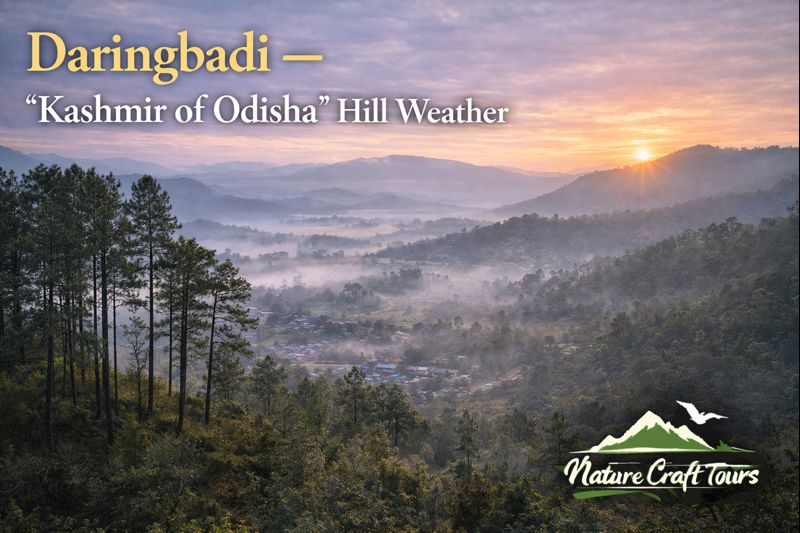
Daringbadi occupies a unique climatic and cultural position in eastern India. Perched high in the Eastern Ghats of southern Odisha, this small hill town is shaped less by monuments and more by atmosphere. Cool air drifts across pine-covered slopes, mist gathers unexpectedly in the afternoons, and winter nights can turn sharply cold—an anomaly in a state otherwise known for tropical heat. It is this contrast that has earned Daringbadi its widely used epithet, the “Kashmir of Odisha,” a comparison rooted not in landscape similarity but in temperature, seasonal rhythm, and emotional relief.
Yet Daringbadi is not an imitation of any northern hill station. Its identity is distinct, formed by plateau forests, tribal hinterlands, and a pace of life that reflects remoteness rather than resort culture. To understand Daringbadi is to engage with hill weather as a shaping force—on crops, settlement patterns, movement, and memory. This is a destination where climate itself becomes the primary attraction, quietly influencing every aspect of the travel experience.
Geographical Setting: Eastern Ghats Highland Plateau
Daringbadi is located in Kandhamal district, within the Eastern Ghats mountain system. Unlike the sharply folded Himalayas, the Eastern Ghats are ancient and eroded, forming rounded hills, elevated plateaus, and gently descending valleys. Daringbadi sits at an altitude of approximately 915 meters above sea level, high enough to produce markedly cooler conditions than the surrounding plains.
The town is surrounded by forested slopes, agricultural clearings, and seasonal streams that flow toward larger river systems. This geography allows cold air to settle at night and mist to form easily during early mornings and late afternoons. The absence of dense urban development helps preserve these microclimatic conditions, making Daringbadi one of the few places in Odisha where temperatures can approach freezing during winter nights.
Why “Kashmir of Odisha”: Climate, Not Comparison
The nickname “Kashmir of Odisha” often leads to misconceptions. Daringbadi does not resemble Kashmir in terrain, vegetation, or scale. What it shares is climatic contrast. In winter, temperatures can drop close to zero degrees Celsius, occasionally producing frost—an extremely rare phenomenon in eastern India.
This cold weather shapes daily routines. Locals adjust agricultural cycles, clothing, and housing styles to accommodate seasonal chill. For visitors from the plains, the experience of cold mornings, visible breath, and mist-laden valleys feels strikingly unfamiliar within an Odishan context.
The comparison persists because it captures emotional impact rather than physical similarity. Daringbadi feels unexpected.
Seasonal Weather Patterns and Hill Climate
Weather defines Daringbadi more strongly than any single landmark. Summers remain mild, with daytime temperatures rarely matching the heat of coastal or central Odisha. Even during peak summer months, evenings are cool, often requiring light layers.
The monsoon transforms the landscape dramatically. Rainfall is abundant, turning forests deep green and feeding numerous small waterfalls. Cloud cover increases, visibility fluctuates, and travel can slow due to wet roads and fog.
Winter is Daringbadi’s defining season. From November through February, temperatures drop steadily, and January often brings the coldest nights. Early mornings may reveal frost on grass, a sight that feels almost surreal in this part of India.
Forest Cover and Ecological Character
Daringbadi is surrounded by mixed forest types, including pine plantations, sal forests, and patches of evergreen vegetation in moisture-retaining zones. Pine trees, though not native to all parts of Odisha, have become visually associated with Daringbadi, reinforcing its hill-station image.
These forests play a crucial role in maintaining the local climate. Canopy cover reduces daytime heating, while forested slopes trap cool air at night. The ecological system also supports diverse birdlife, insects, and small mammals adapted to cooler conditions.
The forest environment remains relatively intact due to limited large-scale development, allowing ecological processes to function with minimal disruption.
Cultural Landscape and Tribal Hinterland
Daringbadi lies within a region inhabited by indigenous communities whose livelihoods are closely tied to land, forest, and climate. Agriculture here differs from lowland Odisha, with crops selected for cooler temperatures and shorter growing seasons.
Traditional knowledge governs sowing cycles, forest use, and seasonal movement. Cultural practices reflect respect for climate variability, particularly the challenges posed by cold winters and heavy monsoon rains.
This cultural depth adds a layer of meaning to travel in Daringbadi, reminding visitors that hill weather shapes not only comfort but survival strategies.
Experiencing Daringbadi: Stillness Over Activity
Daringbadi does not demand constant activity. Its appeal lies in walking through cool air, watching clouds move across ridges, and observing subtle changes in light and temperature. Viewpoints offer wide horizons rather than dramatic peaks, reinforcing a sense of openness.
Travelers familiar with water-driven ecosystems—such as those explored during a Sundarban Tour—will find Daringbadi’s rhythm distinctly different. Here, elevation replaces tide as the controlling factor, and temperature replaces salinity as the defining environmental variable.
The experience encourages slowing down rather than filling time.
Key Attractions and Natural Highlights
Daringbadi’s attractions are understated and dispersed. Hilltop viewpoints reveal rolling terrain fading into haze. Pine forests create shaded walking routes, particularly inviting during summer afternoons.
Seasonal waterfalls appear during monsoon months, offering brief but dramatic displays. Agricultural landscapes surrounding the town provide insight into how hill communities adapt farming to climate.
Rather than iconic landmarks, Daringbadi offers coherence—a sense that weather, forest, and settlement belong together.
Agriculture, Crops, and Climate Adaptation
Farming around Daringbadi reflects careful adaptation to cooler temperatures. Crops such as turmeric, ginger, and certain vegetables thrive in these conditions. Sloped fields and terraced plots manage water runoff during heavy rains.
The agricultural calendar differs from that of coastal Odisha, highlighting how even modest elevation can create distinct economic systems. Observing these practices adds depth to understanding the region’s resilience.
Best Time and Season to Travel
Choosing Weather Over Convenience
The best time to visit Daringbadi depends on the desired experience. Winter months, particularly December and January, offer the coldest conditions and the strongest contrast with the plains. This period appeals to travelers seeking the “Kashmir of Odisha” effect.
Summer months from March to May provide comfortable temperatures and clear views, making them ideal for relaxed exploration. Monsoon season, while visually rich, requires caution due to rain and reduced visibility.
Ideal Travel Duration
Daringbadi is best experienced over two to three days. This allows time to observe daily temperature cycles, explore surrounding forests, and adjust to the slower pace of hill life.
Shorter visits risk reducing the experience to a checklist of viewpoints, missing the atmospheric continuity that defines the destination.
Route and Accessibility
Daringbadi is accessible by road from major towns in southern Odisha. The approach involves gradual ascent through forested terrain, with temperatures cooling noticeably as elevation increases.
Road conditions are generally stable outside the monsoon, though fog and mist can affect visibility during winter mornings and rainy periods. Travel planning should account for slower driving conditions in hill sections.
Practical Insights for Hill Travel
Visitors should prepare for temperature variation, carrying warm layers even during warmer months. Winter visits require proper cold-weather clothing, particularly for early mornings and nights.
Fog can appear suddenly, affecting movement and visibility. Travelers should remain flexible with schedules and avoid night driving in unfamiliar hill terrain.
Daringbadi rewards preparedness rather than spontaneity.
Daringbadi in the Broader Context of Eastern India
Eastern India is often associated with plains, rivers, and deltas. Hill regions like Daringbadi challenge this perception, demonstrating how elevation reshapes climate, ecology, and culture within relatively short distances.
When contrasted with humid, water-dominated landscapes explored through a Sundarban Tour Package, Daringbadi illustrates the climatic diversity contained within the region.
Such contrasts enrich travel understanding beyond surface-level geography.
Why Daringbadi Endures
Daringbadi’s appeal has endured precisely because it has avoided excessive transformation. There are no sprawling resorts or crowded promenades. The town remains shaped by weather, forest, and everyday life rather than large-scale tourism design.
This restraint preserves authenticity. Visitors encounter a place that exists for itself first, and for travelers second.
Hill Weather as Identity
Daringbadi is ultimately a study in how climate defines place. Its cool air, misty mornings, and cold winters shape landscape, livelihood, and memory. The title “Kashmir of Odisha” endures because it captures surprise—the realization that such weather exists here at all.
For travelers seeking contrast rather than spectacle, Daringbadi offers a rare experience. It invites engagement with atmosphere rather than activity, and with continuity rather than novelty.
In a region better known for heat and humidity, Daringbadi stands quietly apart—a reminder that geography often hides its most intriguing variations in plain sight, waiting for those willing to slow down and feel the weather change.