Niyamgiri Foothill Landscapes
— Forested Slopes, Sacred Valleys, and Living Highlands
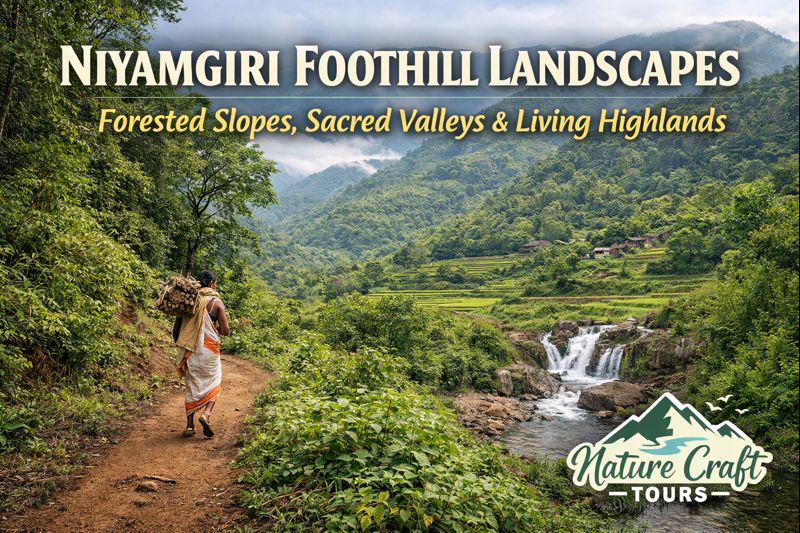
The Niyamgiri foothills form one of the most complex and symbolically charged landscapes in eastern India. Spread across the borderlands of southern Odisha, these foothills are neither merely transitional zones nor simple buffer regions between plains and peaks. They are living landscapes in their own right—where dense forests thin into cultivated clearings, sacred streams descend into agrarian valleys, and cultural memory is embedded into every ridge, grove, and pathway.
Unlike destinations defined by visual spectacle alone, the Niyamgiri foothill landscapes reveal their meaning gradually. The traveller encounters them not through dramatic summits but through layered encounters: a forest road bending around a sal-covered slope, a weekly market at the edge of cultivation, a stream revered as a living ancestor, or a village path that doubles as a ritual boundary. To explore the foothills of Niyamgiri is to enter a terrain where ecology, belief, and livelihood remain inseparable.
Destination Overview: Understanding the Niyamgiri Foothill Zone
The Niyamgiri range rises sharply from the surrounding plains of Kalahandi and Rayagada districts, forming a compact but ecologically dense hill system within the Eastern Ghats. While the upper ridges and forested summits often draw attention, the foothill landscapes represent the most dynamic interface between mountain and lowland environments.
These foothills extend outward as undulating slopes, narrow valleys, and forested terraces that gradually descend toward agricultural plains. Elevation varies between approximately 300 and 700 metres, creating a mosaic of microclimates. Moist valleys support paddy cultivation and perennial streams, while drier slopes host millet fields, fruit trees, and secondary forests.
Administratively, the foothill region spans parts of Muniguda, Bissam Cuttack, Lanjigarh, and adjacent blocks. Culturally and ecologically, however, the area functions as a continuous landscape shaped by shared water systems, forest usage patterns, and ritual geographies rather than by district boundaries.
Landscape Character: Where Mountains Meet Daily Life
The defining feature of the Niyamgiri foothills is gradual transition. Unlike abrupt escarpments, these slopes allow human settlement to adapt incrementally to changing terrain. Villages are typically positioned along contour lines, balancing access to forest resources above and cultivable land below.
Forests here are predominantly mixed deciduous, with sal, mahua, bamboo, and fruit-bearing trees forming layered canopies. Seasonal changes are pronounced. During the monsoon, the foothills turn intensely green, streams overflow their banks, and footpaths soften into red laterite mud. In winter, the landscape opens visually, revealing terraced fields, rocky outcrops, and distant ridge lines.
For travellers, this gradualness allows immersive movement. Short walks from villages often traverse multiple ecological zones, making the foothills ideal for slow exploration rather than destination-driven sightseeing.
Cultural Landscape: Sacred Geography and Community Memory
The foothills of Niyamgiri are not culturally neutral terrain. For indigenous communities, particularly the Dongria Kondh and Kutia Kondh, these slopes represent ancestral space rather than peripheral land. Sacred groves, stream origins, and forest clearings form an interconnected ritual map.
Every valley and slope carries meaning. Certain trees mark clan histories, while specific streams are associated with seasonal rites linked to agriculture and fertility. Unlike monument-based heritage, this cultural geography remains embedded in everyday practice—maintained through movement, cultivation, and oral transmission.
Agriculture as Cultural Expression
Agriculture in the foothills is both economic activity and cultural practice. Mixed cropping systems dominate, combining millets, pulses, oilseeds, and seasonal vegetables. Terraced fields follow natural contours rather than imposed geometries, reflecting an intimate understanding of soil retention and water flow.
Harvest periods coincide with ritual cycles, reinforcing collective memory through shared labour and celebration. For the observant traveller, these patterns provide insight into how subsistence strategies sustain both ecology and identity.
Ecological Significance of the Foothill Zone
Ecologically, the Niyamgiri foothills serve as critical buffers between high-altitude forests and lowland agricultural plains. They regulate water flow, reduce soil erosion, and support biodiversity that depends on transitional habitats.
Numerous perennial streams originate in the higher slopes and gather momentum through foothill valleys. These watercourses sustain not only local agriculture but also downstream ecosystems far beyond the immediate region. The foothills therefore play a disproportionate role in regional hydrology.
Wildlife presence is subtle rather than conspicuous. Small mammals, reptiles, and diverse bird species are commonly encountered, particularly near forest edges and water sources. The relative continuity of forest cover allows ecological processes to function without sharp fragmentation.
Key Attractions and Experiential Highlights
The appeal of the Niyamgiri foothill landscapes lies less in named attractions and more in experiential moments. However, several recurring features shape meaningful itineraries.
Forest Roads and Foot Trails
Narrow forest roads trace the lower slopes of the hills, often following older foot routes used for generations. These roads provide access to multiple villages and valleys while offering uninterrupted forest views. Traffic remains minimal, allowing travellers to pause frequently and explore side trails.
Seasonal Streams and Water Crossings
Small streams crisscross the foothills, swelling during the monsoon and receding into clear pools during winter. Many of these crossings double as communal gathering points, washing areas, or ritual sites. Their seasonal variability adds a temporal dimension to travel planning.
Weekly Markets at the Foothill Edge
Markets situated where foothills meet plains act as economic and social bridges. Forest produce, hill-grown crops, and lowland goods converge here, making these markets valuable sites for understanding exchange systems and cultural interaction.
Best Time and Season to Travel
The most suitable period to explore the Niyamgiri foothill landscapes is between October and February. Post-monsoon months reveal the region at its most balanced, with flowing streams, stable roads, and active agricultural cycles. Temperatures remain moderate, making walking and outdoor exploration comfortable.
The monsoon season from July to September transforms the foothills into a vibrant green corridor, but travel becomes challenging due to slippery paths and stream crossings. Summer months are drier and warmer, particularly in lower elevations, though mornings and evenings remain pleasant.
Ideal Travel Duration and Pace
A minimum of three to four days is recommended to experience the foothill landscapes meaningfully. This duration allows travellers to move between multiple valleys, observe agricultural practices, and engage with local rhythms without haste.
Those interested in deeper cultural or ecological observation may extend their stay to five or six days. The foothills reward slow movement, repeated encounters, and unstructured time.
Route and Accessibility
The foothill region is accessible via road from major towns such as Rayagada and Bhawanipatna. Rail connectivity exists to nearby hubs, from where secondary roads branch toward interior foothill villages.
Public transport operates on limited schedules, making private vehicles the most practical option for flexible exploration. Fuel and basic supplies are available in block towns, but travellers should plan carefully when moving deeper into forested zones.
Comparative Landscape Context
Travellers familiar with other Indian ecological regions may find it useful to place Niyamgiri’s foothills within a broader frame. Just as a Sundarban Tour reveals life shaped by tides, mangroves, and shifting river channels, the Niyamgiri foothills demonstrate how upland communities adapt to gradients, forests, and seasonal water flow. Both landscapes demand attentiveness rather than hurried consumption.
Practical Insights for Responsible Travel
Travellers should approach the foothills with cultural sensitivity and ecological awareness. Many areas hold ritual significance, and access may be regulated informally through community norms. Seeking local guidance is essential for navigating paths, understanding boundaries, and ensuring respectful conduct.
Essential supplies, including water and basic medical items, should be carried. Communication networks can be inconsistent in interior valleys. Photography should be undertaken thoughtfully, particularly around sacred sites and village spaces.
Those accustomed to structured nature itineraries such as a Sundarban Tour Package will find the Niyamgiri foothills notably different. Here, engagement replaces itinerary, and observation replaces spectacle.
Historical Context and Contemporary Relevance
Historically, the foothills functioned as zones of movement and negotiation—between hill communities and plains-based polities, between forest economies and agrarian systems. Colonial administrative boundaries attempted to formalise these zones, but traditional movement patterns persisted.
In contemporary times, the foothills remain central to discussions around land use, conservation, and indigenous rights. Understanding this region therefore requires sensitivity to both historical continuity and ongoing social dynamics.
Reading the Foothills as Living Landscapes
The Niyamgiri foothill landscapes resist simplification. They are neither wilderness nor village hinterland, neither purely sacred nor purely economic. Instead, they represent a living continuum where slopes, streams, forests, and communities shape one another daily.
For the traveller willing to slow down, listen, and observe, these foothills offer a rare opportunity to experience a landscape still governed by relational balance rather than extractive logic. To walk these slopes is not merely to move through space, but to engage with a cultural and ecological system that remains deeply alive.