Kaas Plateau (Satara)
— UNESCO-Linked Western Ghats Flower Plateau:
A Field-Based Travel Chronicle
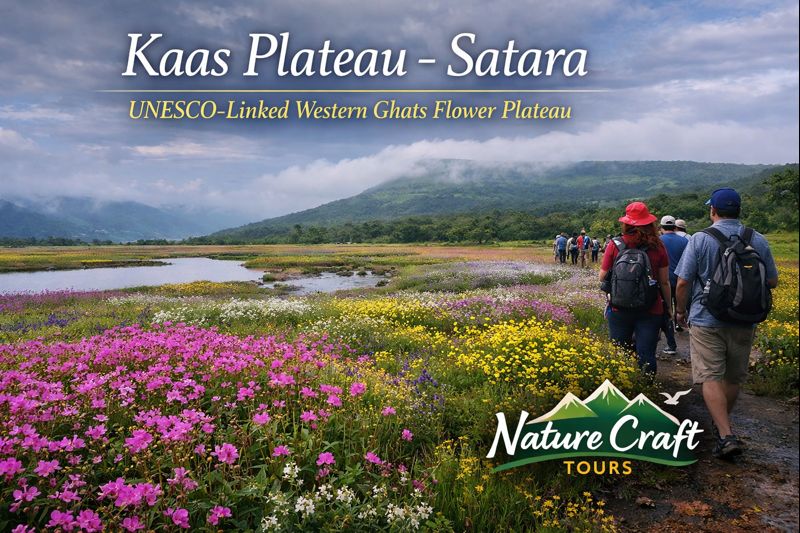
High on the basaltic tablelands of the northern Western Ghats, far removed from crowded hill stations and engineered viewpoints, lies Kaas Plateau near Satara in Maharashtra. Often described in passing as a “valley of flowers,” Kaas is, in reality, something far rarer and scientifically significant—a seasonal ecological event shaped by geology, monsoon rhythms, and evolutionary isolation. This plateau is not merely a scenic destination; it is a living laboratory of endemic flora, a fragile high-altitude grassland system, and a formally recognized extension of the Western Ghats biodiversity hotspot that has earned global conservation attention.
To travel to Kaas is to encounter a landscape that exists for only a few weeks each year in its most spectacular form. Outside the monsoon bloom, the plateau appears austere, almost minimalistic. Yet with the arrival of seasonal rains, dormant seeds awaken, and the ground transforms into a mosaic of colors—purples, yellows, whites, and pinks—each patch representing a distinct plant community adapted to thin soil, lateritic rock, and intense climatic stress. This article documents Kaas Plateau not as a postcard destination, but as an ecological and experiential journey shaped by timing, restraint, and observation.
Geographical and Geological Overview of Kaas Plateau
Kaas Plateau is situated approximately 25 kilometers west of Satara town, at an average elevation of around 1,200 meters above sea level. Geologically, the plateau is part of the Deccan Traps, a vast volcanic province formed by successive basaltic lava flows millions of years ago. The resulting lateritic crust creates a hard, iron-rich surface with extremely shallow soil depth, often no more than a few centimeters thick.
This geological limitation is precisely what defines Kaas’s botanical uniqueness. Trees struggle to establish themselves, leaving the plateau dominated by seasonal herbs, grasses, and insectivorous plants. Waterlogging during monsoon months and extreme dryness during summer create a narrow ecological window where only highly specialized species can survive. Many of these species are endemic, meaning they are found nowhere else on Earth.
Administratively, Kaas Plateau falls within the Satara district of Maharashtra and forms part of the larger Kaas–Patan region. The plateau and its surrounding catchment areas contribute to the headwaters of several small streams that ultimately feed the Krishna River system, underscoring its hydrological importance.
UNESCO Recognition and Western Ghats Significance
Kaas Plateau gained international recognition when it was included as a component of the Western Ghats serial property inscribed on the UNESCO World Heritage List. While Kaas itself is not a standalone UNESCO site, it is formally acknowledged as part of the Western Ghats ecological complex—one of the world’s eight “hottest hotspots” of biological diversity.
The Western Ghats, stretching parallel to India’s western coastline, are older than the Himalayas and host a remarkable concentration of endemic species. Kaas represents the high-altitude lateritic plateau ecosystem within this broader landscape, a habitat type that is both rare and severely threatened by human interference. UNESCO recognition has brought increased attention to conservation planning, visitor regulation, and long-term ecological monitoring in the region.
For the informed traveler, this designation adds a layer of responsibility. Visiting Kaas is not about consumption of scenery but participation in a carefully managed ecological zone where every footstep matters.
Seasonal Transformation and Best Time to Visit
Monsoon Bloom Cycle
The flowering season of Kaas Plateau typically begins in late August and continues through September, sometimes extending into early October depending on monsoon intensity. Unlike alpine meadows that bloom gradually, Kaas operates on a rapid ecological clock. Different species bloom in succession, each lasting only a few days to a week.
Early in the season, one encounters carpets of ground-hugging blossoms such as Smithia and Utricularia species. As the weeks progress, taller flowering plants emerge, creating layered color patterns across the plateau. By late September, the density of blooms begins to thin, replaced by seed formation and gradual dormancy.
Ideal Travel Window
The most reliable window for first-time visitors is between the first week of September and the third week of the month. During this period, floral diversity is at its peak, accessibility is generally manageable, and conservation authorities actively regulate visitor movement. Outside the monsoon season, Kaas remains open but offers a vastly different, subdued landscape that appeals primarily to researchers and solitude seekers.
Ideal Travel Duration and Planning Rhythm
A well-paced visit to Kaas Plateau requires at least one full day, ideally complemented by an additional day to explore the surrounding Satara region. Rushing through Kaas diminishes the experience, as the plateau rewards slow observation rather than hurried sightseeing.
An ideal itinerary includes an early morning arrival to avoid peak crowds, several hours of walking along designated pathways, and time allocated for interpretation—either through guided walks or personal study. Travelers interested in comparative ecosystems may extend their stay to include nearby plateaus such as Thoseghar or Chalkewadi, each offering different hydrological and geological contexts.
Route and Accessibility from Major Cities
Satara serves as the primary gateway to Kaas Plateau. The town is well-connected by road and rail to major urban centers such as Pune, Kolhapur, and Mumbai. From Satara, a state highway leads westward toward Kaas Lake and the plateau entrance.
Road conditions vary with monsoon intensity. While the main access road is generally motorable, fog, reduced visibility, and occasional waterlogging are common during peak flowering season. Travelers are advised to begin their journey early in the day and avoid night driving in the region.
Public transport options exist but are limited during the monsoon. For those accustomed to nature travel in remote regions—whether exploring mangrove deltas during a Sundarban Trip or navigating plateau roads in the Western Ghats—self-planned road journeys offer the most flexibility.
Floral Diversity and Botanical Highlights
Over 850 species of flowering plants have been recorded in and around Kaas Plateau, including orchids, insectivorous plants, legumes, and grasses. Many of these species are endemic to the Western Ghats, with several restricted exclusively to lateritic plateaus.
One of the most scientifically intriguing aspects of Kaas is the presence of carnivorous plants such as bladderworts (Utricularia), which thrive in nutrient-poor soils by supplementing their diet with microscopic organisms. Equally fascinating are the ephemeral orchids that bloom briefly before disappearing entirely until the next monsoon.
Botanical researchers often note that Kaas cannot be understood through photographs alone. Plant identification requires close examination, seasonal knowledge, and awareness of microhabitats—rock depressions, shallow streams, and moss-covered patches each host distinct plant assemblages.
Faunal Presence and Ecological Interactions
While Kaas is primarily celebrated for its flora, the plateau also supports a range of insects, amphibians, reptiles, and birds that are intricately linked to the flowering cycle. Butterflies, bees, and beetles play critical roles in pollination, while frogs and toads emerge in abundance during the rains.
Birdlife is more prominent along the plateau edges and near Kaas Lake, where wetland species coexist with grassland birds. The relative absence of large mammals contributes to the plateau’s delicate balance, allowing plant communities to regenerate without heavy grazing pressure.
Cultural and Historical Context of the Satara Region
The cultural landscape surrounding Kaas Plateau is deeply rooted in the history of the Maratha kingdom. Satara was once the seat of power for the Maratha rulers, and remnants of this legacy are visible in nearby forts, temples, and traditional villages.
Local communities have long recognized the seasonal importance of the plateau, traditionally restricting grazing during the monsoon to allow grass regeneration. This indigenous ecological knowledge aligns closely with modern conservation principles, highlighting the role of cultural practices in landscape preservation.
Visitor Regulation and Conservation Ethics
Due to increasing popularity, Kaas Plateau operates under a regulated entry system during peak flowering season. Visitor numbers are capped daily, and movement is restricted to designated pathways to minimize trampling of sensitive vegetation.
Travelers familiar with fragile ecosystems—whether in coral atolls, high-altitude deserts, or riverine mangroves such as those explored through a Best Sundarban Tour Package—will recognize the necessity of such controls. Conservation at Kaas is not theoretical; it is a daily, practical challenge.
Photography is permitted but must be conducted responsibly. The temptation to step off pathways for the perfect shot has caused irreversible damage in the past, prompting stricter enforcement in recent years.
Practical Insights for Responsible Travelers
Kaas Plateau demands preparation rather than luxury. Footwear with good grip is essential due to slippery laterite surfaces. Weather conditions can change rapidly, making rain protection and layered clothing advisable even on seemingly clear days.
Food options near the plateau are limited and basic. Travelers are encouraged to carry minimal packaged snacks and water while ensuring all waste is carried back. Accommodation is best arranged in Satara or nearby villages, keeping overnight impact away from the plateau itself.
Perhaps the most important preparation is mental. Kaas is not an amusement park or a quick-stop attraction. It is a place of observation, patience, and humility—a landscape that reveals its complexity only to those willing to slow down.
Kaas as a Living Seasonal Phenomenon
Kaas Plateau stands as a reminder that some of the most extraordinary travel experiences are not permanent monuments but fleeting natural events. Its flowers bloom, fade, and vanish within weeks, leaving behind a quiet plateau that waits patiently for the next monsoon.
To witness Kaas at its peak is to understand the Western Ghats not as a static mountain range but as a dynamic system shaped by rain, rock, and time. For travelers who value depth over display and knowledge over novelty, Kaas offers an experience that is as intellectually enriching as it is visually arresting.
In an era where destinations are often consumed rapidly and forgotten just as quickly, Kaas Plateau asks something different of its visitors: attention, respect, and an appreciation for nature’s most delicate expressions.