Lonar Crater Lake (Buldhana)
— Rare Meteor Impact Landscape Preserved in Stone and Time
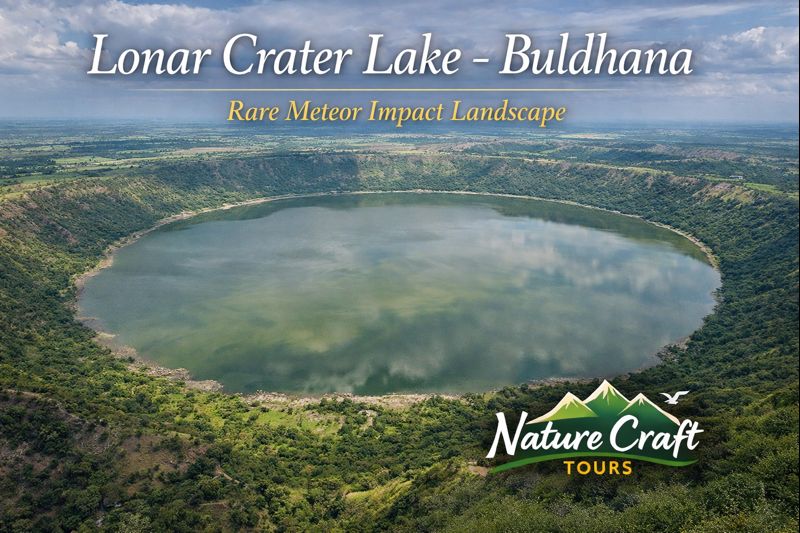
In the heart of Maharashtra’s Deccan Plateau lies a landscape so geologically improbable that it challenges the very assumptions through which we usually understand Indian geography. Lonar Crater Lake, located in the Buldhana district, is not the product of volcanic eruption, tectonic folding, or riverine erosion. Instead, it is the scar of a cosmic collision—an immense meteorite impact that occurred tens of thousands of years ago, carving a perfectly circular depression into solid basalt. This singular origin makes Lonar one of the very few hypervelocity impact craters in the world formed entirely in basaltic rock, and the only confirmed example of its kind in India.
To approach Lonar is to step into a place where planetary science, ecology, mythology, and human history intersect. The lake is alkaline and saline, ringed by dense forest and ancient temples, and surrounded by a cultural landscape shaped by centuries of pilgrimage and settlement. Unlike many destinations that impress through scale or grandeur, Lonar commands attention through its layered complexity—every viewpoint revealing not just scenery, but a narrative that spans cosmic time, evolutionary adaptation, and civilizational memory.
Geographical Setting and Spatial Overview
Lonar Crater Lake is situated approximately 150 kilometers southeast of Aurangabad and about 500 kilometers from Mumbai. The crater measures roughly 1.8 kilometers in diameter and plunges more than 130 meters from rim to lakebed. From the surrounding plateau, the lake is not immediately visible; it reveals itself gradually, the land folding inward until the circular basin opens dramatically below.
The crater’s steep walls form a natural amphitheater, enclosing a self-contained ecosystem. Dense woodland clings to the slopes, while the lake occupies the lowest point, its surface often tinged green due to microbial activity. This enclosed morphology is central to Lonar’s scientific value, as it creates a relatively isolated environment where chemical and biological processes can be observed with minimal external interference.
Meteor Impact Origin and Geological Significance
Formation Through Cosmic Collision
Scientific consensus holds that Lonar Crater was formed by a meteorite impact approximately 50,000 years ago, though some estimates extend this timeline further back. The meteor struck the Earth at hypervelocity, releasing energy equivalent to a massive explosion and vaporizing itself upon impact. The force excavated basalt bedrock, ejecting debris outward and forming the distinctive circular depression visible today.
What makes Lonar exceptional is its basaltic setting. Most known impact craters globally occur in sedimentary or mixed rock environments. Lonar’s formation within the Deccan Traps—one of the largest volcanic provinces on Earth—has made it a subject of intense study for planetary scientists, particularly those researching impact processes on Mars, where basaltic terrain is widespread.
Mineralogical Evidence
Evidence supporting the impact hypothesis includes the presence of shock metamorphism features such as maskelynite and shocked quartz, as well as unusual mineral assemblages formed under extreme pressure and temperature. These findings conclusively distinguish Lonar from volcanic craters, settling earlier debates that persisted until the mid-20th century.
Hydrology and Chemical Character of the Lake
Lonar Lake is both saline and alkaline, with pH levels that can exceed 10. This chemistry is the result of closed-basin hydrology—there is no outlet for water to escape, so dissolved minerals accumulate over time. The lake is fed primarily by rainwater and small freshwater springs along the crater walls, which creates distinct chemical gradients within the water body.
The unusual chemistry supports extremophile microorganisms, including cyanobacteria that impart the lake’s characteristic green hue during certain seasons. These organisms are of considerable scientific interest, offering insights into life in extreme environments and potential analogues for extraterrestrial ecosystems.
Ecological Zones Within the Crater
Forest Ring and Biodiversity
Encircling the crater is a dense belt of dry deciduous forest, markedly different from the surrounding agricultural plains. This vegetation owes its existence to the microclimate created by the crater walls, which trap moisture and reduce wind exposure. The forest supports a range of bird species, reptiles, and small mammals, many of which are rarely seen outside the crater environment.
Seasonal variation plays a crucial role in shaping ecological rhythms. During the monsoon, the forest floor becomes lush and vibrant, while winter brings clarity and visibility, ideal for observation and study.
Lake-Centric Microbial Life
Within the lake itself, microbial mats and planktonic organisms dominate. These life forms not only sustain the lake’s food web but also influence its chemical balance. Researchers have documented shifts in microbial composition across seasons, making Lonar a valuable site for long-term ecological monitoring.
Cultural and Mythological Landscape
Human engagement with Lonar dates back at least two millennia. The crater and its surroundings are dotted with ancient temples, many constructed during the Chalukya and Rashtrakuta periods. These structures, dedicated primarily to Shaivite and Vaishnavite traditions, reflect the spiritual significance attributed to the site.
Local legend associates Lonar with the slaying of the demon Lonasura by Lord Vishnu, an episode said to have sanctified the waters. While mythological interpretations differ from scientific explanations, both narratives coexist, enriching the site’s cultural texture rather than detracting from its scientific importance.
Key Attractions and Areas of Interest
The crater rim offers multiple vantage points, each revealing different aspects of the landscape. From certain angles, the lake appears almost perfectly circular, while from others, the interplay of forest, water, and rock becomes more pronounced. A circumferential trail allows for slow exploration, though it demands careful footing and respect for the terrain.
Descending toward the lake reveals ancient temple ruins partially reclaimed by vegetation. These structures, weathered yet dignified, add a temporal dimension to the journey, reminding visitors that human history here is but a brief chapter in a far longer geological story.
Best Time and Season to Visit
Seasonal Considerations
The most suitable period to visit Lonar Crater Lake is between October and February. During these months, temperatures are moderate, humidity is low, and visibility is excellent. The post-monsoon season revitalizes the forest, while winter ensures stable footing and safer exploration.
Monsoon visits, though visually dramatic, are challenging due to slippery paths and limited accessibility. Summer, on the other hand, brings extreme heat that can make extended exploration uncomfortable and potentially hazardous.
Ideal Travel Duration and Exploration Pace
A comprehensive visit to Lonar requires at least one full day, though an overnight stay in the region allows for a more unhurried experience. This duration accommodates rim exploration, descent toward the lake, temple visits, and time for observation without the pressure of a rushed itinerary.
Travelers accustomed to immersive natural landscapes—whether navigating deltaic waterways during a Sundarban Trip or traversing plateau ecosystems—will appreciate the value of slowing down at Lonar. The site rewards patience more than speed.
Route and Accessibility
Lonar is accessible by road from Aurangabad, Jalgaon, and Akola. The final approach passes through rural settlements and agricultural land, offering glimpses into the region’s everyday life. Public transport options are available but infrequent; private vehicles provide greater flexibility and ease of access.
Road conditions are generally serviceable, though signage can be sparse near the crater. Early arrival is advisable to maximize daylight hours and avoid crowding during peak seasons.
Scientific Research and Global Relevance
Lonar Crater has attracted sustained interest from national and international research institutions. Studies conducted here have informed models of impact cratering on basaltic planets, particularly Mars. The site’s combination of geological clarity and ecological complexity makes it uniquely valuable for interdisciplinary research.
The crater’s closed system has also enabled long-term climate studies, with sediment cores revealing environmental changes over thousands of years. Such research underscores Lonar’s importance not merely as a travel destination, but as a repository of planetary history.
Responsible Travel and Conservation Challenges
Despite its significance, Lonar faces mounting pressure from unregulated tourism, waste accumulation, and ecological disturbance. Responsible visitation is essential to preserving the crater’s integrity. Staying on designated paths, minimizing noise, and carrying back all waste are fundamental practices rather than optional courtesies.
Travelers familiar with sensitive ecosystems—such as mangrove reserves accessed through a Best Sundarban Tour Package—will recognize the parallels. In both landscapes, the margin between appreciation and degradation is narrow.
Practical Insights for Field-Oriented Travelers
Footwear with strong grip is essential, particularly for those descending toward the lake. Adequate hydration, sun protection, and modest provisions should be planned in advance, as facilities near the crater are limited and basic.
Photography is best undertaken during early morning or late afternoon, when light angles accentuate the crater’s contours. However, the true value of Lonar lies not in images captured, but in understanding gained through observation and reflection.
Lonar as a Record of Planetary and Human Time
Lonar Crater Lake stands apart from conventional travel destinations. It is not defined by luxury, entertainment, or spectacle, but by evidence—of cosmic forces, ecological adaptation, and human interpretation layered over millennia. To stand at its rim is to confront scales of time and space that extend far beyond individual experience.
For those willing to engage with the land thoughtfully, Lonar offers a rare opportunity to witness a moment when Earth and cosmos intersected, leaving behind a landscape that continues to inform, challenge, and inspire. It is a place where travel becomes study, and observation becomes understanding.