Amboli Ghat (Sindhudurg)
— Rainforest Mood Near Konkan’s Misty Edge
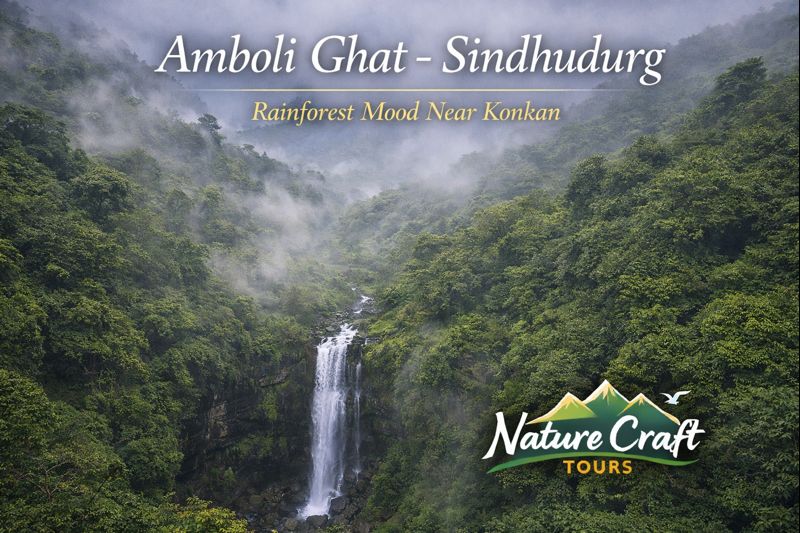
Amboli Ghat occupies a rare atmospheric space in the Western Ghats—neither a conventional hill station nor merely a mountain pass. It is a threshold landscape, where the saturated rainforests of the Sahyadri crest begin their slow descent toward the Konkan coast. Perched at an elevation of around 690 meters, Amboli experiences some of the heaviest rainfall in Maharashtra, creating an environment defined by mist, dripping foliage, shadowed valleys, and an almost constant sense of ecological intimacy. Here, travel is not about wide panoramas alone, but about immersion into moisture, sound, and texture.
To journey through Amboli Ghat is to encounter the Western Ghats in one of their most sensorial forms. Roads cut through dense forest corridors, waterfalls appear without warning, and clouds frequently move at eye level. The ghat’s mood is introspective rather than theatrical—less about grand viewpoints, more about the quiet persistence of rainforest life. This is a place where the monsoon is not a season but an identity, shaping everything from vegetation patterns to cultural rhythms.
Geographical Setting and Landscape Character
Amboli Ghat is located in the Sindhudurg district of southern Maharashtra, close to the Goa border. It forms part of the southern Sahyadri range, where the Western Ghats widen and absorb some of the highest monsoon rainfall in peninsular India. The ghat acts as a climatic barrier between the humid Konkan coast and the drier Deccan interior.
Topographically, Amboli is composed of undulating plateaus, steep escarpments, and deeply forested valleys. Unlike sharper ghats further north, the terrain here feels older and more eroded, softened by millennia of rain. Basalt remains the underlying rock, but thick soil layers and vegetation obscure much of the raw geology, lending the landscape its rainforest character.
Rainforest Ecology of Amboli Ghat
High-Rainfall Evergreen Forests
Amboli lies within the Western Ghats biodiversity hotspot, and its forests are classified as tropical evergreen to semi-evergreen. Persistent rainfall supports dense canopies, rich undergrowth, and continuous leaf litter. Sunlight filters through multiple layers, creating dim, green-tinted interiors where mosses, lichens, and ferns flourish.
Tree species here are adapted to water saturation and shallow root anchoring. Buttressed trunks, epiphytes, and climbers are common, contributing to the forest’s vertical complexity. The result is an ecosystem that feels enclosed and alive, even when viewed from the roadside.
Amphibians, Reptiles, and Microfauna
Amboli is internationally recognized among herpetologists for its diversity of amphibians and reptiles, many of them endemic. The constant moisture and leaf litter provide ideal breeding conditions for frogs, caecilians, and other moisture-dependent species.
During the monsoon, nighttime soundscapes are dominated by frog calls, insect activity, and water movement. This acoustic density reinforces the sense that Amboli is not merely scenic, but biologically active at every scale.
Amboli Ghat as a Monsoon Landscape
While Amboli can be visited year-round, its true character emerges during the monsoon months from June to September. Rainfall here is not intermittent but sustained, often continuing for days with only brief pauses. Fog and low cloud are frequent, reducing visibility but heightening atmospheric depth.
Roads become corridors through mist, forest edges blur into shadow, and waterfalls emerge along slopes and rock faces. Unlike drier hill destinations where monsoon is a spectacle, in Amboli it is an environment—something one moves within rather than observes from a distance.
Key Attractions and Natural Highlights
Amboli Waterfall and Seasonal Cascades
The most prominent waterfall near the ghat is Amboli Waterfall, which becomes active during peak rainfall. Fed by plateau runoff, it plunges into a forested gorge, surrounded by thick vegetation and mist. Beyond this primary cascade, numerous smaller, unnamed waterfalls appear across the ghat during heavy rain, often flowing directly beside the road.
These ephemeral cascades are integral to Amboli’s character. Their presence varies year to year, depending on rainfall patterns, making each monsoon season subtly different from the last.
Sunset and Fog Viewpoints
Amboli offers several viewpoints overlooking the Konkan plains, but their experience is governed by weather rather than schedule. On clear evenings, distant hills and coastal lowlands become visible, bathed in warm light. On most monsoon days, however, these viewpoints are enveloped in cloud, offering instead a study in fog movement and shifting visibility.
This unpredictability is central to Amboli’s appeal. The absence of guaranteed views encourages patience and repeated observation rather than checklist sightseeing.
Cultural and Regional Context
Amboli village and its surrounding settlements reflect a cultural landscape shaped by rainfall, forest dependence, and seasonal isolation. Agriculture here follows monsoon cycles closely, with rice cultivation and horticulture adapted to saturated soils.
Local traditions, festivals, and daily routines align with ecological rhythms rather than tourist seasons. This grounding in landscape continuity gives Amboli a lived-in authenticity, distinguishing it from more commercialized hill destinations.
Best Time and Season to Visit
Monsoon: Immersion and Intensity
June to September is the defining period for Amboli Ghat. Rainforest density, waterfall activity, and biological visibility are at their peak. This season is ideal for travelers seeking mood, texture, and ecological richness rather than wide-angle views.
However, monsoon travel demands caution. Roads can be slippery, leeches are common on forest trails, and visibility fluctuates rapidly. Travelers familiar with saturated ecosystems—such as mangrove landscapes explored during a Sundarban Trip—will find similar challenges and rewards here.
Post-Monsoon and Winter: Structure and Calm
From October to February, rainfall subsides and forests retain their lushness without the intensity of continuous rain. Visibility improves, trails stabilize, and cooler temperatures make exploration more comfortable.
This period is suitable for longer walks, bird observation, and slow travel through the ghat without monsoon-related constraints.
Ideal Travel Duration and Experience Planning
Amboli Ghat rewards unhurried travel. A minimum of two nights allows time to experience the ghat under different light and weather conditions. Shorter visits risk reducing Amboli to a brief stop rather than an immersive environment.
Extended stays allow travelers to attune themselves to daily rhythms—morning fog lift, afternoon rain spells, and evening insect activity—each revealing different aspects of the rainforest mood.
Route and Accessibility
Amboli Ghat is accessible by road from both Maharashtra and Goa. Common approach routes include Sawantwadi and Belgaum, with the ghat road itself climbing gradually into forested terrain.
Road conditions are generally good, though monsoon travel requires attentiveness due to fog, water runoff, and occasional debris. Public transport options exist but are limited in frequency; private vehicles offer greater flexibility for weather-dependent travel.
Ecological Sensitivity and Conservation Value
Amboli’s ecological importance extends beyond its scenic appeal. As part of the Western Ghats, it supports numerous endemic species and functions as a critical watershed zone. Small disturbances—trail widening, littering, noise—can have outsized impacts in such moisture-dependent systems.
Responsible travel here involves minimizing footprint, avoiding off-trail movement, and respecting seasonal closures or local guidance. The rainforest’s resilience depends on restraint rather than access.
Practical Insights for Thoughtful Travelers
Preparation for Amboli Ghat should prioritize weather readiness and ecological awareness. Waterproof clothing, footwear with strong grip, and protection against leeches are essential during the monsoon. Even in drier months, sudden showers are common.
Facilities are limited and understated, reinforcing the importance of self-sufficiency and waste responsibility. Travelers experienced in fragile natural regions—such as deltaic forests visited through a Best Sundarban Tour Package—will recognize similar ethical expectations here.
Amboli Ghat Beyond Scenic Tourism
What distinguishes Amboli Ghat is its refusal to perform. There are no guaranteed viewpoints, no fixed spectacles, and no singular moment of arrival. Instead, the ghat offers continuity—of rain, growth, decay, and renewal.
For researchers, photographers, naturalists, and reflective travelers, Amboli provides conditions for deep observation. It invites engagement with processes rather than outcomes, with atmosphere rather than attraction.
A Rainforest Threshold of the Western Ghats
Amboli Ghat stands as one of the Western Ghats’ most atmospheric passages—a place where rainforest, monsoon, and mountain coexist in close proximity. It does not promise clarity, but offers immersion; it does not deliver spectacle on demand, but reveals complexity over time.
For those willing to slow down and adapt to its rhythms, Amboli becomes more than a destination. It becomes a study in how landscape, climate, and life interweave—quietly, persistently, and with profound depth.