Kufri Near Shimla:
High-Altitude Meadows, Seasonal Snow, and the Quiet Geography of the Himalaya
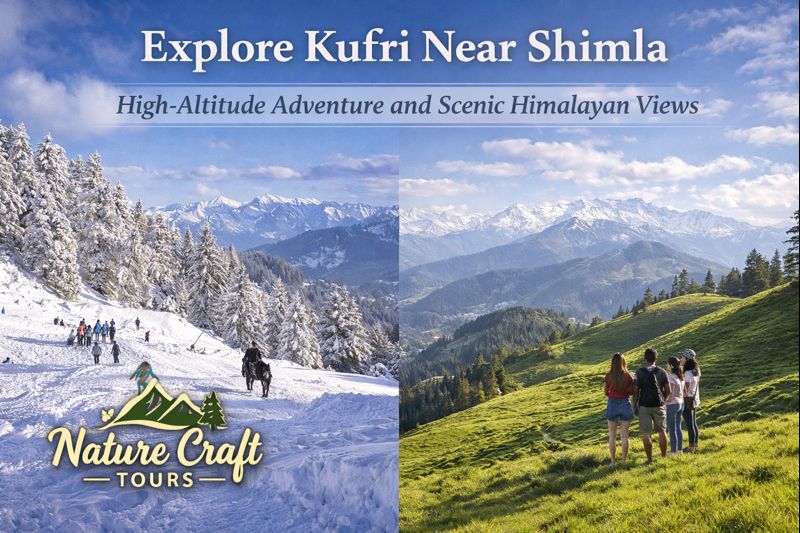
Just beyond the well-known contours of Shimla lies a smaller, higher, and more elemental landscape that often escapes prolonged attention. Kufri, positioned along the eastern ridges above Shimla, is frequently introduced as a short excursion or a winter snow stop. Yet such descriptions only skim the surface. Kufri is not merely an extension of Shimla’s tourism circuit; it is a distinct high-altitude zone shaped by meadow ecology, forest transitions, pastoral memory, and seasonal transformation.
To understand Kufri properly, one must approach it not as a checklist destination, but as a landscape that reveals itself through time, altitude, and restraint. Its appeal does not depend on built heritage or dense attractions. Instead, it rests in open slopes, shifting weather, conifer forests, and a long-standing relationship between human movement and mountain terrain. This is a place where the Himalaya begins to assert itself more quietly yet more decisively than in the town below.
This travel narrative explores Kufri as a geographical and experiential destination near Shimla—examining its environment, seasonal character, access routes, cultural context, and practical realities. It is written for travelers who prefer understanding over spectacle and who seek to read landscapes rather than simply pass through them.
Destination Overview: Where Kufri Sits in the Shimla Region
Kufri lies approximately 16 kilometers east of Shimla, positioned at an elevation of around 2,720 meters above sea level. This elevation difference, though seemingly modest on a map, is crucial to understanding Kufri’s character. The increase in altitude alters temperature patterns, vegetation types, snowfall frequency, and visibility. Kufri belongs more to the transitional Himalayan zone than to the urban hill-station environment of Shimla.
Historically, Kufri functioned as grazing land and seasonal movement territory rather than as a permanent settlement. The name itself is believed to derive from “Kufr,” a local term referring to a lake or depression in the mountains. Over time, as Shimla expanded and road connectivity improved, Kufri entered the public imagination as a winter destination. Yet its older identity—as open pastureland interspersed with forest—still defines its spatial logic.
Unlike Shimla’s ridge-based urban structure, Kufri is defined by slopes, open clearings, and forest belts. Built structures remain limited, and the landscape retains a sense of horizontal openness that is rare in Himalayan towns. This openness is central to Kufri’s appeal.
Why Kufri Feels More “Mountain” Than Shimla
Shimla’s identity is shaped by architecture, promenades, and civic space. Kufri, by contrast, is shaped by terrain and weather. Roads narrow, tree cover thickens, and horizons expand. Human presence becomes lighter, more dispersed. This shift is perceptible almost immediately upon leaving Shimla’s outskirts.
For travelers, this means that Kufri offers a more direct encounter with mountain geography. Views are not framed by buildings; they emerge between ridges. Silence is not engineered; it occurs naturally when traffic thins and wind moves through forest canopies.
The Ecological Character of Kufri
Kufri sits within a sensitive Himalayan ecosystem characterized by mixed conifer forests, alpine meadows, and seasonal snow cover. The ecological identity of the region changes noticeably across the year, making timing a critical factor in how Kufri is experienced.
Forest Composition and Meadow Systems
The forests around Kufri are dominated by deodar, pine, spruce, and oak species, depending on elevation and slope orientation. These forests serve as important catchment areas, supporting soil stability and regulating water flow toward lower valleys. Interspersed among forest belts are open meadows—locally known as “bugyals”—which have traditionally supported grazing.
These meadows are not ornamental landscapes. They are functional ecological systems shaped by centuries of seasonal use. Their openness allows snow to settle evenly in winter and grasses to regenerate in summer, creating a rhythm that aligns with both climate and pastoral activity.
Wildlife Presence and Environmental Sensitivity
Kufri’s forests support a range of Himalayan fauna, including birds, small mammals, and occasionally larger species in less disturbed zones. While wildlife encounters are not guaranteed, the ecological integrity of the area depends on maintaining low-impact visitation.
Travelers should be aware that Kufri’s environment is more fragile than urban hill stations. Trampling of meadows, littering, and unmanaged vehicular movement can cause long-term damage. Responsible travel here is not optional; it is essential.
Seasonal Identity of Kufri
Kufri’s reputation is strongly tied to winter snowfall, but limiting the destination to one season overlooks its broader landscape story. Each season reshapes Kufri in fundamental ways.
Winter: Snow, Stillness, and Compression
From late December through February, Kufri often receives snowfall, transforming meadows and forest clearings into white expanses. This season attracts the highest visitor volume, particularly from nearby cities. Snow compresses movement, limiting access to certain trails while highlighting open slopes.
While visually striking, winter also demands caution. Roads can become slippery, visibility may drop suddenly, and weather conditions can change rapidly. Travelers during this season should prioritize safety and avoid unrealistic itineraries.
Spring: Transition and Renewal
Spring marks Kufri’s most subtle transformation. Snow recedes gradually, revealing grasses and forest floors enriched by meltwater. Temperatures rise without becoming harsh, and visibility improves. This is an excellent season for walking and observation.
Spring also restores a sense of balance to the landscape. Visitor numbers decrease, allowing Kufri’s quieter identity to re-emerge.
Summer: Meadows and Open Horizons
Summer in Kufri is defined by green slopes, long daylight hours, and cooler temperatures than the plains. Meadows become usable spaces again, and forest shade provides natural relief. This season favors travelers interested in gentle exploration rather than snow-based activity.
Autumn: Clarity and Perspective
Autumn offers some of Kufri’s clearest conditions. The air becomes crisp, skies often remain cloudless, and distant Himalayan ranges appear sharper. Vegetation shifts toward muted tones, emphasizing form over color. For photography and contemplation, this season is often the most rewarding.
Route and Accessibility
Kufri is accessed primarily via road from Shimla. The route follows a gradual ascent, passing through forested stretches and occasional viewpoints. While the distance is short, travel time can vary depending on season, weather, and traffic volume.
Approach from Shimla
The road to Kufri departs from eastern Shimla and climbs steadily. During peak seasons, especially winter, congestion can occur. Early departures reduce both traffic stress and environmental impact.
Internal Movement Within Kufri
Once in Kufri, movement is best managed on foot wherever possible. Short walks reveal more than vehicle-based sightseeing. Many of Kufri’s strengths—meadow transitions, forest edges, subtle viewpoints—are accessible only by walking.
Ideal Duration for Visiting Kufri
Kufri is often treated as a half-day excursion, but this approach limits engagement. To experience Kufri meaningfully, at least one full day is recommended, with flexibility to adjust for weather.
Suggested Time Allocation
- Travel from Shimla and orientation: 1–1.5 hours
- Meadow and forest exploration: 2–3 hours
- Seasonal activities or observation time: 1–2 hours
- Return or onward travel: 1–1.5 hours
Travelers seeking a slower pace may choose to combine Kufri with nearby highland routes, allowing for a broader understanding of the region’s geography.
Key Attractions and Highlights
Kufri’s attractions are primarily landscape-based rather than monument-centered. Their value lies in context and timing rather than in individual landmarks.
Mahasu Peak Area
Mahasu Peak represents one of the highest accessible points near Kufri. It offers panoramic views under clear conditions and illustrates the region’s ridge-based geography. Access involves walking, reinforcing the experiential nature of the destination.
Open Meadows and Ridge Walks
The true highlight of Kufri lies in its open slopes. Walking across meadows or along forest-edge ridges reveals how elevation and exposure shape the landscape. These spaces are best appreciated without haste.
Seasonal Snow Zones
In winter, designated snow areas become focal points. While activity-oriented visitors may gravitate here, travelers should also spend time observing how snow reshapes sound, movement, and visibility across the wider landscape.
Cultural and Historical Context
Kufri does not possess grand architectural heritage, but its cultural significance lies in land use and seasonal movement. Historically, the region supported pastoral communities whose livelihoods depended on altitude-based grazing cycles. These patterns influenced how land was perceived—not as property alone, but as seasonal resource.
This relationship between people and landscape echoes across India’s diverse environments. Just as Himalayan meadows shaped pastoral traditions, riverine and deltaic regions fostered entirely different adaptations. Travelers moving between mountains and wetlands often recognize these contrasts more clearly when journeys include ecosystems as distinct as Kufri and the mangrove territories associated with Sundarban Tourism.
Practical Insights for Travelers
Clothing and Footwear
Layered clothing is essential year-round. Weather shifts quickly at altitude, and temperatures can drop unexpectedly. Footwear should be suitable for uneven ground, especially during wet or snowy conditions.
Managing Altitude and Pace
Although Kufri’s altitude is moderate by Himalayan standards, some visitors may feel its effects. Slow pacing, hydration, and adequate rest are advisable, particularly for those arriving directly from low elevations.
Environmental Responsibility
Travelers should minimize waste, avoid damaging meadow surfaces, and respect forest boundaries. Kufri’s appeal depends on its ecological health, which is easily compromised by careless behavior.
Integrating Kufri into a Broader Travel Plan
Kufri works best as part of a balanced itinerary that combines cultural, urban, and natural environments. Pairing highland destinations with lowland ecosystems deepens travel perspective. Structured itineraries such as a Sundarban Tour Package from Kolkata demonstrate how contrasting landscapes demand different travel rhythms and observational skills.
A Thoughtful One-Day Kufri Plan
Morning: Ascent and First Walks
Depart Shimla early to avoid congestion. Begin with a gentle walk through meadow-edge zones, allowing time for acclimatization and observation.
Midday: Peak and Ridge Exploration
Move toward higher points or ridge paths, depending on season. Pause frequently to observe terrain and vegetation changes.
Afternoon: Reflection and Return
Spend final hours revisiting quieter stretches before returning. The descent often reveals new perspectives overlooked during ascent.
Kufri as a Landscape, Not a Shortcut
Kufri is often described in proximity to Shimla, but its true value lies in its difference. Higher, quieter, and less constructed, it represents a Himalayan threshold where forest, meadow, and sky converge. It is not a destination to be rushed or reduced to seasonal novelty.
For travelers who approach Kufri with patience and ecological awareness, the region offers something increasingly rare: space to slow down and read the mountain landscape on its own terms. In doing so, Kufri becomes more than a stop near Shimla—it becomes an understanding of altitude, season, and restraint.