Manali Revisited:
Old Manali, River Walks, and Viewpoints in a Living Himalayan Valley
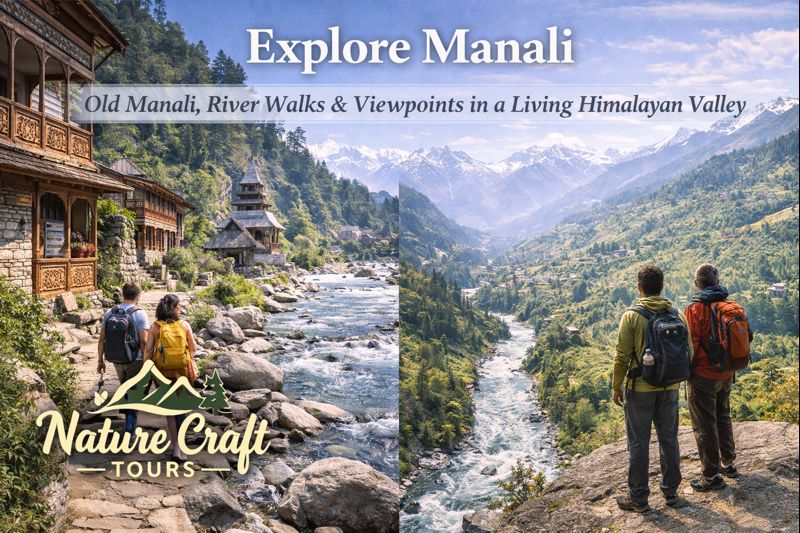
Manali is often introduced as a mountain resort, a base for adventure, or a seasonal escape from the plains. Yet such descriptions only capture fragments of a place that is far more layered. At its core, Manali is a valley settlement shaped by a river, sustained by older village cultures, and oriented toward viewpoints that reveal not spectacle alone, but structure—of land, water, and human adaptation. To understand Manali meaningfully, one must look beyond traffic corridors and activity hubs, toward Old Manali’s village lanes, the slow rhythm of river walks, and elevated viewpoints that contextualize the valley as a whole.
This article explores Manali through three interconnected lenses: Old Manali as a cultural and spatial anchor, river walks as everyday geography, and viewpoints as tools for reading the Himalayan landscape. It is written from the perspective of field observation rather than promotional framing, intended for travelers who seek depth, coherence, and understanding rather than surface impressions.
Destination Overview: Manali as a Valley Settlement
Manali is located in the upper Kullu Valley of Himachal Pradesh, at an elevation of approximately 2,050 meters above sea level. It sits along the Beas River, where the valley narrows and begins its ascent toward higher Himalayan passes. This position—neither lowland valley base nor high-altitude outpost—has shaped Manali’s role as an intermediary space, connecting agricultural landscapes below with alpine regions above.
Unlike ridge-top hill stations, Manali spreads along the river and adjoining slopes. Its growth has followed the contours of water, roads, and older village boundaries rather than a single planned axis. As a result, Manali contains multiple identities within a relatively compact area: the commercial town center, Old Manali’s village fabric, forest-edge neighborhoods, and riverine zones.
Understanding Manali requires recognizing it as a living valley town rather than a singular attraction. Its most meaningful experiences are often found away from crowded nodes, in spaces where daily life continues alongside travel.
From Transit Point to Cultural Landscape
Historically, Manali functioned as a stop along trade and migration routes linking the Kullu Valley with higher Himalayan regions. This role fostered cultural exchange, seasonal movement, and economic adaptability. Over time, tourism layered itself onto this foundation, altering scale and pace but not entirely erasing older patterns. Old Manali, in particular, preserves traces of this earlier structure.
Old Manali: Village Memory Within a Modern Town
Old Manali occupies the original village site from which the modern town expanded. Separated from the newer commercial areas by the Manalsu stream, it retains a distinct spatial and cultural identity. Narrow lanes, traditional wooden houses, small temples, and orchards define its fabric.
Walking through Old Manali reveals a rhythm different from the main town. Movement slows naturally. Conversations replace transactions. Architecture responds to climate and material availability rather than contemporary design trends.
Settlement Pattern and Architecture
Traditional houses in Old Manali often feature wooden balconies, stone bases, and sloped roofs designed for snow management. These structures reflect generations of adaptation to climate, terrain, and resource availability. Even where newer constructions appear, older spatial logic—compact plots, shared courtyards, and pedestrian lanes—persists.
Social Life and Everyday Culture
Old Manali is not a preserved museum zone. It is a functioning neighborhood where residents balance tourism-related livelihoods with domestic routines. Morning prayers, agricultural work on small plots, and local gatherings continue alongside guesthouses and cafés. For travelers, observing this coexistence offers insight into how tourism integrates—sometimes uneasily—into village life.
The Beas and Manalsu Rivers: Walking the Waterlines
Manali’s rivers are not merely scenic elements; they are structural features shaping movement, ecology, and culture. The Beas River defines the valley floor, while the smaller Manalsu stream marks the transition between Old Manali and the newer town.
River Walks as Everyday Geography
Walking along riverbanks reveals Manali’s daily rhythm more clearly than its marketplaces. Locals wash produce, children play along the edges, and paths connect neighborhoods more directly than roads. These river walks are informal yet essential corridors of movement.
For travelers, river walks offer a way to experience Manali without intrusion. They allow observation without spectacle, emphasizing continuity rather than consumption.
Seasonal Behavior of the Rivers
River character changes dramatically across seasons. In spring and early summer, snowmelt increases flow, making the Beas energetic and loud. During monsoon, volume and color shift, reinforcing the river’s power. Autumn brings clarity and steadier levels, while winter quiets movement without freezing it entirely.
These changes influence walking conditions, soundscapes, and the overall atmosphere of the valley.
Viewpoints Around Manali: Reading the Valley from Above
Viewpoints around Manali are often described as places to “see” the mountains. More accurately, they are places to understand structure—how rivers carve valleys, how settlements align with slopes, and how forests transition with altitude.
Lower and Mid-Elevation Viewpoints
Viewpoints accessible from within or near Manali offer perspectives over the town, river bends, and cultivated terraces. These locations reveal how Manali expands outward rather than upward, maintaining connection to the valley floor.
Higher Perspective Zones
Short ascents toward forest edges or higher slopes reveal broader Himalayan geometry. From these points, one can trace the Beas Valley’s direction, identify tributary patterns, and observe how light and weather interact with terrain. Such viewpoints reward patience more than haste.
Ecological Context: Forests, Fields, and Altitude
Manali sits at a transition zone between temperate valley ecosystems and colder alpine regions. This positioning supports ecological diversity but also demands careful balance.
Forest Zones
Surrounding slopes host deodar, pine, and mixed broadleaf forests. These forests stabilize soil, regulate water flow, and support birdlife. They also act as buffers against rapid urban expansion, though pressure on these zones has increased over time.
Agricultural and Orchard Landscapes
Lower slopes and flatter valley sections support orchards and seasonal crops. These working landscapes remind visitors that Manali is not solely a leisure destination but a productive valley.
Cultural and Historical Significance
Manali’s cultural identity reflects its role as a connector—between regions, altitudes, and traditions. Local deity worship, village councils, and seasonal festivals persist alongside global tourism influences.
Temple Culture and Local Belief Systems
Small temples embedded within neighborhoods reflect a decentralized spiritual system. These spaces are integral to daily life, not isolated landmarks. Observing them respectfully offers insight into how belief and landscape intertwine.
Manali in Regional Context
As part of the broader Kullu Valley, Manali participates in valley-wide cultural events and seasonal cycles. This shared identity emphasizes cooperation and movement rather than isolation.
Best Time and Season to Visit Manali
Spring (March to May)
Spring offers balance. Snow recedes from lower slopes, rivers run full, and temperatures remain comfortable. This season is ideal for walking, village exploration, and viewpoints.
Summer (June to September)
Summer brings greenery and agricultural activity. Monsoon rains appear intermittently, enriching landscapes but occasionally affecting travel conditions.
Autumn (October to November)
Autumn provides clarity, stable weather, and cultural richness. River walks and viewpoints are particularly rewarding during this period.
Winter (December to February)
Winter quiets the valley. Snow remains mostly on higher slopes, while Old Manali and river areas retain accessibility. This season favors reflective travel over movement-heavy itineraries.
Ideal Travel Duration
To experience Manali beyond surface impressions, a minimum of four days is recommended. This allows for varied pacing and deeper engagement with different zones.
Suggested Duration
- Day 1: Orientation walk, Old Manali exploration
- Day 2: River walks and town-neighborhood transitions
- Day 3: Viewpoints and forest-edge exploration
- Day 4: Slow observation, cultural spaces, reflection
Route and Accessibility
Manali is accessible by road from the lower Kullu Valley. The approach follows the Beas River, gradually ascending through agricultural zones into forested slopes.
Arrival and Internal Movement
Once in Manali, walking is often the most revealing mode of travel, particularly in Old Manali and along rivers. Short drives complement foot exploration for viewpoints and forest areas.
Manali in a Broader Geographic Perspective
Manali’s river-based valley culture contrasts with other Indian ecosystems shaped by different water dynamics. While Himalayan rivers carve valleys through snowmelt and altitude, deltaic regions respond to tides and mangroves. Experiencing both landscapes enhances geographic understanding.
For instance, journeys that include river valleys like Manali alongside mangrove environments explored on a Sundarban Trip reveal how water governs culture in distinct yet equally powerful ways.
Practical Insights for Travelers
Clothing and Preparation
Layered clothing is essential year-round due to temperature variation between day and night. Comfortable walking shoes are important for uneven paths and riverbanks.
Respecting Local Spaces
Old Manali is a residential area. Travelers should remain mindful of noise, privacy, and cultural norms, especially near temples and homes.
Environmental Responsibility
Avoid littering riverbanks, respect forest boundaries, and minimize noise pollution. Valley ecosystems are sensitive to cumulative impact.
Integrating Manali into Wider Travel Plans
Manali works best as part of a balanced itinerary that includes both cultural and ecological diversity. Structured journeys such as a Sundarban Tour Package from Kolkata illustrate how contrasting landscapes—valleys, rivers, and forests—complement one another in shaping travel perspective.
A Thoughtful Four-Day Plan for Manali
Day One: Old Manali Immersion
Walk through village lanes, observe daily life, and visit small temples. Spend the evening near the Manalsu stream.
Day Two: River Walks
Follow paths along the Beas and Manalsu, observing seasonal behavior and local activity.
Day Three: Viewpoints and Forest Edges
Ascend toward accessible viewpoints for broader valley perspectives. Spend time in forest-edge zones.
Day Four: Reflection and Slow Travel
Revisit meaningful spaces at a slower pace. Allow observation rather than movement to guide the day.
Manali as a Valley of Continuity
Manali’s true character lies not in extremes of altitude or activity, but in continuity—between river and settlement, village and town, past and present. Old Manali preserves memory, river walks reveal rhythm, and viewpoints provide understanding.
For travelers willing to slow down, Manali offers a coherent narrative of Himalayan valley life. It demonstrates that mountains are not only destinations to be reached, but landscapes to be lived with—step by step, along the river’s edge.