Kangra Fort:
History on a Hill and the Long Memory of the Western Himalaya
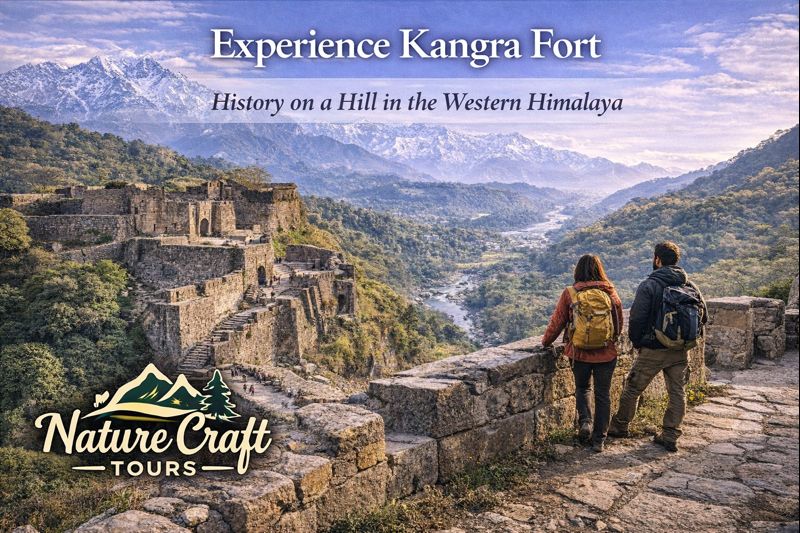
Kangra Fort does not rise abruptly into view like a dramatic ruin meant to impress at first glance. It reveals itself gradually, through ridges, ravines, and layered stonework that seem to grow directly out of the hill on which it stands. Perched above the confluence of the Banganga and Manjhi rivers, Kangra Fort is less a monument placed upon the landscape and more a landscape that has been shaped, defended, rebuilt, and inhabited for centuries. Its walls do not merely enclose space; they enclose time.
Recognized as one of the oldest continuously occupied forts in India, Kangra Fort embodies the strategic, political, and cultural history of the Kangra Valley and the wider Western Himalayan region. Empires have coveted it, armies have laid siege to it, and rulers have fortified and abandoned it in cycles shaped by power and geography. Yet despite invasions, earthquakes, and neglect, the fort endures—weathered but legible, silent yet eloquent.
This article approaches Kangra Fort not as a checklist heritage attraction, but as a historical hillscape. It examines the fort’s geography, architectural logic, political significance, and lived environment, written from an explorer’s perspective that values slow observation, spatial understanding, and contextual reading of place.
Destination Overview: Locating Kangra Fort in the Valley System
Kangra Fort is situated on the outskirts of Kangra town in Himachal Pradesh, overlooking the Kangra Valley from a commanding height. The fort occupies a rocky spur where the Banganga River meets the Manjhi River, a strategic position that allowed natural defenses on multiple sides. Steep slopes, river gorges, and narrow access points made the site ideal for long-term military occupation.
Unlike hill forts built atop isolated peaks, Kangra Fort integrates elevation with valley control. From its walls, one can survey fertile plains, river corridors, and approach routes from multiple directions. This geographic advantage explains why the fort was so fiercely contested throughout history.
The fort complex itself is vast, spread across multiple levels connected by gates, courtyards, and pathways. Movement within the fort mirrors movement through time, as each layer reflects a different historical phase.
A Fort Defined by Terrain Rather Than Skyline
Kangra Fort does not dominate the skyline with vertical height alone. Its power lies in how it follows the contours of the hill, using terrain as defense. Walls align with ridges, gates open into narrow passages, and bastions overlook natural drop-offs rather than open ground.
Historical Foundations: From Ancient Kingdoms to Imperial Ambitions
The origins of Kangra Fort are traditionally traced back to ancient times, often associated with the Trigarta kingdom mentioned in early texts. While legends blur into history, archaeological and textual evidence confirms that the site has been strategically occupied for over two millennia.
The Katoch Dynasty and Regional Power
For much of its history, Kangra Fort was the seat of the Katoch dynasty, one of the oldest ruling families in the Indian subcontinent. From here, rulers controlled trade routes, agricultural lands, and religious centers across the valley.
The fort symbolized continuity and legitimacy. Its possession was synonymous with authority over the region, making it a focal point for both internal governance and external threat.
Invasions and Imperial Attention
Kangra Fort attracted the attention of major powers due to its wealth and strategic position. Accounts describe repeated attempts by invading forces to seize its treasury and control the valley.
The fort witnessed sieges by imperial armies, shifting hands between regional rulers and larger empires. Each transition left architectural and administrative marks, contributing to the fort’s layered character.
Architectural Logic: Defense, Adaptation, and Layered Construction
Kangra Fort’s architecture reflects practical military logic rather than ornamental ambition. Construction materials, spatial planning, and defensive features were shaped by necessity and local conditions.
Gates, Bastions, and Controlled Movement
Entry into the fort is regulated through a series of gates rather than a single grand entrance. Each gate serves a defensive purpose, forcing attackers to slow down, turn, and expose themselves at vulnerable angles.
Bastions are positioned to oversee critical approaches, while walls follow irregular lines dictated by rock formations rather than symmetrical design.
Water Management and Survival Systems
Within the fort complex are remains of water reservoirs, channels, and storage areas. These systems allowed the fort to withstand long sieges by securing essential resources.
The presence of temples, granaries, and administrative spaces within the fort highlights its role as a self-sustaining settlement rather than a purely military outpost.
Sacred Spaces Within the Fort
Kangra Fort is not solely a military structure. Embedded within its walls are temples and sacred spaces that reveal the spiritual dimensions of fort life.
Temples and Ritual Geography
Several temples within the fort complex indicate the importance of religious practice to its inhabitants. These spaces are often located near water sources or elevated viewpoints, reinforcing symbolic connections between faith, protection, and landscape.
Even in times of conflict, ritual continuity remained central to life within the fort.
Ecological Setting: Rivers, Ravines, and Valley Climate
The ecological context of Kangra Fort is inseparable from its history. The fort’s location above river confluences provided both natural defense and access to water.
The Banganga and Manjhi Rivers
Flowing deep below the fort walls, these rivers carved natural moats that reduced the need for artificial defenses. Their seasonal behavior influenced agricultural cycles and strategic planning.
Vegetation and Slope Stability
The surrounding slopes support mixed vegetation typical of the Kangra Valley. Trees and shrubs stabilize soil but also limit visibility in certain areas, influencing defensive strategies and modern conservation challenges.
Cultural and Historical Significance of Kangra Fort
Kangra Fort represents more than a local stronghold. It stands as a record of how Himalayan regions interacted with larger political currents of the subcontinent.
Symbol of Regional Identity
For the Kangra Valley, the fort remains a symbol of resilience and continuity. It embodies regional pride rooted in long-standing governance and resistance.
Kangra Fort in Historical Memory
Travelers, chroniclers, and administrators have written about Kangra Fort across centuries, often remarking on its impregnability and strategic importance. These accounts reinforce its place in the historical imagination.
Key Attractions and Special Highlights
Panoramic Valley Views
From various points within the fort, expansive views open across the Kangra Valley, revealing agricultural patterns, settlements, and distant ridges.
Ruined Palaces and Courtyards
Remnants of palatial structures and open courtyards hint at the administrative and ceremonial life that once animated the fort.
Defensive Passages and Gateways
Walking through successive gates allows visitors to physically experience the fort’s defensive logic and spatial control.
Best Time and Season to Visit Kangra Fort
Spring (March to May)
Spring offers comfortable temperatures and clear views. Vegetation is fresh, and walking through the fort is pleasant.
Summer (June to September)
Summers can be warm, especially during midday. Monsoon rains may make stone paths slippery but enhance the surrounding greenery.
Autumn (October to November)
Autumn provides clarity, stable weather, and ideal conditions for extended exploration.
Winter (December to February)
Winters are cool and quieter. While cold, this season allows reflective visits without crowds.
Ideal Travel Duration
Kangra Fort is expansive and layered. A rushed visit limits understanding.
Suggested Duration
- Half day: Basic exploration of main gates and viewpoints
- Full day: Detailed walking, historical observation, and rest pauses
Route and Accessibility
Kangra Fort is easily accessible from Kangra town by road. The final approach involves a short climb on foot, reinforcing the fort’s elevated character.
Internal Movement
Exploration within the fort requires walking across uneven stone paths. Comfortable footwear and unhurried pacing are essential.
Kangra Fort in a Broader Geographic Perspective
Kangra Fort illustrates how hilltop defenses shaped regional power structures. Elsewhere in India, geography dictated authority in different ways—through rivers, deltas, and forested frontiers.
Travelers who contrast Himalayan strongholds like Kangra Fort with lowland landscapes explored through Sundarban Trip experiences gain insight into how terrain defines strategy and settlement.
Practical Insights for Travelers
Walking and Safety
Stone surfaces can be uneven and slippery during rain. Caution and proper footwear are important.
Historical Sensitivity
The fort is a protected heritage site. Visitors should avoid climbing on fragile structures or removing stones.
Environmental Responsibility
Littering within the fort disrupts both heritage and ecology. Responsible behavior preserves the site for future study.
Integrating Kangra Fort into Wider Travel Plans
Kangra Fort pairs well with journeys that explore contrasting landscapes and histories. Structured itineraries such as a Best Sundarban Tour Package highlight how human societies adapted differently across hills and deltas.
A Thoughtful One-Day Plan for Kangra Fort
Morning: Ascend and Orientation
Arrive early. Walk slowly through initial gates, observing terrain and defensive design.
Midday: Core Exploration
Explore inner courtyards, temples, and water systems. Pause frequently to absorb views.
Afternoon: Reflection and Descent
Spend time at elevated viewpoints before descending toward the valley.
Kangra Fort as a Hill of Enduring Memory
Kangra Fort is not a ruin frozen in time. It is a living record of how geography, power, and culture intersected in the Western Himalaya. Its walls do not merely enclose stone; they enclose centuries of ambition, resilience, and adaptation.
For travelers willing to walk slowly and read the landscape carefully, Kangra Fort offers more than history lessons. It offers perspective—on how hills shape human strategy, how rivers protect as much as they nourish, and how memory persists long after empires fade.