Palampur:
Tea Gardens and the Quiet Rhythm of a Gentle Mountain Town
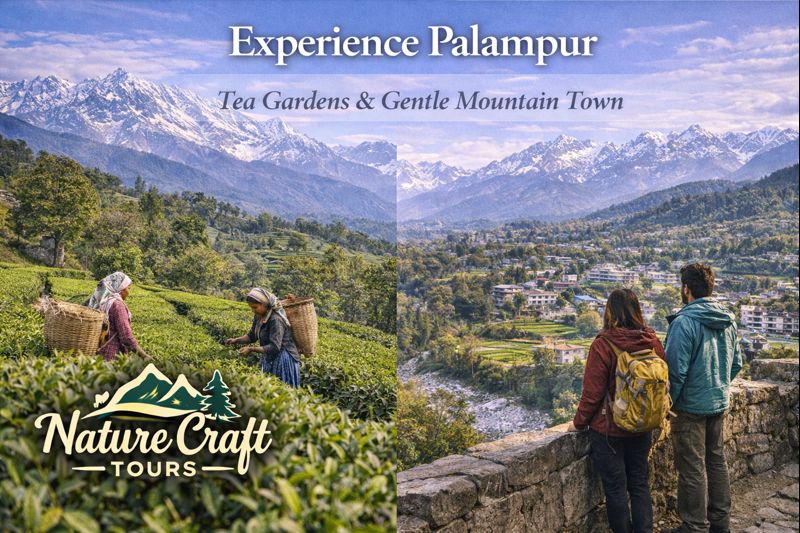
Palampur does not announce itself with spectacle. It reveals itself slowly, through the steady geometry of tea gardens, the soft gradients of foothill terrain, and a townscape shaped more by daily routines than by tourism-driven urgency. Set against the southern slopes of the Dhauladhar range, Palampur represents a different Himalayan experience—one that values continuity over drama, cultivation over conquest, and balance over excess.
Unlike high-altitude towns defined by sharp ascents or dramatic passes, Palampur rests in a zone of relative gentleness. Its elevation allows cool air and clear mountain views, yet its terrain remains hospitable to agriculture, settlement, and long-term habitation. Tea bushes follow the land’s contours with disciplined regularity, villages cluster naturally around fields and streams, and the town itself functions as a lived-in center rather than a seasonal outpost.
This article explores Palampur as a tea-growing landscape and as a mountain town shaped by cultivation, education, and quiet cultural continuity. Written from a field-oriented perspective, it focuses on how geography, economy, and everyday life intersect to create one of Himachal Pradesh’s most understated yet enduring destinations.
Destination Overview: Locating Palampur in the Kangra Foothills
Palampur is located in the Kangra district of Himachal Pradesh, at an average elevation of approximately 1,200 meters above sea level. It lies on a broad plateau formed by ancient geological processes, gently sloping toward the Kangra Valley while rising toward the forested lower reaches of the Dhauladhar mountains.
This geographic position gives Palampur its defining character. It is high enough to enjoy cool temperatures and expansive views, yet low enough to sustain intensive agriculture and permanent settlement. The town is surrounded by tea estates, pine forests, seasonal streams, and small villages that together form a coherent cultural landscape.
Palampur’s spatial organization is dispersed rather than compact. Tea gardens occupy large tracts between settlements, creating a sense of openness and visual continuity uncommon in denser hill towns.
A Landscape Shaped by Cultivation
The defining feature of Palampur is not a single monument or viewpoint but the cultivated landscape itself. Tea gardens function as economic engines, ecological buffers, and aesthetic frameworks, shaping how the town grows and how people move through it.
Historical Context: From Agrarian Plateau to Tea-Growing Region
Before the arrival of organized tea cultivation, the Palampur region supported mixed agriculture and pastoral activities typical of the Kangra foothills. Its transformation began during the nineteenth century, when tea experiments were introduced under colonial administration.
Introduction of Tea Cultivation
The climate and soil conditions of Palampur proved suitable for tea, particularly varieties that thrived in moderate elevations with ample rainfall. Gradually, tea estates expanded across the plateau, reshaping land use patterns and introducing new forms of labor organization.
Unlike plantation systems in some other regions, tea cultivation around Palampur developed alongside existing villages rather than displacing them entirely. This created a mixed landscape where estates, small farms, and settlements coexist.
Continuity and Change
Over time, Palampur evolved into a regional hub for education, administration, and trade, while retaining its agrarian foundation. The town’s growth remained measured, avoiding the rapid, tourism-driven expansion seen elsewhere.
The Tea Gardens: Order, Labor, and Seasonal Rhythm
Tea gardens dominate the visual and cultural identity of Palampur. Stretching across rolling terrain, they introduce a distinctive pattern to the landscape—rows of carefully maintained bushes following gentle curves of the land.
Visual Geometry and Scale
From elevated points, tea gardens appear as textured carpets of green, interrupted by shade trees, workers’ paths, and occasional estate buildings. This geometry creates a calming visual rhythm, reinforcing Palampur’s reputation as a tranquil destination.
Labor and Daily Life
Tea cultivation is labor-intensive and seasonal. Plucking cycles, pruning, and processing define the working calendar, shaping daily routines for many local families. These activities remain largely invisible to casual observers, yet they sustain the town’s economy and identity.
Ecological Dimensions of Tea Cultivation
Tea gardens act as semi-managed ecosystems. While cultivated, they also support soil stability and moderate microclimates. Their presence reduces unchecked urban sprawl and preserves open land around the town.
Palampur Town: Streets, Institutions, and Everyday Calm
Palampur town functions as a service and cultural center for surrounding villages and estates. Its streets are modest in scale, designed for daily commerce rather than spectacle.
Town Structure and Movement
The town spreads horizontally rather than vertically, with low-rise buildings, educational institutions, and markets interspersed with open spaces. Traffic remains limited, and walking remains a practical mode of movement within central areas.
Educational and Cultural Presence
Palampur is known regionally for its educational institutions, which contribute to a steady, year-round population. This academic presence adds to the town’s stability and cultural continuity.
Ecological Setting: Foothills, Forests, and Water Systems
Palampur’s ecology reflects its position between valley and high mountain. Pine forests dominate higher slopes, while mixed vegetation and cultivated land characterize lower elevations.
Forests and Biodiversity
Forests above Palampur regulate water flow and temperature, supporting biodiversity and reducing erosion. These forests form a natural backdrop to the town and its tea gardens.
Streams and Rainfall
Seasonal streams cross the plateau, fed by monsoon rains and mountain runoff. These water systems support agriculture and shape settlement patterns.
Cultural Significance: Rural Continuity and Regional Identity
Palampur’s culture reflects long-term habitation rather than transient populations. Festivals, agricultural cycles, and social structures remain closely tied to land and season.
Village Networks
Surrounding villages maintain strong social and economic links with Palampur town. Weekly markets and shared institutions reinforce these connections.
Quiet Coexistence of Traditions
Modern education, agriculture, and traditional practices coexist without sharp conflict. This balance contributes to Palampur’s understated character.
Key Attractions and Highlights
Tea Garden Walks
Walking through tea estates offers insight into landscape management and seasonal rhythms. These walks emphasize observation rather than activity.
Mountain Views
Clear days reveal the Dhauladhar range rising sharply beyond cultivated slopes, providing a constant visual anchor.
Town Markets and Local Cafés
Local markets reflect everyday life rather than tourist demand, offering a grounded sense of place.
Best Time and Season to Visit Palampur
Spring (March to May)
Spring brings mild temperatures and fresh growth in tea gardens. Visibility is generally good, making this an ideal season for exploration.
Summer (June to September)
Summer is cooler than the plains but marked by monsoon rainfall. The landscape becomes lush, though movement may be limited during heavy showers.
Autumn (October to November)
Autumn offers clear skies, stable weather, and active agricultural scenes. This is one of the most balanced seasons to visit.
Winter (December to February)
Winters are cool and quiet, with occasional cold spells. Snow remains confined to higher elevations.
Ideal Travel Duration
Palampur is best experienced slowly, without rigid schedules.
Suggested Duration
- Two days: Town orientation and tea garden walks
- Three to four days: Deeper exploration of surrounding villages and landscapes
Route and Accessibility
Palampur is accessible by road and rail from major towns in Himachal Pradesh and neighboring regions. Its connectivity supports steady travel without overcrowding.
Internal Movement
Within Palampur, walking and short local transport routes suffice. The town’s scale encourages unhurried movement.
Palampur in a Broader Travel Perspective
Palampur represents a cultivated Himalayan landscape, shaped by agriculture rather than extraction or high-altitude transit. Elsewhere in India, very different geographies have shaped human settlement.
Travelers who contrast Palampur’s tea-growing foothills with river-dominated ecosystems explored on a Sundarban Trip gain insight into how land use and ecology guide cultural development in different regions.
Practical Insights for Travelers
Respecting Working Landscapes
Tea gardens are active workplaces. Visitors should observe from designated paths and avoid disrupting operations.
Weather Awareness
Rainfall can be sudden during monsoon months. Proper clothing and flexible plans are advisable.
Environmental Responsibility
Palampur’s appeal lies in its cleanliness and calm. Responsible waste practices help maintain this balance.
Integrating Palampur into Wider Journeys
Palampur pairs well with travel plans that emphasize ecological diversity. Structured experiences such as a Best Sundarban Tour Package illustrate how contrasting landscapes—from tea gardens to mangrove forests—shape human life.
A Thoughtful Three-Day Plan for Palampur
Day One: Town and Orientation
Explore central Palampur, markets, and nearby tea estates.
Day Two: Tea Landscapes and Villages
Walk through tea gardens and visit surrounding villages, observing agricultural routines.
Day Three: Forest Edges and Reflection
Spend time near forest boundaries and elevated viewpoints, absorbing the region’s quiet rhythm.
Palampur as a Landscape of Balance
Palampur does not seek attention through extremes. Its strength lies in balance—between cultivation and conservation, town and countryside, mountain presence and human scale.
For travelers willing to slow down and observe, Palampur offers a rare Himalayan experience: one where the land is not conquered or consumed, but carefully tended, lived in, and quietly respected.