Khajjiar: Meadow Landscape at the Heart of the Western Himalaya
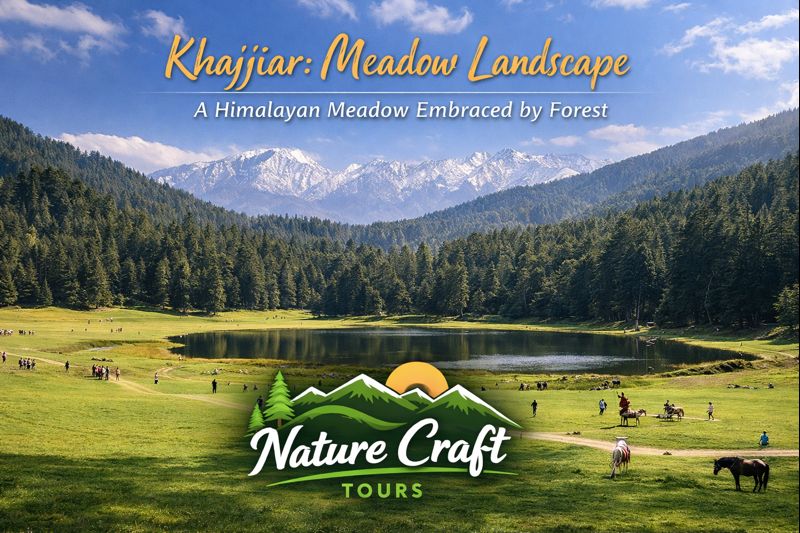
Khajjiar is not a destination that overwhelms the traveler with scale or altitude. It does something subtler and far more enduring. Set within a shallow Himalayan basin and framed by dense deodar forests, Khajjiar presents a meadow landscape that feels deliberately composed—open grassland held gently by tree lines, a quiet lake reflecting sky and season, and surrounding slopes that protect rather than dominate. This is a landscape that invites stillness. It does not demand movement; it allows presence.
Often described through comparisons, Khajjiar does not require borrowed metaphors to establish its identity. Its strength lies in balance. The meadow is neither wild grassland nor manicured park. It is a living ecological clearing shaped by centuries of grazing, forest management, and climatic rhythm. When approached with patience, Khajjiar reveals itself as a textbook example of how Himalayan landscapes transition—forest to pasture, slope to basin, movement to pause.
This travel narrative explores Khajjiar as a meadow ecosystem rather than a postcard stop. It examines the landform, climate, cultural memory, and travel logic that define the place. The intent is not to rush through viewpoints, but to understand how Khajjiar functions as a landscape and why it continues to hold quiet authority within the Western Himalayan travel circuit.
Destination Overview: Understanding Khajjiar as a Meadow System
Geographical Setting and Elevation
Khajjiar is located in the Chamba region of Himachal Pradesh at an elevation of approximately 1,950 meters above sea level. Unlike ridge-top hill stations, Khajjiar occupies a natural depression—a bowl-like meadow surrounded by forested slopes. This topography is essential to its character. The enclosing hills create a sense of shelter, while the open center allows light, wind, and seasonal color to circulate freely.
The meadow spans roughly one square kilometer, though its visual impact extends further due to the gentle gradient of surrounding forests. Deodar cedar dominates the tree cover, accompanied by pine and oak at varying elevations. This composition creates a layered ecological frame, where meadow grasses, water, and woodland coexist in close proximity.
Climate and Seasonal Personality
Khajjiar experiences a temperate mountain climate. Summers remain mild, with daytime temperatures typically ranging between 15°C and 25°C. Evenings cool rapidly, reinforcing the meadow’s calm atmosphere. Winters can be cold, with snowfall occasionally covering the meadow in a thin white sheet that transforms its appearance without erasing its form.
Because Khajjiar sits lower than many high Himalayan viewpoints, it remains accessible for much of the year. However, its landscape changes noticeably with season, making timing an important consideration for travelers seeking specific visual or experiential qualities.
The Meadow Landscape Concept: Why Khajjiar Feels Distinct
A Rare Himalayan Meadow Formation
Natural meadows in the Himalaya are relatively uncommon at mid-elevations. Most open spaces are either high-altitude alpine pastures or narrow terraced clearings. Khajjiar stands apart because its meadow exists as a stable landform, supported by soil depth, seasonal water retention, and long-term vegetation cycles.
The grasses here are not accidental growth. They represent a long ecological negotiation between forest expansion and grazing pressure. Over time, the meadow stabilized, allowing a permanent clearing to exist without collapsing into scrub or reverting fully to woodland.
Visual Balance and Psychological Calm
From a human perception standpoint, Khajjiar offers an ideal balance of openness and enclosure. The meadow provides uninterrupted horizontal space for the eye, while the surrounding forest creates a vertical boundary that prevents visual sprawl. This balance is known to induce calm, which explains why Khajjiar often feels restorative even during short visits.
Unlike dramatic cliff viewpoints that excite the senses, Khajjiar’s meadow landscape slows them. The experience is less about awe and more about quiet grounding.
Historical and Cultural Context
Local Memory and Pastoral Use
Historically, Khajjiar functioned as a grazing ground for surrounding villages. Seasonal movement of livestock shaped the grass composition and maintained open space. This pastoral use embedded the meadow into local economic and cultural systems, long before it entered tourism narratives.
Small temples and local shrines near the meadow reflect its cultural integration. These structures are modest, blending into the landscape rather than asserting dominance. Their presence reinforces the idea that Khajjiar has long been a shared space—used, respected, and preserved through collective practice.
Colonial-Era Recognition
During the colonial period, Khajjiar gained attention as a scenic retreat connected to nearby hill stations. British administrators noted its meadow character as a recreational contrast to forested ridges. However, unlike some hill stations that underwent heavy architectural development, Khajjiar remained largely unchanged, retaining its open form.
Best Time and Season to Visit Khajjiar
Spring to Early Summer (March to June)
This period represents Khajjiar at its most balanced. Grasses regain color after winter, forests remain fresh, and temperatures stay comfortable for long outdoor stays. The meadow appears vibrant without feeling overgrown, making it ideal for walking, sitting, and extended observation.
Monsoon (July to September)
Monsoon introduces deeper greens and occasional mist. While rainfall enhances the meadow’s richness, it can also limit visibility and access. This season suits travelers who value atmosphere over clarity and are comfortable with slower movement.
Autumn (October to November)
Autumn sharpens Khajjiar’s contours. Grass tones shift toward gold, forests thin visually, and distant slopes become more visible. This is an excellent season for photography and quiet exploration.
Winter (December to February)
Winter brings cold and occasional snow. When snow settles lightly on the meadow, Khajjiar transforms into a minimalistic landscape of white, dark trees, and muted sky. Travel during this period requires preparation but rewards with profound stillness.
Ideal Travel Duration and Planning Approach
Khajjiar does not benefit from rushed visits. While it is often treated as a short stop, a more meaningful experience requires time. A minimum stay of one full day allows travelers to witness changes in light, temperature, and activity across the meadow.
When combined with surrounding regions, Khajjiar fits best into a three- to four-day itinerary that includes slow travel rather than constant relocation. Its value lies in repetition—returning to the same spot at different hours and observing subtle shifts.
Route and Accessibility
Approach Routes
Khajjiar is accessible by road from nearby hill towns and valley gateways. The final approach typically involves winding forest roads that descend gently into the meadow basin. This descent is significant: it marks a transition from ridge travel to enclosed landscape, preparing the traveler psychologically for a slower pace.
Those familiar with landscape-led journeys across India may recognize this transition logic. Whether entering a meadow basin or a mangrove delta, such as routes associated with a Sundarban Trip, the approach itself sets the experiential tone.
Local Movement
Once in Khajjiar, movement should be minimal. The meadow is best explored on foot, with slow circuits around its perimeter and pauses near the lake. Vehicles should be used sparingly, only for entry and exit.
Key Attractions and Landscape Highlights
The Central Meadow
The meadow itself is Khajjiar’s primary feature. Walking its edges reveals subtle variations in grass height, moisture, and color. The center remains open and inviting, often dotted with grazing animals that reinforce the landscape’s pastoral heritage.
The Lake
A small lake sits near the center of the meadow, acting as both visual anchor and ecological support. It reflects surrounding trees and sky, changing character with season and weather. The lake contributes to soil moisture and supports birdlife, reinforcing the meadow’s stability.
Forest Edges and Viewpoints
The surrounding deodar forests provide shaded walking paths and elevated perspectives. From certain edges, travelers can observe the meadow as a whole, appreciating its form and relationship with enclosing slopes.
Ecological Significance
Khajjiar represents a rare mid-elevation meadow ecosystem in the Western Himalaya. Its continued existence depends on controlled land use, seasonal grazing balance, and forest preservation. The meadow acts as a micro-habitat supporting grasses, insects, birds, and grazing animals.
Environmental sensitivity is crucial here. Trampling, waste accumulation, and unmanaged tourism pose risks to soil health and vegetation. Conscious travel behavior directly contributes to the meadow’s longevity.
Practical Insights for Responsible Travelers
Clothing and Gear
Layered clothing is essential due to rapid temperature changes. Comfortable walking shoes are recommended, as uneven ground and damp grass can challenge unsuitable footwear.
Time Management
Arrive early or stay late. Midday crowds tend to concentrate briefly, but mornings and late afternoons restore the meadow’s calm. Planning around these rhythms significantly improves experience quality.
Environmental Etiquette
Avoid littering, feeding animals, or damaging grass cover. Khajjiar’s appeal depends on restraint. Treat the meadow as a shared ecological asset rather than an entertainment zone.
Khajjiar in a Broader Nature-Travel Context
Khajjiar belongs to a category of destinations defined not by monumentality but by environmental harmony. Its appeal aligns with other nature-first travel experiences where landscape dictates pace and behavior. Travelers who appreciate such environments often value structured, low-impact itineraries, similar in philosophy to curated journeys like the Best Sundarban Tour Package, where ecosystem sensitivity shapes travel design.
Experiencing Khajjiar Beyond the Surface
Khajjiar is best understood not as a destination to be consumed, but as a landscape to be entered carefully. Its meadow offers space without emptiness, beauty without drama, and calm without isolation. For travelers willing to slow down, observe, and respect the land, Khajjiar delivers a rare Himalayan experience—one defined by balance rather than spectacle.
In an era where travel increasingly favors speed and scale, Khajjiar stands as a reminder that some landscapes are meant to be lived quietly, even if only for a day. Its meadow does not ask for attention. It offers presence. And in that offer lies its enduring value.