Chamba Town:
Temples, River Valley Culture, and the Living Memory of the Western Himalaya
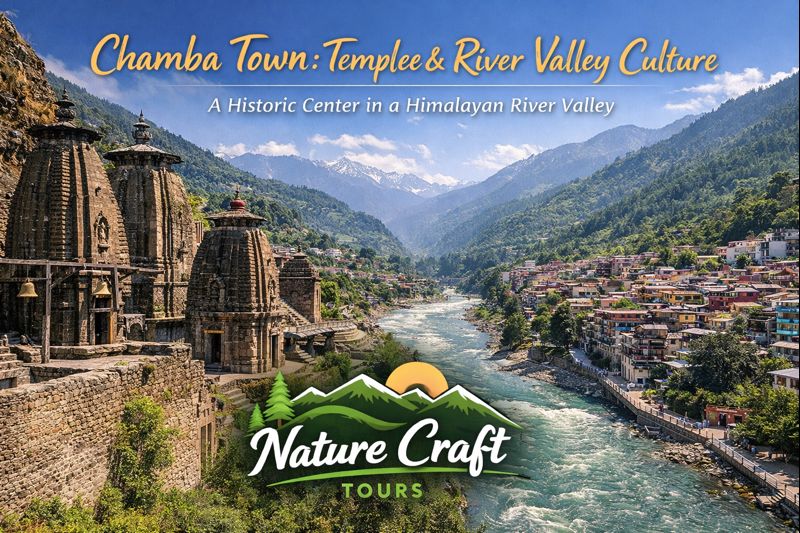
Chamba is not a town that reveals itself at first glance. It does not rely on dramatic skylines or overt spectacle to announce its importance. Instead, Chamba unfolds gradually—through the rhythm of temple bells echoing across the Ravi river valley, through stone pathways shaped by centuries of pilgrimage, and through cultural practices that continue not as performances for visitors, but as lived tradition. Situated in a broad Himalayan basin and surrounded by snow-fed rivers and forested ridges, Chamba represents one of North India’s most intact cultural landscapes.
The identity of Chamba is inseparable from its temples and its river. Here, sacred architecture is not isolated behind gates or elevated on remote peaks; it exists within daily life. The Ravi River flows past ghats, fields, and old settlements, shaping both the economy and the spiritual imagination of the region. Chamba’s culture emerged not from conquest or rapid urbanization, but from continuity—dynasties that ruled locally, artisans who worked for generations, and a geography that encouraged inward focus rather than outward expansion.
This travel narrative approaches Chamba Town as a cultural and river-valley system rather than a checklist destination. It examines how temples, water, history, and everyday life intersect, and how a traveler can experience this intersection respectfully and deeply. Chamba rewards patience. The more slowly one moves through it, the more coherent and meaningful it becomes.
Destination Overview: Where Chamba Stands in the Himalayan Landscape
Geographical Setting and River Valley Context
Chamba Town lies in the western Himalayan region of Himachal Pradesh, positioned on the right bank of the Ravi River at an elevation of approximately 1,000 meters above sea level. Unlike many hill towns built along ridgelines, Chamba occupies a river valley terrace—broad enough to support agriculture, settlement, and ceremonial spaces, yet enclosed by mountains that preserve its climatic and cultural distinctiveness.
The Ravi River is central to Chamba’s identity. Originating in the higher Himalaya, the river descends into the Chamba valley, carrying glacial melt, seasonal sediment, and cultural symbolism. Over centuries, this river supported irrigation, trade routes, and ritual bathing. Even today, its presence defines daily rhythms—morning activity near ghats, seasonal festivals aligned with water cycles, and an agricultural calendar shaped by flow and flood.
Climate and Environmental Character
Chamba experiences a moderate mountain climate compared to higher-altitude hill stations. Summers are warm but rarely oppressive, while winters can be cold without being extreme. This climatic balance contributed to Chamba’s historical role as a stable capital rather than a seasonal retreat. The surrounding hills are covered with mixed forests, while the valley floor supports cultivated land, orchards, and grazing areas.
Historical Foundations of Chamba Town
Origins and Local Dynasties
Chamba’s recorded history extends back over a millennium. The town served as the capital of a small but culturally rich princely state ruled by local dynasties who maintained relative autonomy despite larger regional powers. This continuity of local rule allowed Chamba to develop a distinct architectural and artistic language rather than absorbing external styles wholesale.
Rulers invested heavily in temple construction, public spaces, and patronage of artisans. Unlike imperial capitals designed to project power outward, Chamba evolved inward—focusing on ritual order, artistic refinement, and social stability. This inward orientation remains visible today in the town’s layout and cultural practices.
Chamba Under Colonial Observation
During the colonial period, Chamba was noted for its cultural conservatism and relative isolation. British administrators documented its temples, manuscripts, and court traditions, but large-scale infrastructural transformation remained limited. As a result, Chamba avoided the architectural disruption experienced by many other towns during this era.
Temples of Chamba: Sacred Architecture as Cultural Backbone
Lakshmi Narayan Temple Complex
The Lakshmi Narayan Temple complex stands at the spiritual heart of Chamba. Built between the 10th and 11th centuries, this group of stone temples exemplifies North Indian shikhara-style architecture adapted to Himalayan conditions. The temples are not isolated monuments; they are integrated into the town’s social and ceremonial life.
Daily worship, seasonal festivals, and community gatherings continue here much as they have for centuries. The stone carvings depict deities, mythological narratives, and symbolic motifs that reflect both religious devotion and artistic sophistication.
Chamunda Devi and Riverine Worship
Situated near the river, the Chamunda Devi temple reflects the intimate relationship between spirituality and water in Chamba. River valleys in the Himalaya have long been associated with feminine divine energy, fertility, and protection. Rituals here often incorporate water offerings, reinforcing the sacred geography of the Ravi.
Small Shrines and Living Ritual Spaces
Beyond major temples, Chamba is dotted with smaller shrines—often at crossroads, near springs, or along old paths. These spaces are not tourist attractions; they are functional sacred nodes used by residents in everyday life. Observing these sites offers insight into how spirituality operates organically within the town.
River Valley Culture: Life Shaped by the Ravi
Agriculture and Seasonal Cycles
The Ravi River supports fertile valley soils that have sustained Chamba’s agricultural traditions for centuries. Fields of grains, vegetables, and fodder crops occupy terraces along the riverbanks. Seasonal planting and harvesting remain aligned with water availability, monsoon patterns, and traditional calendars.
This agrarian rhythm influences festivals, food culture, and even local architecture, where storage spaces and courtyards reflect agricultural needs.
Ghats, Pathways, and Social Interaction
River ghats in Chamba are not merely ritual sites; they are social spaces. People gather to bathe, wash clothes, converse, and observe daily life. These interactions reinforce community bonds and maintain the river as a shared resource rather than a distant backdrop.
Cultural Expressions: Art, Craft, and Living Heritage
Chamba Rumal and Textile Tradition
One of Chamba’s most celebrated cultural contributions is the Chamba Rumal, a form of embroidered textile traditionally used for ceremonial purposes. Characterized by intricate narrative embroidery, these textiles depict mythological scenes, court life, and natural motifs.
The tradition emerged under royal patronage and continues today through skilled artisans who preserve its techniques. The rumal represents more than craft; it is a visual archive of Chamba’s cultural imagination.
Music, Dance, and Oral Tradition
Chamba’s folk music and dance forms are closely tied to agricultural cycles and religious festivals. Songs narrate local legends, seasonal changes, and devotional themes. Unlike stage performances, these expressions are woven into communal events, reinforcing cultural continuity.
Best Time and Season to Visit Chamba Town
Spring and Early Summer (March to June)
This period offers the most comfortable conditions for exploration. Temperatures are moderate, and the river valley appears lush without excessive rainfall. Temple visits, walking tours, and cultural observation are especially rewarding during this season.
Monsoon (July to September)
Monsoon transforms the valley into a deeply green landscape, but heavy rainfall can limit movement. Travelers who value atmosphere and introspection may find this season appealing, though flexibility is essential.
Autumn and Winter (October to February)
Autumn brings clarity and crisp air, while winter introduces cold temperatures and occasional snowfall in surrounding hills. Cultural life continues year-round, but winter travel requires appropriate preparation.
Ideal Travel Duration for Chamba
A meaningful visit to Chamba requires time. A minimum of three days allows for temple exploration, river valley walks, and cultural observation. A four- to five-day stay enables deeper engagement with local life and nearby landscapes.
Chamba rewards repetition rather than speed. Visiting the same temple at different times of day or observing the river across changing light conditions reveals layers often missed in rushed itineraries.
Route and Accessibility
Approach to Chamba
Chamba is accessible by road from regional transit hubs. The journey descends gradually into the Ravi valley, marking a transition from forested slopes to cultivated land. This approach prepares travelers for the town’s river-centric orientation.
Travelers accustomed to landscape-led journeys across India may recognize similar transitions when entering ecosystems such as the mangrove deltas explored during a Sundarban Trip, where geography dictates movement and pace.
Movement Within the Town
Chamba is best explored on foot. The town’s historic core, temples, and riverfront are closely connected. Walking allows for observation of daily life and architectural detail that vehicular travel obscures.
Key Attractions and Special Highlights
Chowgan Ground
Chowgan is a broad open space that functions as Chamba’s communal heart. Historically used for royal ceremonies and festivals, it continues to host gatherings and cultural events. Its openness contrasts with the dense temple precincts, offering spatial balance.
Bhuri Singh Museum
The museum houses manuscripts, sculptures, textiles, and artifacts that document Chamba’s artistic and intellectual history. It provides essential context for understanding the town’s temples and crafts.
Practical Insights for Thoughtful Travelers
Cultural Sensitivity
Chamba’s temples remain active religious sites. Modest attire, quiet behavior, and respect for rituals are essential. Photography should be approached cautiously, especially during worship.
Travel Pace and Mindset
Chamba is not a destination for rapid sightseeing. Its value emerges through observation and patience. Travelers seeking high-adrenaline experiences may find it understated, while those interested in cultural depth will find it profoundly rewarding.
Environmental Responsibility
The Ravi River and surrounding valley are sensitive ecosystems. Avoid littering, minimize plastic use, and respect local water practices. Conscious behavior supports both cultural and ecological preservation.
Chamba in a Broader Cultural Travel Context
Chamba exemplifies a form of travel rooted in cultural continuity rather than spectacle. Its appeal aligns with other destinations where landscape and tradition shape experience. Travelers who value such depth often appreciate structured, low-impact itineraries similar in philosophy to nature- and culture-led journeys like the Best Sundarban Tour Package, where environment and heritage guide movement.
Chamba as a Living Cultural Landscape
Chamba Town is not preserved behind glass. It lives—through temples that still echo with prayer, through a river that continues to shape daily routines, and through cultural practices sustained across generations. Its strength lies in continuity rather than reinvention.
For travelers willing to slow down and engage respectfully, Chamba offers a rare opportunity to witness Himalayan culture not as performance, but as lived reality. In its temples and river valley, one finds not only history, but an enduring way of life that continues quietly, confidently, and with remarkable depth.