Sangla Valley: Baspa River Flow and the Enduring Texture of Himalayan Village Life
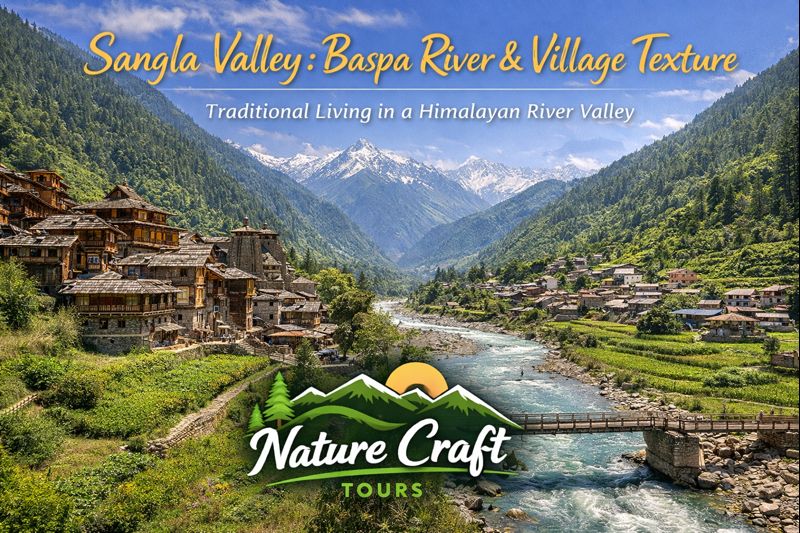
Sangla Valley does not present itself as a dramatic arrival. There is no single moment where the landscape suddenly reveals its full scale. Instead, the valley unfolds gradually—through the steady sound of the Baspa River, through wooden villages clinging to slopes, and through orchards that soften the severity of the high Himalaya. This is a landscape shaped less by spectacle and more by continuity. Sangla Valley is lived in, worked upon, and remembered by generations who have adapted their lives to altitude, season, and river.
The essence of Sangla lies in the relationship between water and settlement. The Baspa River, clear and forceful, carves the valley floor and sustains agriculture, while villages rise above it in tiers of wood, stone, and slate. Unlike destinations designed primarily for tourism, Sangla Valley remains fundamentally agrarian and domestic. Visitors do not enter a curated scene; they step into an ongoing rhythm of work, worship, and seasonal movement.
This travel narrative approaches Sangla Valley as a cultural river corridor rather than a single destination. It explores how the Baspa River shapes ecology, how village architecture responds to climate, and how daily life continues largely unchanged despite increased visibility. The goal is to understand Sangla not as a stopover, but as a living Himalayan system where landscape and people remain deeply interdependent.
Destination Overview: Sangla Valley in the Context of the Western Himalaya
Geographical Setting and Valley Structure
Sangla Valley is located in the Kinnaur region of Himachal Pradesh, extending along the course of the Baspa River, a major tributary of the Sutlej. The valley begins near Karcham and rises steadily toward higher alpine terrain, with elevations ranging roughly from 2,600 meters to well above 3,500 meters in surrounding ridges.
The valley is narrow and linear, with steep slopes on either side. This geography has shaped settlement patterns: villages are built on stable terraces above the river, while fields occupy gentler gradients close to water sources. Forests of pine, deodar, and birch dominate higher elevations, transitioning into alpine meadows further up.
Climate and Environmental Character
Sangla Valley experiences a cold temperate climate. Summers are cool and dry, with warm daylight hours and sharp temperature drops at night. Winters are long and severe, with heavy snowfall isolating the valley for months. These climatic conditions dictate agricultural cycles, architectural design, and travel feasibility.
The Baspa River moderates local microclimates, preventing extreme dryness during summer while contributing to fertile alluvial soils along its banks. This balance allows orchards and crops to thrive despite high altitude.
The Baspa River: Lifeline of the Valley
River Origin and Flow Dynamics
The Baspa River originates from glacial sources in the higher Himalaya, fed by snowmelt and seasonal precipitation. Its flow remains relatively consistent during summer, increasing during peak melt periods and monsoon influence. The river’s clarity and force are defining sensory elements of Sangla Valley.
For residents, the Baspa is not a scenic backdrop but an active participant in daily life. It irrigates fields, supports micro-hydropower, and marks boundaries between cultivated and uncultivated land.
Cultural Relationship with Water
Water holds ritual as well as practical significance in Sangla Valley. Springs, streams, and riverbanks are often associated with local deities and seasonal ceremonies. Offerings and prayers near water reflect a worldview in which natural forces are acknowledged as sentient and powerful.
Village Texture: Architecture, Settlement, and Daily Life
Traditional Wooden Architecture
Villages such as Sangla, Rakcham, and Chitkul display a distinctive architectural style adapted to cold, seismic conditions. Houses are built with interlocking wooden beams and stone infill, topped with slate roofs. This construction provides insulation, flexibility during earthquakes, and durability under heavy snow.
Upper floors are typically used for living spaces, while lower levels store fodder or house livestock. Balconies face the valley, allowing maximum sunlight during winter months.
Spatial Organization and Community Structure
Villages are compact, with homes clustered for warmth and defense against weather. Narrow paths connect houses, fields, and communal spaces. Temples and gathering grounds occupy central positions, reinforcing social cohesion.
Despite increasing outside contact, daily routines remain rooted in agriculture, animal husbandry, and seasonal labor. Visitors who observe quietly will notice how work, conversation, and ritual intertwine seamlessly.
Cultural and Historical Context of Sangla Valley
Kinnauri Heritage and Local Belief Systems
Sangla Valley forms part of the larger Kinnauri cultural region, known for its distinct language, customs, and spiritual practices. Local belief systems blend Hindu, Buddhist, and animistic elements, with village deities playing a central role in governance and seasonal decision-making.
Festivals are timed to agricultural milestones and climatic shifts. Masks, music, and processions serve both religious and social functions, reinforcing collective identity.
Historical Isolation and Gradual Connectivity
Historically, Sangla Valley remained isolated due to its terrain and climate. Trade routes existed but were seasonal and limited. This isolation preserved cultural practices and architectural styles with minimal external influence.
Road connectivity arrived relatively late, and even today access remains dependent on weather conditions. This limited accessibility has slowed mass tourism, allowing the valley to retain its character.
Best Time and Season to Visit Sangla Valley
Late Spring to Early Summer (May to June)
Snow begins to retreat, revealing green slopes and flowing streams. Orchards bloom, and temperatures are comfortable for travel and walking. This is an ideal period for first-time visitors.
Mid-Summer to Early Autumn (July to September)
The valley reaches peak vibrancy. Fields are cultivated, forests are dense, and the Baspa River runs strong. Occasional rain enhances greenery without overwhelming infrastructure. This season offers the fullest expression of village life.
Late Autumn (October)
Harvest season brings golden tones to fields and orchards. Temperatures drop, and preparations for winter begin. This period offers cultural insight and visual clarity but requires warm clothing.
Winter (November to April)
Heavy snowfall isolates the valley. Travel is difficult and often not recommended unless specifically prepared for winter conditions. However, winter defines the valley’s rhythm and explains many aspects of its culture and architecture.
Ideal Travel Duration and Experience Design
Sangla Valley cannot be meaningfully experienced in haste. A minimum stay of three nights allows acclimatization, village walks, and river observation. A five- to six-day itinerary permits deeper engagement, including short hikes, cultural interaction, and slow travel between villages.
The valley rewards repetition. Walking the same path at different times of day reveals changes in light, sound, and activity that define its character.
Route and Accessibility
Approach to the Valley
Access to Sangla Valley is via mountain roads branching from the Sutlej corridor. The journey involves dramatic elevation changes, tunnels, and narrow stretches carved into rock. Travel times are longer than distances suggest, reinforcing the need for patient planning.
As with other ecosystem-driven journeys in India, the approach itself is part of the experience. Travelers familiar with landscape transitions—whether entering a Himalayan valley or navigating tidal forests during a Sundarban Trip—will recognize how geography sets the pace long before arrival.
Movement Within the Valley
Local movement is best done on foot for short distances. Roads connect villages, but walking paths offer closer engagement with fields, riverbanks, and forest edges. Vehicles should be used sparingly to preserve the valley’s quiet character.
Key Attractions and Highlights
Sangla Village
Sangla serves as the valley’s cultural center. Its traditional houses, temple complex, and river views provide an introduction to local life. Short walks around the village reveal orchards, wooden bridges, and agricultural terraces.
Rakcham: Where Valley Narrows
Rakcham lies deeper in the valley, closer to alpine terrain. The village sits amid dramatic landscapes, with the Baspa River rushing close by. It offers a quieter, more remote experience than Sangla.
Chitkul: Upper Valley Settlement
Chitkul marks one of the last inhabited villages along the Baspa. Surrounded by open landscapes and high peaks, it represents the transition from forested valley to alpine zone. The village retains strong traditional practices and architectural integrity.
Ecological Significance of Sangla Valley
Sangla Valley forms part of a sensitive Himalayan ecosystem. Its forests regulate water flow, prevent soil erosion, and support diverse flora and fauna. Alpine meadows above the villages provide seasonal grazing and biodiversity reservoirs.
Human activity here has historically remained within ecological limits. Modern travel must respect these boundaries to avoid disrupting fragile systems.
Practical Insights for Responsible Travelers
Clothing and Preparation
Layered clothing is essential due to rapid temperature changes. Even in summer, nights are cold. Sturdy footwear is recommended for uneven paths and village walks.
Cultural Sensitivity
Villages are not open-air museums. Seek permission before photographing people or private spaces. Observe rituals quietly and dress modestly near temples.
Environmental Responsibility
Avoid single-use plastics, minimize waste, and respect water sources. The Baspa River supports life far beyond the visible valley. Conscious behavior directly contributes to its preservation.
Sangla Valley in a Broader Nature-Travel Perspective
Sangla Valley exemplifies travel rooted in environment and community rather than consumption. Its appeal aligns with destinations where landscape dictates movement and behavior. Travelers who value such depth often appreciate carefully designed, low-impact journeys similar in philosophy to experiences like the Best Sundarban Tour Package, where ecology and culture shape itineraries.
Sangla Valley as a Living River Corridor
Sangla Valley is not defined by a single viewpoint or attraction. It is defined by flow—of water, of seasons, of daily life shaped around the Baspa River. Its villages retain texture because they are lived in, not curated. Its landscapes remain compelling because they are worked, not staged.
For travelers willing to slow down and observe, Sangla offers something increasingly rare: an intact Himalayan valley where culture, ecology, and settlement remain meaningfully connected. It does not seek attention. It sustains itself quietly, through continuity and balance, inviting visitors to witness rather than consume.