Tabo: Monastery Village Atmosphere in the High Desert of Spiti
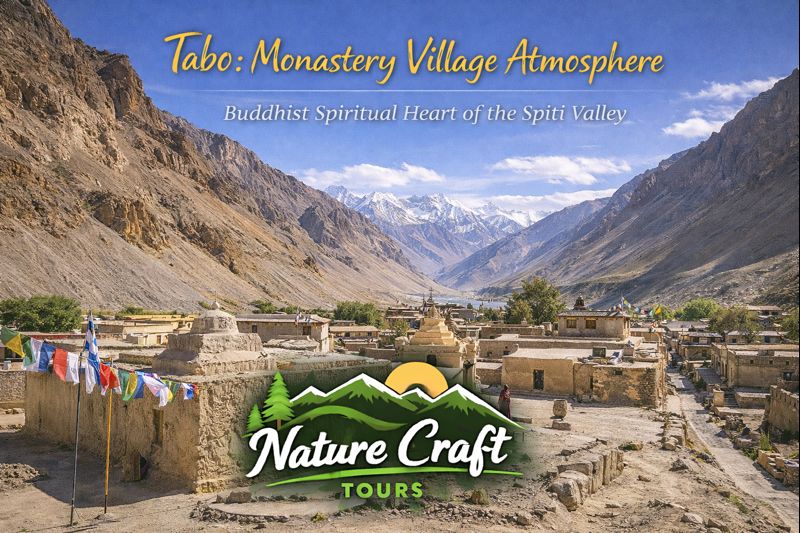
Tabo does not introduce itself through grandeur or elevation. It announces its presence through stillness. Set quietly along the Spiti River, far below dramatic cliffs and away from the fortress-like silhouettes of other Himalayan monasteries, Tabo unfolds as a lived spiritual settlement rather than a monumental statement. The atmosphere here is not defined by spectacle, but by continuity—of prayer, of learning, of daily village routines shaped around one of the oldest surviving monastic institutions in the Trans-Himalayan world.
The phrase “Monastery Village Atmosphere” captures Tabo’s essence precisely. The monastery does not sit above the village; it sits within it. Homes, fields, footpaths, prayer halls, and classrooms coexist without sharp boundaries. Monks walk alongside farmers, children pass murals older than a millennium on their way to school, and the rhythm of bells and chants blends seamlessly with ordinary village sounds. Tabo is not a destination one merely visits—it is a place one temporarily enters, adapting to its pace and discipline.
This travel narrative explores Tabo as a cultural landscape rather than a single attraction. It examines how monastic life and village life are interwoven, how history survives through daily practice, and how travelers can experience Tabo respectfully without disrupting its fragile balance. Using field-oriented observation and research-based context, this guide presents Tabo as one of the most quietly profound destinations in Spiti Valley.
Destination Overview: Where Tabo Stands in Spiti Valley
Geographical Setting and Elevation
Tabo is located in the eastern part of Spiti Valley, Himachal Pradesh, at an elevation of approximately 3,280 meters above sea level. Unlike many monasteries that occupy defensive hilltops, Tabo rests on the valley floor, close to the Spiti River. This location is not accidental. It reflects Tabo’s historical role as a center of learning rather than military or political authority.
The surrounding terrain is characteristic of the Trans-Himalayan cold desert—arid slopes, eroded cliffs, and broad skies with minimal vegetation. The river corridor provides a narrow strip of cultivable land where the village sustains itself through limited agriculture and livestock rearing.
Climate and Environmental Conditions
Tabo experiences an extreme high-altitude climate. Summers are short, dry, and intensely sunlit, while winters are long, cold, and isolating. Annual rainfall is minimal, with snowfall acting as the primary source of water. Temperature fluctuations between day and night are sharp, reinforcing the need for architectural and behavioral adaptation.
These conditions shape daily life in Tabo. Construction materials, clothing, food storage, and travel timing are all dictated by environmental necessity rather than convenience.
The Monastery Village Concept: Why Tabo Feels Different
No Elevated Citadel, No Fortress Walls
Unlike monasteries such as Key or Dhankar, Tabo Monastery does not dominate its surroundings from a height. Its buildings are low, earth-toned, and visually integrated into the village. From a distance, it can be difficult to distinguish where monastery ends and village begins. This spatial equality reflects Tabo’s philosophical orientation—learning and spirituality embedded within daily life rather than separated from it.
This lack of visual dominance contributes to the village’s calm atmosphere. Tabo does not overwhelm the senses; it steadies them.
Living with History, Not Displaying It
Tabo’s murals, stupas, and prayer halls are among the oldest surviving examples of Indo-Tibetan Buddhist art. Yet they are not preserved behind glass or treated as museum artifacts. They remain part of active ritual life. This continuity gives Tabo a lived authenticity that cannot be replicated through restoration alone.
Historical Significance of Tabo Monastery
Foundation and Early Patronage
Tabo Monastery was founded in 996 CE during the reign of the Tibetan king Yeshe-Ö, making it one of the oldest continuously operating Buddhist monasteries in the Himalaya. Established as a center for translation and learning, Tabo played a crucial role in the second diffusion of Buddhism into the region.
Scholars, translators, and teachers associated with Tabo helped standardize Buddhist texts and practices across the Western Himalaya. This intellectual legacy continues to shape the monastery’s identity today.
Survival Through Change
Over more than a thousand years, Tabo has survived political upheaval, climatic extremes, and shifting trade routes. Its valley-floor location made it vulnerable to flooding and erosion, yet its cultural importance ensured continuous community support and maintenance.
Rather than expanding aggressively, Tabo adapted incrementally—repairing, repainting, and reinforcing existing structures while preserving original layouts and functions.
Architectural Character and Sacred Spaces
Mud-Brick Structures and Thermal Intelligence
Tabo’s buildings are constructed primarily of mud brick, stone, and timber. Thick walls provide insulation against cold nights and intense daytime sun. Flat roofs and compact forms minimize exposure to wind and snow accumulation.
This architecture is not decorative; it is practical, reflecting centuries of accumulated environmental knowledge.
Assembly Halls, Stupas, and Murals
The monastery complex includes multiple assembly halls adorned with intricate murals depicting mandalas, deities, and narrative scenes from Buddhist philosophy. These murals are internationally recognized for their age and artistic quality, yet within Tabo they remain functional teaching tools rather than static exhibits.
Small stupas and chortens dot the complex, serving as focal points for circumambulation and meditation.
Monastic Life and Village Rhythm
Daily Life of Monks
Monks at Tabo follow a disciplined routine of prayers, study, teaching, and communal responsibilities. Many are young novices from surrounding villages, receiving education in Buddhist philosophy, language, and ritual practice.
Their presence is understated. Robed figures move quietly through narrow paths, blending into village life rather than standing apart from it.
Village Life Around the Monastery
Residents of Tabo village are deeply connected to the monastery. Agricultural cycles, festivals, and social decisions often align with monastic calendars. Fields are cultivated during the short summer, livestock tended carefully, and supplies stored for long winters.
The monastery provides not only spiritual guidance but also educational and cultural continuity for the village.
Cultural and Spiritual Importance
A Center of Learning
Tabo’s historical role as a learning center continues in modern form. Teachings, debates, and textual study remain central to monastic life. Visiting scholars and senior lamas periodically conduct teachings that draw participants from across the region.
Symbolism of Simplicity
In Buddhist thought, humility and impermanence are core concepts. Tabo’s modest scale and earthen architecture embody these principles physically. The monastery’s power lies not in elevation or visibility, but in endurance and intellectual depth.
Best Time and Season to Visit Tabo
Late Spring to Early Summer (May to June)
As snow melts and access roads reopen, Tabo emerges from winter isolation. Days are cool and bright, nights remain cold, and visitor numbers are manageable. This period allows quiet exploration and acclimatization.
Peak Summer (July to September)
This is the most accessible season. Village life is active, agricultural work is visible, and monastic routines are fully underway. Cultural festivals may occur during this period, offering insight into local traditions.
Autumn (October)
Autumn brings clear skies and reduced visitor traffic. Harvest activities shape village life, but temperatures drop rapidly. Snowfall can occur toward the end of the month.
Winter (November to April)
Heavy snowfall isolates Tabo. Travel is extremely limited and requires specialized preparation. Winter conditions explain much of Tabo’s architectural and cultural discipline.
Ideal Travel Duration
Tabo is best experienced slowly. A minimum of one full day allows basic exploration, but two nights are ideal for absorbing the monastery village atmosphere. Longer stays provide deeper understanding of daily rhythms and seasonal adaptation.
Route and Accessibility
Approach Routes
Tabo is accessible via the main Spiti Valley road, connecting it with Kaza and the broader Himalayan network during the summer months. Travel times are long due to terrain and altitude, reinforcing the need for patient planning.
As with other landscape-governed journeys—whether crossing Himalayan passes or entering tidal forests during a Sundarban Trip—the journey to Tabo shapes expectations before arrival.
Movement Within Tabo
Tabo village is compact and best explored on foot. Walking allows observation of daily life without intrusion and encourages respectful engagement with residents and monks.
Key Attractions and Highlights
Main Assembly Hall
The main assembly hall houses some of the oldest murals in the Himalayan region. Time spent here should be quiet and unhurried, allowing the artwork and atmosphere to speak for themselves.
Village Walks
Simple walks through fields, footpaths, and riverbanks reveal how monastic and agricultural life intersect. These walks often provide more insight than formal sightseeing.
Ecological Sensitivity
Tabo exists within a fragile high-altitude ecosystem. Limited water availability, slow soil regeneration, and extreme climate require careful resource management. Visitor impact must be minimal to avoid long-term damage.
Practical Insights for Travelers
Acclimatization and Health
At over 3,000 meters, gradual acclimatization is essential. Travelers should hydrate, rest adequately, and avoid strenuous activity on arrival.
Cultural Sensitivity
Tabo is an active religious and residential space. Silence, modest attire, and respectful behavior are mandatory within monastery premises. Photography should be discreet and permitted.
Preparation
Layered clothing, sun protection, and sturdy footwear are essential. Weather conditions can change rapidly even in summer.
Tabo in the Context of Conscious Travel
Tabo represents a form of travel grounded in respect, patience, and observation. Its appeal aligns with journeys where culture and ecology dictate pace, similar in philosophy to carefully structured experiences such as the Best Sundarban Tour Package, where environmental awareness shapes engagement.
Tabo as a Quiet Continuum
Tabo does not impress through height or drama. It resonates through continuity. For more than a thousand years, its monastery and village have functioned as one organism—learning, farming, praying, and enduring together in one of the world’s harshest inhabited environments.
For travelers willing to slow down and observe rather than consume, Tabo offers an experience of rare depth. Its monastery village atmosphere is not curated or performed; it is lived daily. In that quiet persistence lies Tabo’s true significance—an unbroken thread of faith and community stretching across centuries.