Sittong’s Silence: A Dialogue Between Birds, Breeze, and Hillside Agriculture
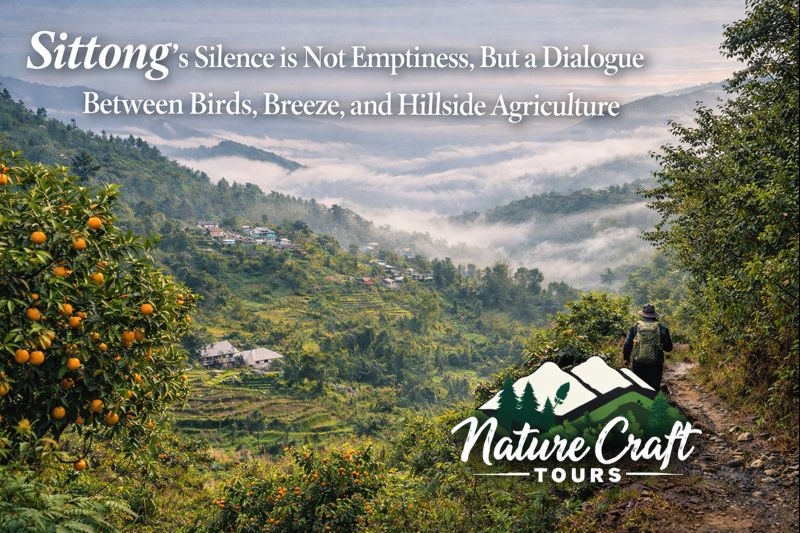
Sittong’s silence is not emptiness, but a dialogue between birds, breeze, and hillside agriculture. In a world increasingly conditioned to equate silence with absence, Sittong offers a counterpoint—a landscape where quietness is active, layered, and expressive. The village does not fall silent because nothing happens here; it grows quiet because life proceeds without interruption. Every sound belongs, every pause has purpose, and every movement—natural or human—fits into a long-established rhythm.
Located in the lower Eastern Himalayan foothills, Sittong is not shaped by spectacle or speed. Its defining quality lies in continuity: the unbroken relationship between forest ecology, subsistence agriculture, and everyday rural life. To understand Sittong is to listen carefully—not just with the ears, but with attention trained on patterns, cycles, and subtle interactions. This is a destination that reveals itself gradually, rewarding patience over urgency and observation over itinerary.
Destination Overview: Where Sittong Exists and How It Lives
Sittong lies in the lower Darjeeling hills of northern West Bengal, positioned between the better-known hill towns of Kurseong and Kalimpong. Geographically, it occupies a transitional zone where higher Himalayan terrain gently descends into river-fed foothills. This location places Sittong at an ecological crossroads, where subtropical climate patterns dominate and biodiversity remains exceptionally high.
The village is not organized around a central market or tourist hub. Instead, it consists of several small hamlets scattered across slopes, ridges, and valleys. Agricultural terraces, forest patches, and narrow footpaths define movement and settlement. Roads exist, but they do not dominate; walking remains integral to daily life. This dispersed structure reduces density and noise, allowing natural soundscapes to remain intact.
Sittong’s identity is rooted not in what it offers visitors, but in how it sustains itself. The village functions as a living landscape, shaped by land use rather than land display.
Understanding Silence as an Ecological Language
In Sittong, silence is not the absence of sound but the absence of intrusion. The background noise of engines, crowds, and amplified activity is largely missing. What remains is a layered acoustic environment shaped by wind through leaves, water flowing through channels, bird calls, and the occasional human voice engaged in work rather than performance.
This soundscape is an indicator of ecological health. Birds vocalize freely because their habitats are intact. Wind patterns are audible because tree cover remains dense and continuous. Agricultural activity produces rhythmic, low-impact sounds—tools striking soil, footsteps along paths—that blend rather than dominate.
For travelers, this environment recalibrates perception. Listening becomes as important as seeing, and silence becomes informative rather than empty.
Birdlife: The Most Consistent Voices in the Landscape
Birds are among the most expressive participants in Sittong’s daily dialogue. The combination of subtropical forest cover, fruit-bearing trees, water sources, and low disturbance levels creates ideal conditions for a wide range of resident and migratory species. Mornings and late afternoons are especially active, marked by layered calls that change with season and weather.
Unlike destinations where birdwatching is formalized into designated zones, Sittong offers incidental encounters. Birds appear along footpaths, near agricultural plots, and at forest edges. Their presence is not staged or predictable, reinforcing the sense that the village exists primarily as habitat rather than attraction.
For attentive visitors, these sounds provide insight into seasonal transitions, weather changes, and ecological balance.
The Role of Breeze and Microclimate
Wind plays a subtle but essential role in Sittong’s environment. Breezes move through valleys and along ridges, carrying moisture, moderating temperature, and dispersing seeds and pollen. The interaction between wind and vegetation creates constant, gentle sound—leaves shifting, bamboo bending, grasses brushing against one another.
Cloud cover further shapes microclimate. Morning mist often settles into lower areas, lifting gradually as temperatures rise. This cloud presence maintains humidity levels essential for subtropical vegetation and contributes to the acoustic softness of the landscape.
For agriculture, these conditions are critical. Crops such as oranges and cardamom rely on stable moisture and filtered sunlight, both of which are supported by Sittong’s climate patterns.
Hillside Agriculture as a Living System
Agriculture in Sittong is inseparable from the surrounding hills. Terraced fields follow natural contours, minimizing erosion and maximizing water retention. Cultivation practices have evolved over generations in response to slope, soil, and rainfall rather than market uniformity.
Orange orchards are among the most visible agricultural features, particularly in winter. Cardamom is grown under forest shade, requiring intact canopy and stable humidity. Seasonal vegetables and subsistence crops fill smaller plots, ensuring food security and crop diversity.
These fields are not silent spaces. They carry the sounds of daily labor—measured, repetitive, and purposeful. Agriculture here contributes to the village’s acoustic identity, reinforcing the idea that silence in Sittong is structured rather than vacant.
Forest Ecology and Low Human Disturbance
Sittong is surrounded by mixed broadleaf forests characteristic of the Eastern Himalayan foothills. These forests function as ecological corridors, linking higher-altitude habitats with riverine systems below. Because the village lies outside major tourism circuits, forest disturbance remains minimal.
Wildlife presence is subtle. Small mammals, reptiles, and amphibians are part of the ecosystem, though rarely seen directly. Their existence is inferred through tracks, calls, and movement within undergrowth. Artificial lighting is limited, allowing nocturnal species to maintain natural behavior.
This low level of disturbance contributes directly to the village’s quiet character. Silence here reflects ecological stability rather than isolation.
Cultural Life Rooted in Routine, Not Performance
The cultural fabric of Sittong is shaped by land, season, and shared labor. Communities are small and closely connected, with social interactions grounded in familiarity rather than formality. Daily routines revolve around farming, forest use, and weather patterns.
Festivals and gatherings often align with agricultural cycles rather than fixed dates. Architecture prioritizes function—sloped roofs for heavy rainfall, raised foundations to manage moisture, and materials chosen for longevity. There is little emphasis on visual display or tourist-oriented design.
Visitors encounter a culture that does not seek attention. Meaningful engagement arises through observation, patience, and respect for local pace.
Forest Trails and the Experience of Moving Quietly
Sittong’s forest trails are essential to daily life. These paths connect homes, fields, water sources, and forest interiors. They are shaped by repeated use rather than formal planning, following contours that minimize effort and environmental impact.
Walking these trails encourages slow movement. Paths may narrow, fork, or become obscured by vegetation, particularly after monsoon rains. The absence of signage reinforces reliance on awareness rather than direction.
For travelers, these trails offer immersion without intrusion—movement that aligns with the landscape rather than imposing upon it.
Best Time to Visit Sittong
Winter (November to February)
Winter provides the most stable conditions for travel. Days are cool and clear, nights remain mild, and agricultural activity—particularly orange harvest—is visible. Trails are generally accessible, and soundscapes are crisp and defined.
Spring (March to April)
Spring brings flowering trees, renewed cultivation, and heightened bird activity. This season is ideal for extended walks and ecological observation.
Monsoon (May to September)
The monsoon transforms Sittong into a lush, water-rich environment. While visually striking, travel during this period requires flexibility due to slippery paths and intermittent access challenges.
Ideal Travel Duration
A stay of two to three nights allows sufficient time to experience Sittong’s rhythms without haste. Longer stays suit travelers interested in slow travel, writing, or environmental study, as the village reveals itself through repetition rather than variety.
Route and Accessibility
Sittong is accessed from Siliguri via hill roads passing through intermediate towns. The final approach involves narrow roads that clearly signal a transition from urban networks to rural seclusion. Public transport options are limited, making private or shared vehicles the most practical choice.
Key Attractions and Subtle Highlights
- Bird-rich forest edges and agricultural fields
- Orange orchards and shade-grown cardamom plots
- Soft wind movement through subtropical canopy
- Forest trails used for daily life rather than tourism
- Quiet valleys shaped by cloud and breeze
Sittong in a Broader Eastern India Journey
Many travelers choose to contrast the quiet foothill environment of Sittong with other ecological regions in eastern India. After time here, some continue toward deltaic landscapes through a Sundarban Trip, where tidal rhythms and mangrove forests create a dramatically different soundscape. Others prefer a structured Sundarban Tour Package to explore the coastal ecosystems of the region.
Within the Darjeeling hills, travelers seeking quieter alternatives increasingly focus on Sittong for its restraint and ecological balance. Deeper narrative context can be found through long-form explorations of Sittong and its surrounding foothills.
Practical Insights for Thoughtful Travelers
Travel in Sittong requires preparation and adaptability. Footwear suitable for uneven terrain is essential, and itineraries should allow for weather-related changes. Connectivity may be inconsistent, reinforcing the importance of self-reliance.
Above all, travelers should approach Sittong without expectations of entertainment or curated experiences. The village offers no schedule, only an invitation to listen, observe, and adjust to a landscape that speaks softly but continuously.
Listening to a Living Silence
Sittong’s silence is not emptiness, but a dialogue between birds, breeze, and hillside agriculture. It is a silence shaped by balance, continuity, and restraint—a soundscape where every element belongs. For travelers willing to slow down and listen, Sittong offers something increasingly rare: a place where quietness communicates, and where the absence of crowds allows the land to speak in its own, enduring voice.