🏔️ Amarnath Yatra – 5 Days
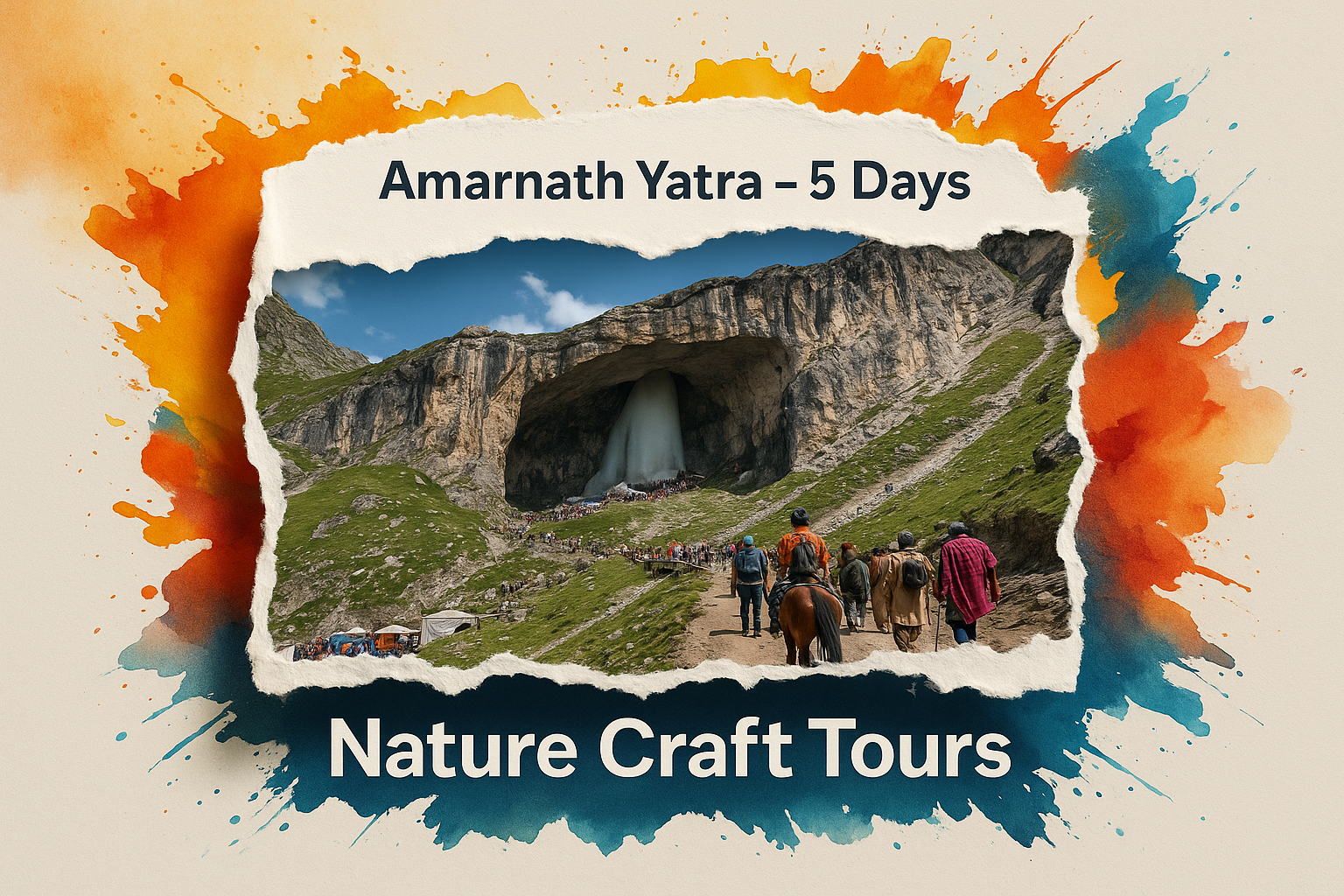
“A Sacred Sojourn to the Cave of Eternal Ice”
The Amarnath Yatra is one of the most revered pilgrimages in India, a journey that transcends physical endurance and touches the realm of divine faith. Hidden high in the Himalayas of Jammu and Kashmir, at an altitude of about 3,888 meters, the Amarnath Cave houses a naturally formed ice Shiva Linga that waxes and wanes with the lunar cycle. Devotees from across the world undertake this sacred yatra each year to seek blessings from Lord Shiva. The journey to this holy cave is not merely a trek—it is an experience of surrender, devotion, and awakening.
🌄 Overview of the Amarnath Yatra
The Amarnath Yatra is organized annually by the Shri Amarnath Shrine Board (SASB) during the summer months, usually from late June to August, coinciding with the Hindu month of Shravan. The yatra takes pilgrims through breathtaking mountain passes, dense pine forests, snowfields, and streams. The main attraction is the naturally occurring ice Shiva Lingam, which symbolizes Lord Shiva and is believed to form from water droplets falling from the cave’s roof.
Two traditional routes lead to the holy cave: Baltal and Pahalgam. The Baltal route is shorter but steeper, preferred by trekkers seeking a quicker yet challenging climb. The Pahalgam route, on the other hand, is longer but more scenic and spiritually enriching, often chosen by devotees who wish to absorb the essence of the Himalayas and the stories associated with the journey.
🕉️ Mythological Significance
According to Hindu mythology, Lord Shiva revealed the secret of immortality, the Amar Katha, to Goddess Parvati in this cave. To ensure no living being overheard this secret, Shiva left behind his vehicle Nandi, the moon, the five elements, and even his son Ganesha before entering the cave. It is said that a pair of pigeons overheard the secret and became immortal, and even today, many pilgrims report sightings of these divine birds near the cave, symbolizing the eternal presence of Lord Shiva’s power.
🗓️ 5-Day Detailed Itinerary – Amarnath Yatra
📍 Day 1: Arrival at Srinagar – Gateway to the Divine
Your journey begins with arrival at Srinagar, the picturesque capital of Jammu and Kashmir. The city, known as “Heaven on Earth,” rests gracefully on the banks of the Jhelum River. Upon arrival, travelers can explore the charming Dal Lake, enjoy a Shikara ride, and stroll through the Mughal Gardens—Shalimar Bagh, Nishat Bagh, and Chashme Shahi. Overnight stay in Srinagar offers both acclimatization and spiritual calm before the arduous trek begins.
🏡 Suggested Stay Options:
- Deluxe Houseboats on Dal Lake
- Luxury hotels around Boulevard Road
- Budget lodges and local guesthouses in Rajbagh or Dalgate
📍 Day 2: Srinagar to Pahalgam (95 km / 3 hours) – Base of the Yatra
After breakfast, drive from Srinagar to Pahalgam, often referred to as the “Valley of Shepherds.” This charming valley, located at 2,200 meters, serves as one of the main base camps for the Amarnath Yatra. En route, devotees often visit the Mamleshwar Temple and Martand Sun Temple—two sacred sites steeped in ancient legends.
Pahalgam is a serene retreat surrounded by pine-clad mountains and the Lidder River. It is an ideal location to rest, collect permits, hire porters or ponies, and prepare for the spiritual journey ahead.
🏡 Recommended Stays:
- Premium Resorts near Lidder River
- Mid-range hotels at Aru and Chandanwari base
- Budget camps and Yatri Niwas accommodations
📍 Day 3: Pahalgam to Chandanwari – Trek to Sheshnag (12 km / 5-6 hrs)
From Pahalgam, a short drive takes you to Chandanwari (16 km), the starting point of the trek. The trail begins amidst majestic mountains and alpine meadows. Pilgrims chant “Har Har Mahadev” as they ascend the winding path towards Sheshnag—a high-altitude lake believed to be the abode of the mythical serpent deity Sheshnag, who served Lord Vishnu. The turquoise waters of the lake reflect snow-laden peaks and create an aura of divinity.
Overnight stay at Sheshnag in tented camps or government-run Yatri camps offers a thrilling experience of sleeping under the stars at nearly 3,600 meters.
📍 Day 4: Sheshnag to Panchtarni – Visit to Amarnath Cave (14 km / 7 hrs)
The trek from Sheshnag to Panchtarni is both challenging and rewarding. Pilgrims cross the Mahagunas Pass (4,200 meters) before descending into the wide Panchtarni Valley, named after the five rivers that flow from this sacred land. From Panchtarni, the Amarnath Cave lies just 6 km away—a journey that takes pilgrims through glacial streams and rocky paths, testing both faith and endurance.
Upon reaching the cave, devotees bow before the majestic ice Shiva Lingam, symbolizing the eternal presence of Lord Shiva. The atmosphere resonates with chants, the fragrance of incense, and the hum of bells. The cave, despite its simplicity, exudes an inexplicable spiritual force that humbles every soul.
After darshan, pilgrims return to Panchtarni for an overnight stay in camps.
📍 Day 5: Panchtarni to Baltal (14 km) – Drive to Srinagar (100 km / 3.5 hrs)
The return journey follows a different route through Baltal, known for its steep yet shorter descent. The route offers mesmerizing views of glaciers, waterfalls, and rugged cliffs. At Baltal, vehicles await to transfer pilgrims back to Srinagar, marking the completion of a divine circle—the journey from man to god and back to the world with renewed faith.
In the evening, enjoy leisure time by the lake or a visit to local bazaars before concluding the Yatra.
🚗 How to Reach Amarnath
By Air ✈️
The nearest airport is Srinagar International Airport (Sheikh-ul-Alam Airport), well-connected to major Indian cities like Delhi, Mumbai, Kolkata, and Chennai. From the airport, taxis and shared cabs are available to reach Pahalgam or Baltal, the base points for the Yatra.
By Rail 🚉
The closest railway station is Jammu Tawi Railway Station (about 270 km from Pahalgam and 400 km from Baltal). Regular trains operate from Delhi, Kolkata, Mumbai, and other cities. From Jammu, pilgrims can take buses or private taxis to reach the Yatra camps.
By Road 🛣️
Jammu and Srinagar are connected by the National Highway 44 (NH-44). Government and private buses, as well as tourist coaches, ply regularly from Jammu to Srinagar, Pahalgam, and Baltal. Roads remain open during the summer months but may close in winter due to heavy snowfall.
🧭 Major Distances
| Route | Distance |
|---|---|
| Srinagar to Pahalgam | 95 km / 3 hours |
| Pahalgam to Chandanwari | 16 km / 1 hour drive |
| Chandanwari to Sheshnag | 12 km trek |
| Sheshnag to Panchtarni | 14 km trek |
| Panchtarni to Amarnath Cave | 6 km trek |
| Panchtarni to Baltal | 14 km trek |
| Baltal to Srinagar | 100 km / 3.5 hours drive |
🏕️ Accommodation Options
During the Yatra season, various staying options are provided by both private and government agencies:
- Yatri Niwas: Managed by the Shrine Board in Jammu, Srinagar, Baltal, and Pahalgam, offering dormitory and basic room facilities.
- Tented Camps: Comfortable and secure tents with bedding and warm blankets are available at Chandanwari, Sheshnag, and Panchtarni.
- Hotels in Srinagar: Range from 3-star boutique hotels to luxury houseboats on Dal Lake offering unmatched comfort and Kashmiri hospitality.
- Government Guest Houses: Located in Pahalgam and Baltal for pilgrims seeking budget accommodation.
It is recommended to book accommodations in advance as availability becomes limited during the peak pilgrimage months of July and August.
🧘♂️ Important Points to See During the Yatra
- Amarnath Cave: The central shrine housing the ice Shiva Linga.
- Sheshnag Lake: A mystical lake with mythological significance and breathtaking alpine beauty.
- Panchtarni: Confluence of five sacred rivers believed to represent the five elements of creation.
- Chandanwari: The symbolic spot where Lord Shiva left behind his moon and ornaments.
- Pissu Top: A high-altitude pass marking the victory of devas over demons, offering panoramic Himalayan views.
- Pahalgam Valley: Known for lush meadows and as the starting point of the traditional Yatra route.
- Srinagar: A perfect blend of spirituality and scenic grace, offering houseboats, gardens, and the charm of Kashmiri culture.
📜 Registration & Permits
All pilgrims must register with the Shri Amarnath Shrine Board before commencing the journey. The registration process includes a compulsory health certificate to ensure that devotees are physically fit for the high-altitude trek. The SASB also provides RFID cards for tracking and safety. Registration usually opens in April, and yatris can choose between the Pahalgam and Baltal routes.
🚶♀️ Modes of Travel to the Cave
- On Foot: The traditional and most rewarding way, though physically demanding.
- Pony/Mule: Available on hire at Chandanwari or Baltal for the entire route.
- Palki (Doli): Carried by porters for elderly or differently-abled pilgrims.
- Helicopter Service: Helicopter rides are available from Baltal and Pahalgam up to Panchtarni, reducing travel time significantly.
🕒 Best Time to Visit
The Amarnath Yatra is open only during the summer months when the weather permits safe passage to the cave. The ideal time to visit is between July and mid-August, aligning with the Shravan month as per the Hindu calendar. During this period, the ice Lingam reaches its full size, and the climate remains comparatively mild for trekking.
Early July offers less crowd and cooler weather, while August provides better accessibility and infrastructure. Avoid the monsoon peaks or late-August when melting snow may cause slippery trails.
⚠️ Travel Tips & Precautions
- Carry sufficient woolens, gloves, and rain protection as weather conditions change abruptly.
- Acclimatize properly at Pahalgam or Srinagar before ascending to high altitudes.
- Drink water frequently to avoid dehydration and altitude sickness.
- Carry dry fruits, chocolates, and glucose for energy.
- Do not litter—maintain the sanctity of the Himalayas.
- Follow the instructions of the Shrine Board and security forces strictly.
- Avoid overexertion; proceed gradually and take rest at designated points.
🙏 Spiritual Essence of the Yatra
Every step on the Amarnath trail echoes the name of Lord Shiva. The rhythmic chants, the ringing bells, the Himalayan winds, and the serene solitude together create a sacred symphony. Pilgrims describe a sense of inner cleansing—a feeling of having reached the abode of eternity. The journey teaches humility, patience, and faith, reminding every traveler that true pilgrimage is not only about reaching a destination but about discovering oneself in the divine silence of the mountains.
🌅 Poetic Tribute – “Whispers of the Ice Cave”
Beneath the sky of azure hue,
Where glaciers guard the morning dew,
A whisper calls from peaks afar,
“Come seek the truth of who you are.”

The bells resound, the rivers sing,
The soul ascends on faith’s own wing.
Through pain and prayer, through storm and snow,
To Amarnath, the hearts all go.

The cave awaits in silver light,
The Lingam gleams in frozen white.
There stands the Lord, serene and still,
Beyond all time, beyond all will.

Pilgrims bow with tears and grace,
In Shiva’s realm, they find their place.
The ice dissolves, the heart is freed,
For God is found in every creed.
🌍 Responsible Travel
As guardians of nature’s sanctuaries, travelers must preserve the purity of the Himalayas. The Amarnath region is ecologically fragile—avoid plastic usage, respect local traditions, and follow eco-friendly practices. Responsible travel ensures that this sacred path remains open for future generations of seekers.
🌺 Conclusion
The Amarnath Yatra is more than a pilgrimage—it is a dialogue between the human soul and the eternal spirit. From the lush valleys of Pahalgam to the icy silence of the cave, every mile narrates a story of faith, endurance, and divine revelation. As the journey concludes, pilgrims carry home not just the blessings of Lord Shiva but a profound understanding of life’s impermanence and the serenity of surrender.
Embark on this sacred five-day journey with reverence and preparation, for it is said that one who completes the Amarnath Yatra with a pure heart attains liberation from the cycle of birth and death—Moksha itself.