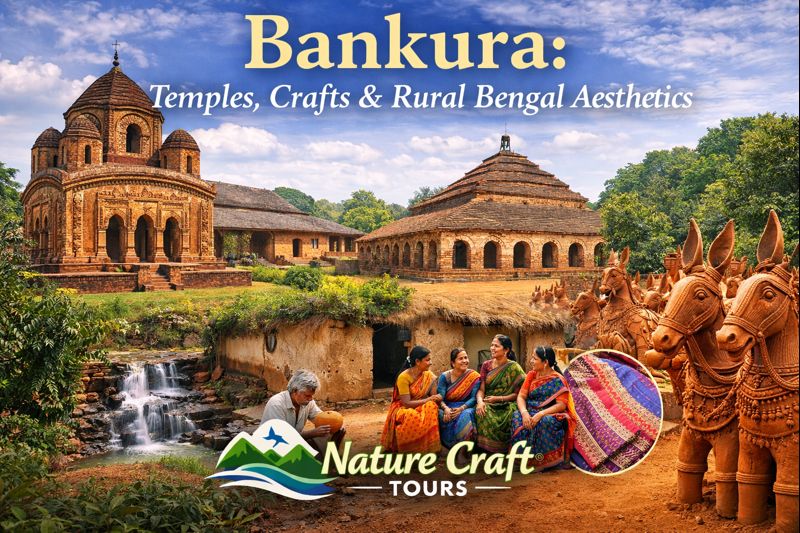
Bankura is a district where Bengal reveals its most grounded and enduring identity. Far removed from colonial grandeur and urban spectacle, Bankura embodies the rural heart of western Bengal—an expansive land of laterite soil, terracotta temples, folk crafts, forested hills, and age-old village rhythms. Situated between the plains of central Bengal and the undulating edge of the Chota Nagpur Plateau, Bankura is both a cultural bridge and a geographical transition zone.
To explore Bankura is to encounter Bengal in its elemental form. Here, art grows out of clay-rich earth, temples rise in harmony with village life, and craft traditions are inseparable from everyday survival. This article approaches Bankura as an explorer would—reading its landscape, listening to its silences, and understanding how aesthetics, faith, and rural economy have evolved together over centuries.
Geographical Context: The Land of Laterite and Sal Forests
Bankura occupies the western flank of West Bengal and is characterized by lateritic red soil, rocky terrain, and scattered forest cover. Rivers such as the Damodar, Kangsabati, and Dwarakeswar flow across the district, though they are largely seasonal and dependent on monsoon rainfall.
The landscape transitions gradually from fertile plains in the east to dry uplands and forested tracts in the west. This geographical diversity has shaped distinct settlement patterns, agricultural practices, and artistic traditions. Scarcity of water and arable land encouraged resilience, frugality, and deep ecological awareness among local communities.
Historical Overview: From Ancient Kingdoms to Temple Patronage
Bankura’s historical narrative stretches back to ancient times, with references to early settlements in epigraphic and literary sources. The region gained prominence during the medieval period under local Hindu dynasties who ruled semi-autonomous territories.
These rulers were not imperial conquerors but regional patrons. Their legacy survives primarily through temple architecture rather than palaces or forts. The temples of Bankura were built not only as religious centers but also as markers of social cohesion, craftsmanship, and artistic expression.
Unlike urban temple complexes elsewhere in India, Bankura’s temples were deeply embedded within village life. Festivals, agricultural cycles, and community gatherings revolved around these sacred structures.
Terracotta Temples of Bankura: Architecture Born from Earth
Bishnupur: The Temple Town
Bishnupur stands as the cultural nucleus of Bankura. Once the capital of the Malla kings, the town is renowned for its exquisite terracotta temples built between the 17th and 18th centuries. Constructed primarily of baked clay bricks, these temples exemplify how material constraints were transformed into artistic opportunity.
Terracotta panels depict scenes from epics, folklore, daily rural life, and flora-fauna motifs. Each panel functions as both decoration and narrative, offering insight into the social imagination of the period.
Rasmancha
Rasmancha is among the earliest brick temples in the region, designed as a ceremonial platform for Vaishnavite festivals. Its distinctive pyramidal structure reflects experimentation in form and spatial design. During religious festivals, idols from surrounding temples were brought here, turning the structure into a focal point of communal worship.
Jor Bangla and Shyam Rai Temples
The Jor Bangla Temple mimics the traditional Bengali hut style, with its curved roof and twin structures. This architectural choice symbolizes the seamless integration of sacred and domestic forms. The Shyam Rai Temple, with its pancharatna (five-towered) design, showcases some of the finest terracotta artistry in Bengal.
Craft Traditions: Art as Livelihood
Bankura Terracotta Horses
The iconic terracotta horse of Bankura is more than a decorative object; it is a ritual symbol offered to village deities. Crafted by hand using locally sourced clay, these horses vary in size and design, reflecting both aesthetic sensibility and devotional intent.
Over time, the terracotta horse has become a symbol of rural Bengal itself—an emblem of faith, craftsmanship, and continuity.
Baluchari Sarees
Baluchari sarees, traditionally woven in and around Bishnupur, are known for their elaborate narrative pallus depicting mythological scenes. Although the craft faced decline, revival efforts have restored its significance as a cultural and economic asset.
Each saree represents weeks of labor and storytelling through thread, preserving visual narratives once carved in temple walls.
Rural Life and Aesthetic Simplicity
Bankura’s villages offer an immersive experience of rural Bengal aesthetics. Mud houses with painted walls, courtyards shaded by trees, and ponds serving as social centers create a visual harmony rooted in practicality.
Daily life follows natural rhythms—early mornings, midday rest, and evenings filled with conversation and folk music. Seasonal festivals, harvest rituals, and village fairs reinforce community bonds and cultural memory.
Nature and Forested Landscapes
Sal Forest Belts
Western Bankura features sal-dominated forests that support biodiversity and tribal livelihoods. These forests are integral to local culture, providing medicinal plants, fuel, and spiritual spaces.
Hillocks and Reservoirs
Low hill ranges and man-made reservoirs punctuate the landscape, especially near the plateau edge. These areas offer serene settings for nature walks and quiet reflection.
Best Time to Visit Bankura
October to February
The most suitable time to explore Bankura is from October to February. Cooler temperatures and dry weather allow comfortable exploration of temples, villages, and craft centers.
Seasonal Observations
Summer months can be intensely hot, particularly in lateritic zones. Monsoon brings lush greenery but may restrict movement due to muddy roads and waterlogging in rural areas.
How to Reach Bankura
Bankura is well connected by rail from Kolkata and other parts of West Bengal. Road travel offers scenic routes through rural landscapes and temple towns.
The nearest major airport is Kolkata, from where onward travel by train or car is convenient.
Suggested 4-Day Explorer’s Tour Plan
Day 1: Arrival and Bishnupur Orientation
Arrive in Bankura and proceed to Bishnupur. Visit Rasmancha and nearby temples. Spend the evening observing local life and temple surroundings.
Day 2: Temple and Craft Exploration
Explore Jor Bangla, Shyam Rai, and Madan Mohan temples. Visit terracotta craft workshops and weaving clusters to understand traditional techniques.
Day 3: Rural Villages and Forest Edge
Travel to nearby villages and forested areas. Interact with artisans and farmers to gain insight into rural livelihoods and seasonal practices.
Day 4: Cultural Reflection and Departure
Spend the final day revisiting favorite sites or attending local markets. Depart Bankura with a deeper understanding of rural Bengal aesthetics.
Bankura in the Broader Travel Narrative
For travelers interested in exploring Bengal beyond its urban centers, Bankura provides an essential perspective. Many culturally inclined journeys combine temple towns and rural craft regions with ecological destinations such as the Sundarban Tour, offering a comprehensive understanding of Bengal’s diverse landscapes.
Extended itineraries often weave together plateau districts and riverine ecosystems through curated routes that include heritage and nature-focused experiences such as a Sundarban Travel journey.
Why Bankura Matters
Bankura does not overwhelm the traveler with spectacle. Instead, it invites quiet attention—to clay shaped by hand, stories carved into temple walls, and villages sustained by collective memory. Its importance lies in continuity, where art and life are inseparable.
For the explorer, Bankura offers a rare opportunity to witness how rural aesthetics emerge naturally from land, labor, and belief. In its temples and crafts, one finds a Bengal that endures not through preservation alone, but through daily practice and shared identity.