Bhadrak–Chandabali Coastal Backwaters
— Local Coastal Life Along Odisha’s Quiet Estuaries
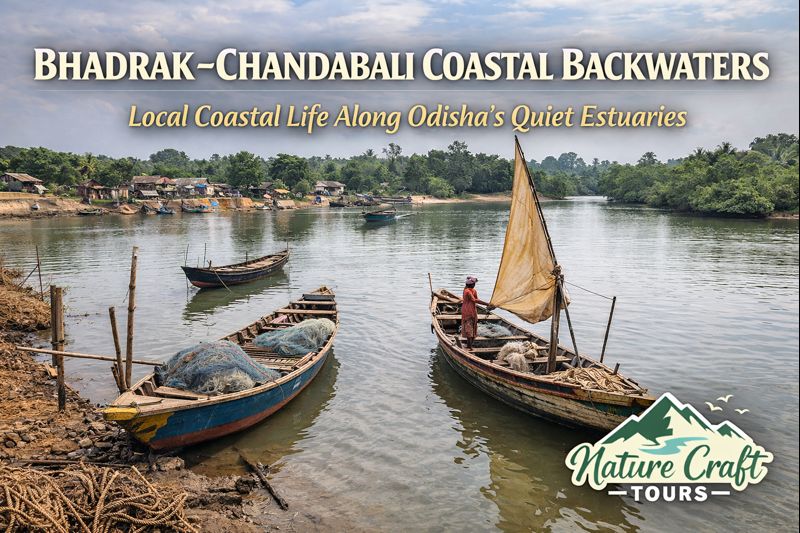
Between the open Bay of Bengal and the agrarian heartland of northern coastal Odisha lies a lesser-known but culturally rich water world: the Bhadrak–Chandabali coastal backwaters. This region is not shaped by dramatic beaches or resort-driven tourism, but by estuaries, tidal rivers, fishing hamlets, and everyday coastal livelihoods that continue much as they have for generations. Here, water is not a scenic backdrop; it is the organising principle of life.
The hook “Local Coastal Life” captures the essence of this landscape more accurately than any visual description. The backwaters between Bhadrak and Chandabali are lived-in waters—worked, crossed, fished, worshipped, and negotiated daily. To travel through this region is to observe how coastal communities adapt to tides, cyclones, seasonal fish movements, and shifting river mouths. The experience is immersive, slow, and deeply human.
Destination Overview: Understanding the Bhadrak–Chandabali Backwater Belt
The Bhadrak–Chandabali coastal backwaters occupy the northern segment of Odisha’s long and varied coastline. This belt is defined by the lower reaches of the Baitarani River and its distributaries as they meet the sea near Chandabali. Rather than forming a single lagoon, the region consists of interconnected tidal channels, creeks, mudflats, and semi-enclosed water bodies shaped by river flow and marine tides.
Bhadrak functions as the inland administrative and commercial anchor, while Chandabali marks the point where riverine and marine worlds converge. Between these two nodes stretches a network of villages whose orientation is toward water rather than road. Boats, embankments, and tidal calendars are as important as markets and schools.
Geographically, this backwater zone represents a transition—from freshwater-dominated river systems upstream to saline-influenced estuaries closer to the coast. Ecologically and culturally, this transition creates a distinctive coastal life that differs from both deep-sea fishing villages and inland agrarian settlements.
Landscape Character: Tides, Creeks, and Working Waters
The defining feature of the Bhadrak–Chandabali backwaters is movement. Water levels rise and fall twice daily, altering shorelines, exposing mudflats, and reshaping navigation routes. Narrow creeks branch off from wider channels, winding past mangrove patches, fishing ghats, and low-lying farmlands protected by earthen embankments.
The visual landscape is understated but layered. Fishing boats rest on muddy banks at low tide; at high tide, the same spaces become navigable waterways. Nets dry on bamboo frames, while piles of shells and fish crates signal the day’s catch. Unlike manicured waterfronts, this is a working coast, where functionality shapes form.
For travellers, the absence of spectacle becomes an advantage. The backwaters encourage observation—of tidal rhythms, labour patterns, and subtle ecological changes that might be overlooked in more commercial coastal destinations.
Local Coastal Life: Communities Shaped by Water
Life along the Bhadrak–Chandabali backwaters is inseparable from the water cycle. Fishing communities, boat operators, salt-pan workers, and small-scale traders all operate within a shared tidal framework. Knowledge of currents, seasonal fish migration, and weather patterns is passed down informally through practice rather than written instruction.
Fishing as Daily Practice
Fishing here is largely small-scale and estuary-based. Gill nets, cast nets, and traditional traps are commonly used, targeting species adapted to brackish water conditions. The catch varies with season and salinity, linking livelihoods directly to ecological balance.
Fish landing points are modest—often just sloping banks or wooden platforms—but they function as social hubs where information, labour, and produce circulate. Observing these spaces offers insight into how coastal economies operate beyond industrial fisheries.
Boat Travel and Waterborne Connectivity
In many villages, boats remain essential for short-distance travel, transport of goods, and access to fishing grounds. Even where roads exist, water routes often provide more direct connections. This dual transport system shapes settlement patterns and daily routines.
Historical Context: Ports, Rivers, and Coastal Exchange
Historically, Chandabali served as a minor port and anchorage, particularly during the colonial period, when riverine access was crucial for trade and administration. The Baitarani River acted as a conduit linking the interior to the sea, facilitating the movement of rice, salt, timber, and other goods.
Over time, silting and changes in navigation technology reduced Chandabali’s port significance, but the legacy of coastal exchange remains visible in settlement layouts and occupational patterns. The backwaters continue to function as economic arteries, albeit on a local scale.
This layered history distinguishes the region from purely rural coastlines. The backwaters are not isolated; they are shaped by centuries of interaction between land and sea.
Ecological Significance of the Backwater System
Ecologically, the Bhadrak–Chandabali backwaters form a productive estuarine environment. The mixing of freshwater and seawater supports diverse fish populations, crustaceans, and birdlife. Mudflats and mangrove patches act as nurseries for aquatic species and buffers against coastal erosion.
Seasonal changes strongly influence ecological dynamics. During the monsoon, freshwater inflow dominates, reducing salinity and expanding feeding grounds. In the dry season, saline intrusion increases, altering species composition. Local communities adjust their practices accordingly, demonstrating adaptive ecological knowledge.
These backwaters also play a role in flood moderation and sediment deposition, protecting inland agricultural areas while continuously reshaping the coastline.
Key Attractions and Experiential Highlights
The appeal of the Bhadrak–Chandabali backwaters lies not in isolated attractions but in experiential continuity. However, certain features consistently define the travel experience.
Tidal River Journeys
Boat journeys along tidal channels offer the most immersive way to understand the region. Moving with the tide reveals how water access expands and contracts, connecting villages that appear distant by road. These journeys provide close views of fishing activity, embankments, and everyday riverbank life.
Fishing Ghats and Village Edges
Spending time near fishing ghats allows travellers to observe the rhythm of coastal labour—net repair, sorting of catch, and preparation for the next tide. These spaces are dynamic and best experienced without haste.
Mangrove Fringes and Mudflats
Small mangrove stands and exposed mudflats offer opportunities for quiet nature observation, particularly birdlife. These areas illustrate the ecological foundations that sustain local livelihoods.
Best Time and Season to Travel
The most suitable period to explore the Bhadrak–Chandabali backwaters is between October and March. Post-monsoon months bring stable weather, active fishing cycles, and comfortable temperatures for boat travel and walking.
The monsoon season, while ecologically vibrant, poses challenges due to strong currents, heavy rainfall, and limited accessibility. Summer months are warmer, but early mornings and evenings remain pleasant, especially along water bodies.
Ideal Travel Duration
A focused exploration of the backwater region can be comfortably undertaken over three to four days. This allows time for river journeys, village visits, and observation of daily coastal life without rushing.
Travellers seeking deeper engagement—particularly those interested in coastal ecology or ethnographic observation—may extend their stay to five days or more, using Bhadrak as a logistical base.
Route and Accessibility
Bhadrak is well-connected by rail and road to major cities in Odisha and eastern India. From Bhadrak, road routes lead toward Chandabali and intermediate coastal villages. Final access to backwater areas often involves short boat crossings or narrow embankment roads.
Public transport reaches most major points, but flexible exploration is best undertaken with local transport arrangements that align with tidal schedules.
Comparative Coastal Perspective
Travellers familiar with other Indian wetland systems may find useful contrasts here. Just as a Sundarban Tour introduces visitors to mangrove-dominated delta life shaped by tides and wildlife, the Bhadrak–Chandabali backwaters reveal a quieter estuarine world centred on fishing, rivers, and human-scale adaptation. Both landscapes depend on water, but their social rhythms differ significantly.
Practical Insights for Responsible Coastal Travel
Visitors should approach the backwaters with respect for working environments. Fishing activities take priority over observation, and travellers should avoid disrupting daily routines. Seeking permission before photographing people or boats is essential.
Tide awareness is crucial for planning boat travel. Local guidance helps ensure safe navigation and meaningful access to villages and creeks. Basic supplies should be arranged in advance when venturing beyond main settlements.
Those accustomed to structured itineraries such as a Sundarban Tour Package may find the Bhadrak–Chandabali region less formalised. Here, understanding grows through time spent observing rather than through curated experiences.
Cultural Resilience and Contemporary Challenges
The backwater communities of Bhadrak and Chandabali face ongoing challenges, including coastal erosion, changing fish populations, and increased weather variability. Yet cultural resilience remains strong, rooted in adaptive practices and communal knowledge.
Traditional understanding of tides, embankment maintenance, and resource sharing continues to shape responses to environmental change. Observing these systems offers valuable insight into sustainable coastal living beyond policy frameworks.
Reading the Coast Through Everyday Life
The Bhadrak–Chandabali coastal backwaters do not seek attention through spectacle. Their significance lies in continuity—in the daily negotiation between land and water, labour and tide, tradition and adaptation.
For travellers interested in local coastal life rather than resort-driven narratives, this region offers a grounded and instructive experience. To move through these backwaters is to witness a coastal world that remains deeply functional, resilient, and human at its core.