Bhandardara + Arthur Lake
— Quiet Water and Mountains in the Western Ghats
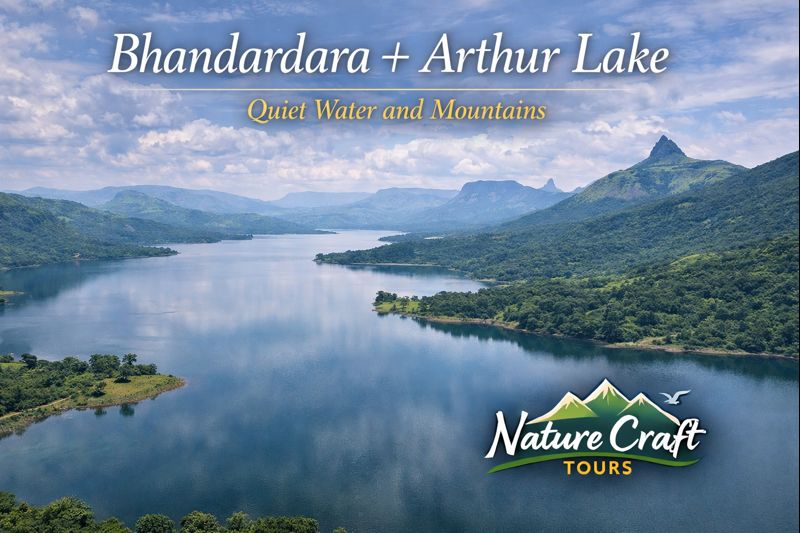
In the northern reaches of Maharashtra’s Western Ghats lies a landscape that resists spectacle and rewards patience. Bhandardara and Arthur Lake do not announce themselves with grand resorts or dramatic marketing. Instead, they reveal their character gradually—through still water reflecting basalt hills, through slow-moving clouds caught along ridgelines, and through the steady rhythm of a mountain settlement shaped more by monsoon and agriculture than by tourism. This is a destination defined not by excess, but by equilibrium: water and rock, forest and village, silence and seasonal sound.
To travel to Bhandardara is to step into a geography where human presence has long adapted itself to terrain rather than reshaped it. Arthur Lake, formed by the Wilson Dam across the Pravara River, lies at the heart of this region, anchoring both its ecology and its everyday life. Together, Bhandardara and Arthur Lake form a coherent landscape unit—one that can only be understood by moving slowly through it, observing how water collects, how hills contain it, and how communities live alongside both.
Geographical Setting and Landscape Structure
Bhandardara is located in the Ahmednagar district of Maharashtra, positioned on the eastern slopes of the Sahyadri range. The terrain here transitions from the high, rain-soaked escarpments of the Western Ghats to the comparatively drier Deccan interior. This transitional location gives the region its distinctive character: lush during the monsoon, restrained and open during winter, and austere yet expansive in summer.
Arthur Lake occupies a natural basin created by surrounding hills and later deepened by the construction of Wilson Dam in the early twentieth century. The lake’s elongated form follows the contours of the valley, creating multiple inlets, forested edges, and quiet coves. Unlike artificial reservoirs designed purely for storage, Arthur Lake retains a strong visual and ecological connection to its mountainous surroundings.
Arthur Lake and the Pravara River System
Hydrological Importance
Arthur Lake is fed primarily by the Pravara River and seasonal streams descending from the surrounding hills. During the monsoon, the lake swells dramatically, absorbing runoff from the upper catchment and regulating downstream flow. In drier months, its exposed banks reveal the fluctuating boundary between land and water—a visible reminder of the region’s dependence on seasonal rainfall.
The lake plays a critical role in irrigation and water supply for downstream settlements, making it both a scenic and functional landscape element. Its management reflects a long-standing balance between human need and environmental constraint, a balance that is increasingly rare in rapidly urbanizing regions.
Seasonal Visual Character
In the monsoon, Arthur Lake appears expansive and fluid, its surface broken only by submerged tree lines and distant hill reflections. Post-monsoon months bring clarity and stillness, with water levels stabilizing and visibility improving. By late winter, the lake becomes a mirror—its calm surface amplifying the sense of quiet that defines the region.
Bhandardara as a Mountain Settlement
Bhandardara village is small, functional, and shaped by its surroundings. Unlike hill towns developed around tourism economies, Bhandardara retains the rhythms of an agrarian settlement. Fields, grazing land, and forest edges coexist within a compact area, and daily life continues largely independent of visitor presence.
This grounded character is one of Bhandardara’s strengths. Travelers do not encounter a curated version of rural life, but rather an ongoing one—marked by seasonal labor, water management, and community interaction. The village’s relationship with Arthur Lake is practical as much as aesthetic, reinforcing the sense that landscape here is lived-in rather than consumed.
Best Time and Season to Visit
Monsoon: Water and Movement
The monsoon season, from late June to September, transforms Bhandardara into a dynamic, water-dominated landscape. Hills turn green, streams appear along every slope, and the lake reaches its fullest extent. This is also the season of waterfalls, including the well-known Randha Falls, which displays its greatest force during peak rainfall.
Travel during this period requires caution. Roads can be slippery, fog is common, and visibility fluctuates rapidly. For those accustomed to monsoon travel in other fragile ecosystems—such as riverine or delta landscapes explored during a Sundarban Trip—these conditions will feel familiar rather than restrictive.
Post-Monsoon and Winter: Stillness and Clarity
From October through February, Bhandardara enters its most balanced phase. Water levels remain high, vegetation is stable, and the climate is cool and dry. This period is ideal for extended walks, lakeside observation, and exploration of nearby hill viewpoints. The absence of heavy rain allows the landscape’s structural details—rock layers, forest boundaries, and waterlines—to become more apparent.
Ideal Travel Duration and Pace
A minimum of two nights is recommended to experience Bhandardara and Arthur Lake meaningfully. A shorter visit risks reducing the destination to a checklist of viewpoints, while a longer stay allows the traveler to adapt to the region’s slow tempo.
An ideal itinerary balances time near the lake with exploration of surrounding features, while leaving space for unstructured observation. Early mornings and late afternoons are particularly valuable, as light and sound conditions change subtly but significantly during these hours.
Route and Accessibility
Bhandardara is accessible by road from Mumbai and Pune, with the journey typically passing through Ghoti or Igatpuri. The final stretch winds through forested terrain and agricultural land, offering a gradual transition from urban density to rural quiet.
Rail connectivity is available up to Igatpuri, from where road transport completes the journey. While public transport options exist, their schedules are limited. Travelers seeking flexibility and early-morning access to key areas generally prefer private vehicles.
Key Attractions and Natural Highlights
Wilson Dam and Spillway
Wilson Dam, completed in 1910, is a defining structure in the Bhandardara landscape. Its spillway, often active during the monsoon, demonstrates the controlled power of water released from Arthur Lake. The dam’s stonework and scale reflect early twentieth-century engineering approaches adapted to local materials and terrain.
Randha Falls and Gorge
Located downstream of the dam, Randha Falls is most dramatic during the monsoon, when the Pravara River plunges into a deep gorge carved through basalt rock. Outside peak flow, the area reveals geological layers and erosion patterns that speak to long-term fluvial processes rather than momentary spectacle.
Lake Periphery and Forest Walks
The edges of Arthur Lake offer opportunities for quiet exploration. Forested sections alternate with open banks, each supporting different bird and plant species. Walking here emphasizes proximity rather than elevation, allowing close engagement with water, soil, and vegetation.
Ecological Character and Biodiversity
Bhandardara lies within the Western Ghats biodiversity zone, though its flora and fauna differ from the high-rainfall coastal slopes. Dry deciduous forests dominate, interspersed with grassland patches and riparian vegetation near the lake and streams.
Birdlife is particularly notable, with waterbirds, raptors, and forest species present across seasons. Amphibians and insects become prominent during the monsoon, while winter brings increased visibility and activity among mammals such as deer and smaller carnivores.
Cultural and Historical Context
The region around Bhandardara has long supported agrarian communities dependent on monsoon cycles and water storage. The construction of Wilson Dam altered local hydrology but did not erase traditional practices; instead, it became integrated into existing patterns of land and water use.
Small temples, shrines, and village gathering spaces reflect a cultural landscape oriented toward continuity rather than display. Religious and social activities remain tied to seasonal rhythms, reinforcing the connection between environment and everyday life.
Practical Insights for Thoughtful Travelers
Bhandardara rewards preparation rooted in realism rather than expectation. Weather conditions can change rapidly, particularly near the lake and higher viewpoints. Layered clothing, sturdy footwear, and attention to local guidance are essential.
Facilities in the region are limited and intentionally understated. Travelers accustomed to curated tourism environments may initially find this sparse, but those familiar with sensitive natural destinations—such as mangrove forests visited through a Best Sundarban Tour Package—will recognize restraint as a form of preservation rather than absence.
Noise discipline, waste management, and respect for local routines are not abstract ideals here; they are practical necessities for maintaining the region’s character. The appeal of Bhandardara lies precisely in what has not been overdeveloped.
Bhandardara Beyond Sightseeing
What distinguishes Bhandardara and Arthur Lake from more prominent hill destinations is not a single landmark, but a sustained atmosphere. The region does not demand attention; it invites it. Long periods of stillness, punctuated by water movement or distant human activity, define the experience.
For researchers, photographers, and reflective travelers, this quiet continuity offers conditions conducive to deeper engagement. Observations made here tend to accumulate rather than impress instantly, aligning the traveler’s pace with that of the landscape.
Water, Mountains, and Measured Travel
Bhandardara and Arthur Lake represent a form of travel increasingly rare in an era of accelerated movement and curated destinations. Here, water does not perform; it persists. Mountains do not dominate; they contain. Human presence does not overwhelm; it adapts.
To spend time in this landscape is to accept a slower metric of value—one measured in changing light, stable horizons, and the quiet assurance of a place continuing largely on its own terms. For those willing to listen rather than consume, Bhandardara offers an experience that is not dramatic, but deeply grounding.