Bhitarkanika — Mangrove Wilderness and Estuarine Wildlife:
An Immersive Exploration of Odisha’s Tidal Forest Realm
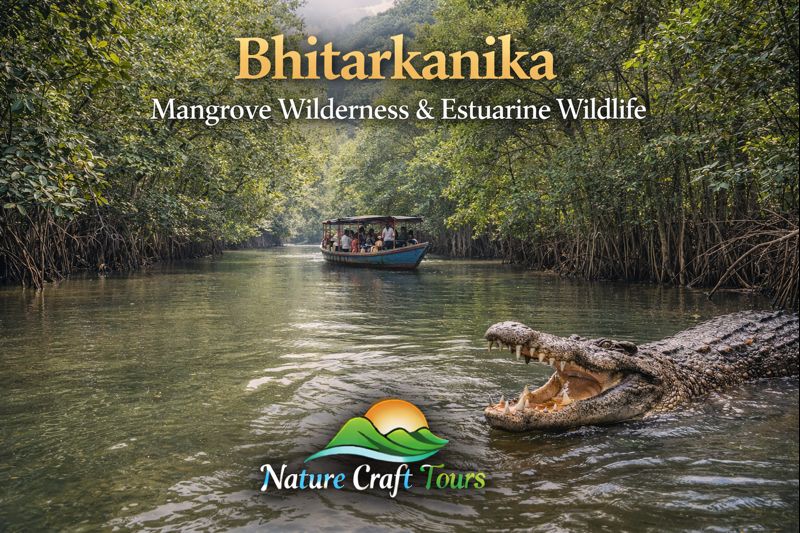
Bhitarkanika is not a destination that reveals itself instantly. It unfolds slowly, through winding tidal creeks, dense mangrove canopies, shifting mudflats, and the quiet awareness that every movement of water carries life, memory, and risk. Located in coastal Odisha, Bhitarkanika represents one of the most complex and least disturbed mangrove ecosystems in India. It is a place shaped by tides rather than roads, by estuaries rather than plains, and by wildlife that remains dominant rather than displaced.
Described often as a mangrove wilderness, Bhitarkanika is fundamentally an estuarine world—where freshwater rivers meet the saline push of the Bay of Bengal, creating a constantly changing environment. For the serious traveler, researcher, or nature-focused explorer, Bhitarkanika offers a rare opportunity to witness how ecology, geography, and human restraint coexist. This article presents a deeply researched, field-informed exploration of Bhitarkanika, focusing on its landscape structure, wildlife systems, seasonal rhythms, and practical realities, written for readers seeking depth rather than spectacle.
Destination Overview: Understanding Bhitarkanika’s Mangrove Geography
Bhitarkanika lies within a vast deltaic region formed by the Brahmani, Baitarani, Dhamra, and other river systems as they approach the Bay of Bengal. The area is characterized by an intricate network of creeks, channels, islands, and mudbanks, all influenced by semi-diurnal tides. Unlike coastal beaches or inland forests, Bhitarkanika exists in a state of constant transition, with water levels, salinity, and visibility changing multiple times a day.
The mangrove forests here form a dense, interlocking system of roots and canopies, stabilizing soil, reducing erosion, and supporting extraordinary biodiversity. This landscape functions as both a wildlife refuge and a natural shield against cyclones and storm surges, making Bhitarkanika ecologically vital far beyond its visible boundaries.
The Estuarine System: Rivers, Tides, and Mangrove Dynamics
Freshwater–Saltwater Interaction
The defining feature of Bhitarkanika is the interaction between freshwater inflow and tidal seawater. During high tide, saline water penetrates deep into the mangrove channels, while low tide exposes mudflats and concentrates aquatic life within creeks. This rhythmic exchange creates gradients of salinity that determine plant distribution, fish movement, and animal behavior.
Mangrove species here have evolved specialized adaptations—such as aerial roots and salt-filtering mechanisms—that allow them to survive in oxygen-poor, saline soils. These adaptations form the foundation of the entire ecosystem.
Creeks as Wildlife Corridors
The narrow creeks of Bhitarkanika function as natural highways for wildlife. Crocodiles, fish, otters, and birds use these channels for movement, feeding, and territorial control. Boat travel through these creeks offers a direct, immersive view into the functioning of an estuarine ecosystem, where every bend in the channel may reveal signs of life.
Mangrove Forest Composition and Ecological Role
Mangrove Diversity
Bhitarkanika supports one of the highest levels of mangrove species diversity in India. Different species occupy specific zones based on tidal exposure, salinity tolerance, and sediment type. Taller mangroves dominate more stable areas, while shorter, denser growth appears along frequently inundated edges.
This layered vegetation structure provides shelter, nesting sites, and feeding grounds for countless organisms, from insects and crustaceans to birds and reptiles.
Coastal Protection and Climate Function
Beyond biodiversity, Bhitarkanika’s mangroves perform critical ecological services. They absorb wave energy during storms, trap sediments, and sequester significant amounts of carbon. In an era of increasing coastal vulnerability, the role of mangrove systems like Bhitarkanika has become globally significant.
Estuarine Wildlife of Bhitarkanika
Saltwater Crocodiles as Apex Species
Bhitarkanika is internationally known for its population of saltwater crocodiles, among the largest reptiles on Earth. These apex predators regulate the estuarine food web, influencing fish populations and the behavior of other animals. Crocodiles are commonly seen basking on mudbanks during low tide or gliding silently through water channels.
Their presence underscores the wild integrity of Bhitarkanika; this is not a managed safari landscape but a functioning predator-dominated ecosystem.
Birdlife and Seasonal Patterns
Birdlife in Bhitarkanika is abundant and varied. Resident species dominate much of the year, while migratory birds arrive seasonally, particularly during winter. Herons, egrets, kingfishers, and raptors utilize different zones of the mangrove and estuarine system depending on prey availability and water levels.
Bird observation here is most rewarding during early mornings, when activity peaks along creek edges and open water patches.
Aquatic and Semi-Aquatic Species
Fish, crabs, and other aquatic organisms form the base of Bhitarkanika’s food web. Their movements are closely tied to tides and lunar cycles. Observant travelers may notice subtle cues—ripples, surface disturbances, or bird behavior—that signal underlying aquatic activity.
Human Presence and Cultural Context
Traditional Livelihoods on the Fringe
Human settlements exist along the outer boundaries of Bhitarkanika, where fishing, honey collection, and small-scale agriculture have historically supported local communities. These livelihoods evolved with a deep understanding of tides, seasons, and wildlife behavior.
Strict conservation measures have reduced human intrusion into core areas, helping maintain ecological balance while reshaping how communities interact with the forest.
Cultural Respect for the Mangrove Realm
Local belief systems often reflect respect for the forest and its dangers. Mangroves are not romanticized but understood as powerful, unpredictable spaces requiring caution and humility. This cultural attitude aligns closely with modern conservation principles.
Bhitarkanika in the Context of India’s Mangrove Landscapes
When compared to other mangrove systems in India, Bhitarkanika stands out for its relatively intact structure and low level of urban pressure. Travelers familiar with mangrove–tiger ecosystems such as those explored during a Sundarban Tour may notice key contrasts here: Bhitarkanika is quieter, more enclosed, and shaped less by human settlement density.
Both landscapes, however, demonstrate how estuarine systems support apex predators and complex food webs, reinforcing the importance of mangrove conservation across regions.
Best Time to Visit Bhitarkanika
Seasonal Conditions
The most suitable time to visit Bhitarkanika is between October and March. During these months, temperatures are moderate, rainfall is minimal, and wildlife visibility improves due to stable water conditions. Winter months also coincide with increased bird activity.
The monsoon season brings heavy rainfall and flooding, restricting access and boat movement. Summer months can be hot and humid, though early mornings remain manageable.
Ideal Travel Duration
A minimum of two nights and three days is recommended to experience Bhitarkanika meaningfully. This allows time for multiple boat excursions, varied tidal conditions, and unhurried observation. Shorter visits risk reducing the experience to surface-level sightseeing.
Route and Accessibility
Approach to the Mangrove Region
Access to Bhitarkanika involves a combination of road travel and boat entry, reflecting the region’s estuarine nature. The final approach typically transitions from terrestrial landscapes into water-based navigation, reinforcing the sense of entering a different ecological zone.
Movement Within Bhitarkanika
Exploration within Bhitarkanika is primarily boat-based. Walking access is limited and regulated to minimize disturbance. Boat journeys through creeks provide the most comprehensive view of mangrove structure and wildlife behavior.
Key Attractions and Highlights
- Dense mangrove corridors and tidal creeks
- Saltwater crocodile sightings in natural habitat
- Estuarine birdlife and mudflat ecosystems
- Quiet, minimally disturbed wilderness atmosphere
Practical Insights for Thoughtful Travelers
Visitors should approach Bhitarkanika with respect for both wildlife and regulations. Silence, patience, and adherence to guidelines enhance safety and ecological integrity. Clothing suitable for humidity, sun protection, and insect awareness is essential.
Travelers interested in comparative estuarine experiences may find value in combining Bhitarkanika with other mangrove landscapes through a Sundarban Tour Package, gaining deeper insight into how different delta systems function across India’s eastern coast.
Bhitarkanika as Living Estuarine Wilderness
Bhitarkanika is not a destination defined by ease or entertainment. It is a place of ecological intensity, where survival, adaptation, and balance are constantly negotiated. Its mangrove forests and estuarine wildlife form a living laboratory of coastal resilience and biological complexity.
For travelers willing to engage attentively and respectfully, Bhitarkanika offers one of India’s most authentic wilderness experiences—an encounter with a landscape that operates on its own terms, shaped by tides, roots, and ancient evolutionary rhythms.