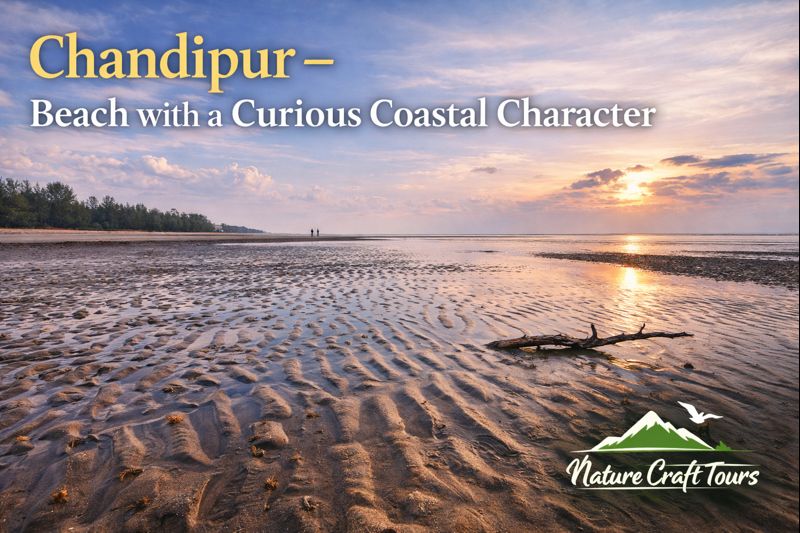
Chandipur is not a beach that announces itself with drama. There are no towering cliffs, no palm-lined promenades, and no constant roar of waves. Instead, Chandipur reveals its identity gradually, through an unusual rhythm of retreat and return that reshapes the coastline twice every day. Located along the northern coast of Odisha, this quiet seaside settlement is defined by a phenomenon that is both scientifically intriguing and experientially disorienting—the sea here recedes several kilometers during low tide, exposing vast stretches of seabed before returning hours later with calm inevitability.
To stand at Chandipur is to question familiar ideas of what a beach should look like. The shoreline is not fixed; it moves. The ocean is not always present; it arrives and departs on its own terms. This dynamic relationship between land and sea gives Chandipur its distinctive character and makes it less a conventional seaside resort and more a living coastal laboratory where natural processes unfold openly before the observer.
Geographical Setting and Coastal Context
Chandipur lies in Balasore district, on the Bay of Bengal coast, approximately sixteen kilometers from the town of Balasore. The beach occupies a shallow coastal shelf, where the gradient between land and sea is extremely gentle. This subtle slope is the primary reason behind Chandipur’s remarkable tidal behavior.
Unlike steep beaches where tides rise and fall vertically, Chandipur’s flat seabed allows horizontal movement of the waterline across vast distances. During low tide, the sea withdraws up to four or five kilometers, leaving behind rippled sand, shallow pools, and exposed marine life. When high tide returns, the water advances slowly, almost imperceptibly, reclaiming the shoreline over several hours.
This geographical feature places Chandipur among a small number of beaches worldwide where tidal recession is so visually dramatic, making it a site of both scientific interest and quiet wonder.
The Phenomenon of the Vanishing Sea
The most defining feature of Chandipur is the periodic disappearance of the sea. At first encounter, the effect can be unsettling. Visitors arriving during low tide may find themselves standing on what appears to be a vast, empty plain, with the ocean reduced to a distant silver line on the horizon.
This phenomenon is driven by the gravitational pull of the moon and sun, amplified by the beach’s shallow continental shelf. The retreat is gradual rather than abrupt, allowing observers to walk far into areas that would normally be underwater elsewhere. However, the returning tide is equally steady, emphasizing the importance of awareness and timing.
The experience of walking on the exposed seabed—over wet sand, small shells, and shallow tidal channels—creates a rare sense of intimacy with coastal processes that are usually hidden beneath waves.
Ecological Characteristics of the Intertidal Zone
Chandipur’s extensive intertidal zone supports a distinct ecological system adapted to periodic exposure and submersion. Small crustaceans, mollusks, and marine worms inhabit the sand, emerging briefly during low tide before retreating as water returns.
Birdlife is especially noticeable during these hours. Shorebirds forage across the exposed flats, feeding on organisms revealed by the receding water. The absence of strong waves and commercial activity allows these ecological interactions to occur with minimal disturbance.
Unlike coral reefs or mangrove forests, Chandipur’s ecology is understated. Its value lies not in visual abundance, but in the visibility of natural processes—erosion, sediment movement, and tidal cycles—that shape coastlines worldwide.
Historical and Cultural Context
Chandipur’s history is modest but layered. The region has long been associated with fishing communities who adapted their livelihoods to the unusual tidal patterns. Traditional knowledge of tidal timing has been essential for safe navigation and sustainable harvesting.
In the post-independence period, Chandipur gained strategic significance due to its proximity to defense research installations along the Odisha coast. While these facilities are not part of the tourist landscape, their presence has limited overdevelopment, inadvertently preserving the area’s quiet character.
Culturally, Chandipur reflects coastal Odisha’s understated traditions—simple rituals, seasonal festivals, and a lifestyle shaped more by environment than by tourism.
Experiencing Chandipur as a Traveler
Chandipur is best experienced through observation rather than activity. This is not a destination for swimming, water sports, or crowded entertainment. Its appeal lies in timing—arriving when the sea is retreating, watching the coastline transform, and waiting patiently for its return.
Walking along the exposed seabed offers a sense of scale rarely encountered at beaches. The horizon feels distant, and human presence feels small. This experience contrasts sharply with more dynamic coastal ecosystems explored during journeys such as a Sundarban Tour, where tides interact with dense mangrove forests rather than open sand.
Key Attractions and Points of Interest
Chandipur’s primary attraction is the beach itself, but subtle features add depth to the visit. Tidal pools formed during low tide reflect the sky and host small marine organisms. Sand ripples create natural patterns that change daily, shaped by wind and water.
Nearby coastal villages offer glimpses into everyday life shaped by the sea’s rhythm. Simple fishing boats, nets drying on sand, and early-morning routines reflect a continuity that predates tourism.
Seasonal Character and Best Time to Visit
Weather and Tidal Considerations
The most favorable period to visit Chandipur is between October and February, when temperatures are moderate and humidity is relatively low. During these months, walking along the beach is comfortable, and visibility is clear.
Summer months can be hot and humid, though early mornings remain pleasant. The monsoon season brings dramatic skies and refreshed landscapes but may limit access due to rainfall and rough conditions.
Regardless of season, consulting tide charts is essential. The experience of Chandipur depends entirely on understanding when the sea will recede and return.
Ideal Travel Duration
Chandipur is best suited for short, contemplative stays. One to two days are sufficient to observe multiple tidal cycles and experience the beach under different conditions. Longer stays may feel repetitive unless combined with exploration of nearby coastal or cultural sites.
Route and Accessibility
Chandipur is accessible by road from Balasore, which is well connected to major cities by rail and highway. The final approach passes through flat coastal terrain, gradually transitioning from urban surroundings to open shoreline.
Local transport options are available, but private travel offers greater flexibility in aligning visits with tidal timings.
Practical Insights for Responsible Visitors
Visitors should exercise caution when walking far into the exposed seabed. While the returning tide is gradual, distances can be deceptive, and awareness of time is essential. Footwear suitable for wet sand is advisable.
Swimming is not recommended due to shallow gradients and changing water levels. Respect for local fishing activities and avoidance of littering are essential to maintaining the area’s ecological balance.
Chandipur in the Broader Coastal Narrative of Eastern India
Eastern India’s coastline is shaped by diverse processes—river deltas, mangroves, sandy beaches, and estuaries. Chandipur represents one end of this spectrum, where tidal movement dominates visual experience. At the other end lie regions where water and forest interlace, often explored through journeys such as a Sundarban Tour Package from Kolkata.
Together, these landscapes illustrate the complexity of the Bay of Bengal coast, where subtle geographical differences create profoundly different environments.
Chandipur as a Study in Coastal Subtlety
Chandipur does not compete for attention; it invites contemplation. Its defining feature—the vanishing sea—is less a spectacle than a lesson in patience and perception. The beach reminds visitors that landscapes are not static backdrops but living systems governed by rhythms beyond human control.
For travelers willing to slow down and observe, Chandipur offers a rare opportunity to witness coastal dynamics in their purest form. It stands as a quiet counterpoint to more crowded beaches, demonstrating that curiosity, rather than excitement, can be the most rewarding guide to travel.