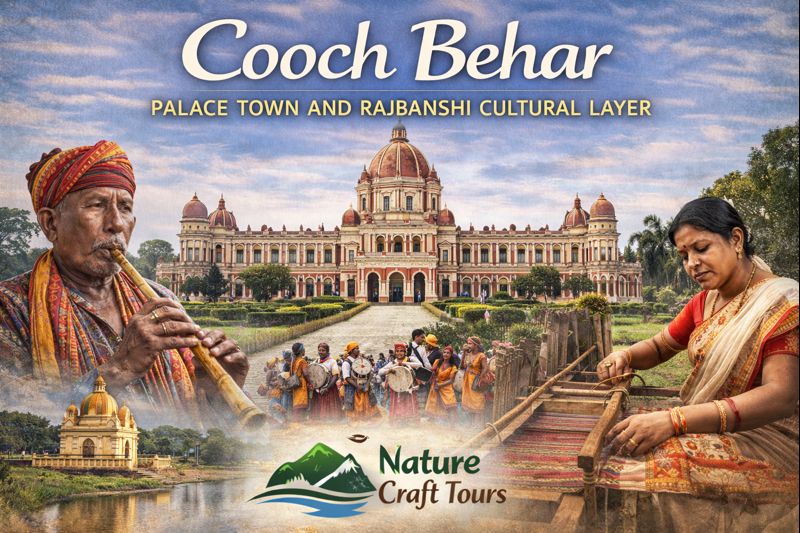
Some towns announce their importance through sheer scale, others through relentless modernity. Cooch Behar speaks in a quieter yet far more enduring voice — the voice of continuity. Nestled in the northern plains of West Bengal, close to the foothills of the Eastern Himalayas, Cooch Behar is a rare example of a palace town where royal legacy, indigenous Rajbanshi culture, agrarian rhythms, and colonial-era transformations coexist with remarkable coherence.
To explore Cooch Behar as an explorer is to peel back layers rather than rush through landmarks. It is a journey through dynastic authority expressed in stone, through community identity preserved in rituals and language, and through landscapes shaped by rivers, monsoon cycles, and political boundaries. Cooch Behar is not merely a former princely state; it is a living cultural territory where history remains embedded in daily life.
Geographical Setting and Environmental Context
Cooch Behar lies in the fertile alluvial plains of North Bengal, bordered by Assam to the east and Bangladesh to the south. Numerous rivers and distributaries crisscross the region, creating a landscape that is both agriculturally productive and ecologically sensitive. Seasonal flooding, silt deposition, and monsoon rains have historically shaped settlement patterns, architecture, and livelihoods.
The flat terrain, expansive skies, and lush greenery distinguish Cooch Behar from the hilly districts further north. This geography allowed the emergence of a stable agrarian economy, which in turn sustained royal administration and cultural patronage for centuries.
Climate and Best Time to Visit
Cooch Behar experiences a humid subtropical climate. Summers, from April to June, are warm and moist, with temperatures rising steadily before the monsoon. The monsoon season, between July and September, brings heavy rainfall, rejuvenating the landscape but occasionally disrupting travel.
The most suitable time to visit Cooch Behar is from October to February. Winter months offer pleasant temperatures, clear skies, and ideal conditions for heritage walks, palace exploration, and cultural immersion. Major festivals and local fairs during this period further enrich the travel experience.
Historical Emergence of Cooch Behar as a Princely State
Cooch Behar’s political history is distinct from that of southern Bengal. The region evolved as a powerful kingdom long before colonial intervention, governed by the Koch dynasty. Over time, this kingdom adapted to changing political realities, eventually becoming a princely state under indirect colonial administration.
Unlike many princely capitals shaped solely by colonial planning, Cooch Behar retained its indigenous political identity. Royal authority was expressed not only through governance but also through cultural patronage, religious tolerance, and integration with local Rajbanshi traditions.
The Koch Dynasty and Political Continuity
The Koch rulers played a crucial role in stabilizing the region amid shifting regional powers. Through strategic alliances, military organization, and administrative reforms, they maintained autonomy while engaging diplomatically with larger empires.
This political continuity allowed Cooch Behar to develop as a palace town where governance was centralized yet deeply connected to rural society.
Cooch Behar Palace: Architecture of Authority
The most prominent landmark of the town is its grand palace, an architectural statement of royal ambition and modernity. Constructed during the late nineteenth century, the palace reflects European influences adapted to local climatic and cultural conditions.
Symmetry, expansive lawns, and monumental proportions characterize the structure. Unlike defensive forts, the palace emphasizes openness and ceremonial authority, symbolizing a confident ruling house engaged with global aesthetics.
Interior Spaces and Symbolic Design
Inside the palace, large halls and corridors were designed for durbars, state functions, and formal receptions. Decorative elements, furniture, and spatial layout reveal how royal life balanced tradition with modern administrative practices.
The palace functioned not merely as a residence but as the epicenter of political decision-making, cultural events, and diplomatic engagement.
Rajbanshi Culture: The Indigenous Foundation
At the heart of Cooch Behar’s identity lies Rajbanshi culture. The Rajbanshi community, with its unique language, customs, and agrarian traditions, forms the cultural backbone of the region. Royal authority historically aligned itself with Rajbanshi identity rather than imposing an external elite culture.
This integration ensured cultural continuity even during periods of political transition. Folk songs, seasonal rituals, agricultural festivals, and oral traditions remain integral to everyday life.
Festivals, Rituals, and Community Life
Local festivals reflect a close relationship with nature and agricultural cycles. Harvest celebrations, river-based rituals, and ancestor worship coexist alongside court-sponsored ceremonies. These traditions offer travelers insight into how culture adapts without losing its core identity.
Religious and Cultural Landscape
Cooch Behar’s religious landscape is marked by inclusivity. Temples, shrines, and sacred groves coexist within the town and surrounding countryside. Religious patronage by the royal family supported multiple traditions, reinforcing social harmony.
Architectural simplicity characterizes most religious structures, aligning them closely with community use rather than monumental display.
Complete Tour Plan: Exploring Cooch Behar Thoughtfully
A well-structured visit to Cooch Behar ideally spans three days, allowing sufficient time for palace exploration, cultural immersion, and rural context.
Day One: Palace Town Orientation
Arrive in Cooch Behar by morning and settle into your accommodation. Begin exploration with the palace complex, walking through its exterior gardens and interior halls to understand royal life and governance. Spend the evening exploring nearby heritage zones and observing daily town life.
Day Two: Cultural and Community Exploration
Dedicate the second day to understanding Rajbanshi culture. Visit local markets, cultural centers, and rural neighborhoods to observe traditional livelihoods. Engage with artisans and community members to gain insight into language, customs, and agricultural practices.
Day Three: Landscape and Reflection
On the final day, explore surrounding countryside areas shaped by rivers and farmlands. Observe how geography influences settlement patterns and cultural expression. Depart in the afternoon with a holistic understanding of the region.
Connectivity and Travel Access
Cooch Behar is well connected by rail and road from major North Bengal towns. The nearest airport lies at a reasonable distance, making multi-modal travel feasible. The town’s compact layout allows easy exploration on foot or by local transport.
Many travelers prefer to combine heritage journeys with ecological destinations across West Bengal. Linking a cultural exploration of North Bengal with a riverine and forest-based experience such as a Sundarban Tour offers a broader understanding of how geography and power shaped different regions of the state.
Cooch Behar in a Wider Bengal Narrative
Cooch Behar occupies a unique place in Bengal’s historical geography. Unlike metropolitan centers or colonial capitals, it represents a model of regional authority deeply rooted in indigenous culture. Its palace does not overshadow local life; instead, it stands as a symbol of integration.
Extending travel beyond urban heritage into ecological frontiers further enriches understanding. Pairing a visit to Cooch Behar with a curated Sundarban Travel experience allows travelers to witness Bengal’s cultural and environmental diversity within a single itinerary.
Why Cooch Behar Matters for the Explorer
Cooch Behar is not a destination defined by spectacle. Its strength lies in continuity — of culture, governance, and landscape. It demonstrates how power can coexist with community, how architecture can reflect restraint, and how identity can endure through political change.
For explorers seeking authenticity, cultural depth, and historical clarity, Cooch Behar offers a rare and rewarding journey. It stands as a testament to Bengal’s layered past and its capacity for cultural resilience.