Dhani Nallah Mangrove Walkway (Rangat Region):
Boardwalk Through Living Mangrove Systems
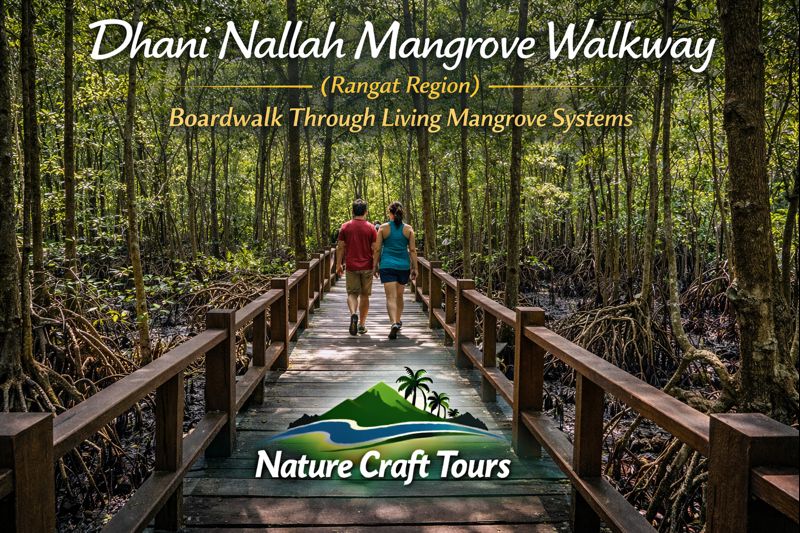
Dhani Nallah Mangrove Walkway: Walking Inside a Living Mangrove Ecosystem in Middle Andaman
Hidden within the quiet ecological heart of Middle Andaman lies Dhani Nallah Mangrove Walkway, one of the most scientifically meaningful and emotionally grounding nature experiences in the Andaman Islands. Unlike beaches that impress through openness or islands that astonish through isolation, Dhani Nallah speaks through proximity. Here, the forest does not stand at a distance—it surrounds, rises, breathes, and moves beneath the visitor’s feet. The elevated wooden boardwalk allows travelers to enter a living mangrove system without disturbing its fragile foundations, creating a rare opportunity to observe one of Earth’s most productive ecosystems from within.
Dhani Nallah is not designed for speed or spectacle. It is an experience of stillness, texture, sound, and slow observation. The mangrove forest here is not ornamental; it is functional, dynamic, and essential to coastal survival. For explorers, naturalists, photographers, educators, and thoughtful travelers, this walkway represents one of the most refined ecological encounters in the Andaman archipelago.
Geographical Setting: Where Dhani Nallah Fits in the Rangat Landscape
Dhani Nallah is located near Rangat in Middle Andaman, along the Andaman Trunk Road. Geographically, it occupies a low-lying coastal zone where freshwater flow from inland forests meets tidal seawater. This mixing zone creates ideal conditions for mangrove growth, allowing a dense and diverse mangrove forest to establish itself over time.
The area is characterized by muddy substrates, tidal creeks, and shallow estuarine waters. Unlike exposed coastlines, this landscape is shaped not by waves but by tidal rhythms and sediment deposition. The boardwalk has been carefully constructed to float above this sensitive zone, ensuring that visitors can enter the ecosystem without compressing soil, damaging roots, or disturbing water flow.
Why Dhani Nallah Is Ecologically Significant
Mangroves are among the most productive ecosystems on the planet, and Dhani Nallah represents a relatively undisturbed example. The forest here performs critical functions: it stabilizes shorelines, filters sediments, sequesters carbon, buffers storms, and provides nursery habitat for marine and estuarine species. Dhani Nallah offers a rare chance to witness these processes at close range.
The Mangrove Walkway Concept: Access Without Impact
The defining feature of Dhani Nallah is its elevated wooden boardwalk, which stretches deep into the mangrove forest. This structure is not merely a convenience; it is a conservation tool. By lifting human movement above the substrate, the walkway prevents trampling of pneumatophores (aerial roots), avoids soil compaction, and allows tidal water to flow freely beneath.
The boardwalk gradually guides visitors from the forest edge into the core mangrove zone. With each step, the environment changes subtly—light levels shift, humidity increases, sounds soften, and the smell of salt and organic matter intensifies. This gradual immersion is essential to understanding mangroves not as static trees but as living systems.
Walking Through a Forest That Breathes
Mangroves breathe through specialized roots that emerge from the mud to absorb oxygen. At Dhani Nallah, these roots form dense patterns beneath the walkway, creating a visible map of the forest’s respiratory system. Observing this from above reinforces the idea that mangroves are engineered for survival in hostile conditions.
Mangrove Species and Structural Diversity
Dhani Nallah supports multiple mangrove species, each adapted to specific microconditions of salinity, tidal exposure, and sediment type. Tall trees with stilt roots dominate some sections, while shorter, shrub-like mangroves appear closer to creek edges.
The diversity of root structures—prop roots, knee roots, and pneumatophores—illustrates evolutionary adaptation at its finest. These roots anchor trees in soft mud while allowing gas exchange during tidal inundation.
Mangroves as Engineers of the Coast
Mangroves do not merely survive in coastal zones; they actively create land by trapping sediment and organic matter. Over time, this process raises ground levels and reduces erosion. Similar principles operate at a larger scale in deltaic regions explored during a Sundarban Tour, but Dhani Nallah allows these processes to be observed at human scale.
Wildlife Along the Walkway
Despite its quiet appearance, Dhani Nallah is alive with subtle activity. Crabs move across the mud, fish flicker through shallow water during high tide, and birds call from the canopy above. The absence of loud human activity makes wildlife encounters more frequent and natural.
Birdlife includes species adapted to mangrove environments—kingfishers, herons, and small insectivorous birds. During certain seasons, migratory birds may also appear, using the mangrove as a feeding and resting ground.
A Corridor for Juvenile Marine Life
The submerged roots provide shelter for juvenile fish and crustaceans, protecting them from predators. This nursery function is one of the reasons mangroves are critical to marine fisheries, a relationship also seen in tidal ecosystems associated with Sundarban Travel landscapes.
Best Time to Visit Dhani Nallah Mangrove Walkway
Timing influences both comfort and ecological visibility.
October to March: Ideal Exploration Window
These months offer pleasant temperatures, lower humidity, and stable access conditions. Tidal variations remain predictable, and wildlife activity is high.
April to May: Early Morning Advantage
During warmer months, early morning visits are recommended. The forest is most active during cooler hours, and light filtering through the canopy creates striking visual patterns.
June to September: Monsoon Transformation
Monsoon rains increase water flow and enhance mangrove vitality. While access may occasionally be limited, this season showcases the forest at its most dynamic.
How to Reach Dhani Nallah
Dhani Nallah is easily accessible from Rangat town, located along the Andaman Trunk Road. The walkway is well-marked, and a short approach path leads to the boardwalk entrance.
Its roadside accessibility makes it suitable for travelers moving between South and North Andaman, yet its depth of experience often surprises those who expect only a brief stop.
Complete Tour Plan: Dhani Nallah as a Core Ecological Experience
Day 1: Arrival in Rangat
Reach Rangat after a long road journey. Spend the evening walking nearby beaches or resting to prepare for a slow, immersive experience the next day.
Day 2: Dhani Nallah Mangrove Walkway
Visit Dhani Nallah in the morning. Walk slowly along the boardwalk, stopping frequently to observe root systems, water movement, and birdlife. Allocate at least 1.5 to 2 hours to fully experience the forest without rushing.
Day 3: Comparative Landscape Exploration
Explore Rangat’s beaches or freshwater wetlands to understand how mangroves connect inland and marine systems.
Educational and Interpretive Value
Dhani Nallah functions as an open-air classroom. It demonstrates ecological principles such as adaptation, nutrient cycling, carbon sequestration, and coastal defense in a tangible, visible way.
For students, educators, and researchers, the walkway offers direct exposure to processes that are often discussed abstractly in textbooks.
Responsible Travel and Visitor Ethics
Visitors should remain on the boardwalk at all times, avoid loud noise, refrain from touching roots or wildlife, and carry back all waste. Photography should be done without disturbing animals or altering the environment.
Mangrove ecosystems are resilient yet sensitive. Their protection depends on minimal interference.
Who Should Visit Dhani Nallah Mangrove Walkway?
This experience is ideal for slow travelers, nature lovers, photographers, birdwatchers, educators, and anyone interested in understanding how coastal ecosystems function beneath the surface.
It is especially meaningful for travelers who value depth over diversity and learning over entertainment.
Walking Through a System That Sustains the Coast
Dhani Nallah Mangrove Walkway does not overwhelm—it instructs quietly. Each step along the boardwalk reveals how life adapts to uncertainty, how roots anchor against tides, and how forests protect coastlines without drawing attention to themselves.
In a world where natural systems are increasingly threatened by speed and neglect, Dhani Nallah offers a different lesson: that resilience is often built slowly, silently, and below the surface.
For explorers who seek to understand rather than consume, this boardwalk through living mangrove systems stands as one of Middle Andaman’s most meaningful journeys—measured not in distance covered, but in insight gained.