Dhankar: Cliff-Edge Heritage Above the Confluence of Silence and Stone
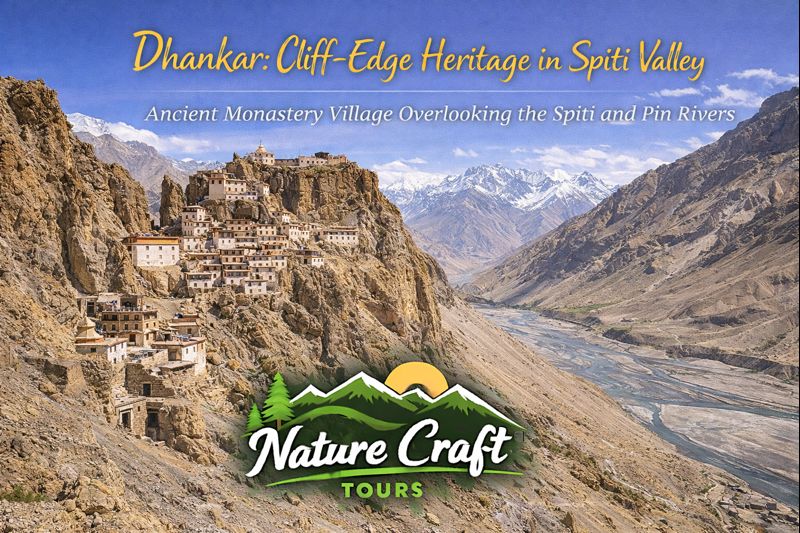
Dhankar does not reveal itself gently. It confronts the traveler with immediacy—of height, of exposure, of endurance. Perched dramatically on a knife-edge cliff high above the confluence of the Spiti and Pin rivers, Dhankar stands as one of the most audacious human settlements in the Himalaya. Here, architecture defies gravity, history clings to eroding rock, and daily life continues in quiet negotiation with risk and reverence.
The phrase “Cliff-Edge Heritage” is not metaphorical in Dhankar’s case. The monastery and village are physically anchored to a crumbling precipice, their survival dependent on centuries-old construction wisdom and constant adaptation. From below, Dhankar appears almost unreal—a compact mass of mud, stone, and whitewashed walls fused seamlessly with the mountain itself. From within, it feels introspective and austere, shaped by isolation, altitude, and a worldview that accepts impermanence as a given.
This travel narrative explores Dhankar not merely as a viewpoint or historic site, but as a living cultural landscape where faith, geology, and human resilience intersect. Approached with patience and respect, Dhankar offers one of the most profound heritage experiences in Spiti Valley—an experience defined as much by silence and restraint as by visual drama.
Destination Overview: Dhankar’s Place in Spiti Valley
Geographical Setting and Elevation
Dhankar is located in central Spiti Valley, Himachal Pradesh, at an elevation of approximately 3,900 meters above sea level. It occupies a strategic position on a steep rocky spur overlooking the confluence of the Spiti and Pin rivers. This location historically provided both defensive advantage and spiritual symbolism, placing Dhankar at the intersection of two valleys and two lifelines.
The surrounding landscape is stark and elemental—sheer rock faces, eroded slopes, and expansive skies with little vegetation. The cliff itself is composed of fragile sedimentary material, making Dhankar’s continued existence a testament to traditional engineering and constant maintenance.
Climate and Environmental Conditions
Dhankar experiences an extreme Trans-Himalayan climate. Summers are short, dry, and intensely sunlit, while winters are long, cold, and isolating. Temperature fluctuations between day and night are significant, and strong winds are common due to the exposed cliff-top location.
These conditions have shaped every aspect of settlement—from compact architecture and narrow paths to seasonal movement and storage practices. Dhankar is not designed for comfort; it is designed for survival.
The Meaning of Cliff-Edge Heritage
Architecture at the Limit of Possibility
Dhankar’s most defining characteristic is its location. The monastery and village are built directly onto the cliff face, with walls often forming part of the rock itself. Buildings appear stacked vertically, their irregular forms dictated by the contours of the precipice rather than aesthetic symmetry.
This architecture reflects a worldview shaped by scarcity and impermanence. Structures are modest, functional, and adaptive. There is no excess—only what is necessary to endure climate, altitude, and time.
Heritage Shaped by Risk
Erosion, landslides, and seismic activity pose constant threats to Dhankar. Portions of the settlement have already collapsed over the centuries, and preservation efforts remain delicate and ongoing. Unlike restored monuments, Dhankar’s heritage is fragile and unresolved—existing in a state of continuous negotiation with nature.
This vulnerability adds depth to the experience. Dhankar is not frozen in history; it is actively aging, changing, and resisting disappearance.
Historical Significance of Dhankar
Former Capital of Spiti
Dhankar once served as the capital of the Spiti kingdom. Its commanding position allowed rulers to monitor trade routes and valley movement. The fort-monastery complex functioned as both administrative center and spiritual authority, reflecting the inseparability of governance and religion in the region’s past.
This dual role shaped Dhankar’s layout. Defensive features coexist with prayer halls, monk cells, and communal spaces, creating a hybrid structure unique to Himalayan political history.
Transition from Power to Contemplation
With shifts in political structure and administrative centers, Dhankar gradually lost its role as capital. However, it retained spiritual significance. Over time, its identity shifted from authority to contemplation, from control to continuity.
Today, Dhankar’s value lies not in dominance, but in endurance and memory.
Dhankar Monastery: Faith on the Edge
Sacred Spaces and Interior Life
Dhankar Monastery is compact yet profound. Inside, prayer halls house ancient statues, murals, and ritual objects that reflect centuries of Buddhist practice. The interiors are dimly lit, emphasizing focus and restraint rather than ornamentation.
The monastery continues to function as a place of worship and study, though its monastic population is smaller than in earlier periods. Rituals proceed quietly, often unnoticed by casual visitors.
Symbolism of Elevation and Exposure
In Buddhist philosophy, elevation often symbolizes spiritual aspiration. At Dhankar, this symbolism is literal. The monastery’s exposed position reinforces impermanence, humility, and awareness—core tenets of Buddhist thought.
Village Life at Dhankar
A Settlement of Necessity
Dhankar village is small and tightly clustered. Homes are built close together for structural stability and thermal efficiency. Narrow paths wind through the settlement, often without barriers separating them from steep drops.
Residents rely on limited agriculture, livestock, and seasonal movement. Life here is defined by adaptation rather than expansion.
Community and Continuity
Despite its harsh conditions, Dhankar maintains a strong sense of community. Shared labor, collective maintenance, and mutual reliance are essential. Festivals, rituals, and agricultural cycles reinforce social cohesion.
Key Attractions and Highlights
Dhankar Monastery Complex
The monastery itself is the primary attraction. Time spent here should be unhurried, allowing visitors to absorb both architectural detail and atmosphere.
Dhankar Lake (High-Altitude Walk)
Above the village lies a small high-altitude lake, accessible via a moderate hike. The walk offers expansive views of the valley and provides contrast to the enclosed intensity of the cliff settlement.
River Confluence Views
From various points around Dhankar, the confluence of the Spiti and Pin rivers is visible far below. These views contextualize Dhankar’s historical importance and strategic placement.
Best Time and Season to Visit Dhankar
Late Spring to Early Summer (May to June)
Snow begins to recede, and access roads reopen. Days are cool and clear, offering dramatic light on cliffs and valleys. Visitor numbers remain manageable.
Peak Summer (July to September)
This is the most accessible period. Roads are stable, and weather conditions are relatively predictable. However, increased visitation requires heightened respect for fragile infrastructure.
Autumn (October)
Autumn brings clarity and quiet, with fewer travelers and golden tones across the valley. Temperatures drop rapidly, and snowfall can begin unexpectedly.
Winter (November to April)
Dhankar becomes largely inaccessible due to snow and extreme cold. Winter conditions explain much of the settlement’s architectural discipline and seasonal rhythm.
Ideal Travel Duration
Dhankar is best visited as part of a broader Spiti itinerary. A half-day stop offers only surface impressions. Ideally, travelers should allocate a full day, allowing time for walking, reflection, and acclimatization.
Route and Accessibility
Approach from Kaza
Dhankar is accessible by road from Kaza, the administrative hub of Spiti. The final approach involves a steep ascent along narrow mountain roads. Travel should be unhurried, with awareness of altitude and exposure.
As with other landscape-driven journeys—whether traversing Himalayan valleys or entering tidal forests during a Sundarban Trip—the approach itself shapes perception before arrival.
Movement Within Dhankar
Walking is the only way to explore Dhankar. Footpaths are uneven and exposed. Sturdy footwear and careful pacing are essential.
Cultural and Ecological Significance
Dhankar represents a rare fusion of cultural heritage and extreme geography. Its continued existence highlights traditional knowledge of construction, land use, and community resilience in fragile ecosystems.
The area supports limited flora and fauna adapted to arid high-altitude conditions. Human impact must remain minimal to prevent irreversible damage.
Practical Insights for Travelers
Health and Acclimatization
At nearly 4,000 meters, altitude effects are significant. Travelers should acclimatize in lower areas before visiting Dhankar and avoid strenuous activity on arrival.
Cultural Sensitivity
Dhankar is a living settlement and religious site. Silence, modest attire, and respectful behavior are mandatory. Photography should be discreet and permitted.
Environmental Responsibility
Waste management is extremely challenging in Dhankar. Visitors must carry back all non-biodegradable waste and avoid stressing fragile paths and structures.
Dhankar in the Context of Conscious Travel
Dhankar exemplifies travel that prioritizes understanding over consumption. Its appeal aligns with journeys where environment and heritage dictate pace, similar in philosophy to carefully structured experiences such as the Best Sundarban Tour Package, where ecological sensitivity guides exploration.
Dhankar as Living Precarity and Legacy
Dhankar is not comfortable, convenient, or easily accessible—and that is precisely its significance. It stands as a living example of how human belief, architecture, and community adapt at the edge of possibility. Its cliff-edge heritage is not only about location, but about mindset: acceptance of risk, respect for impermanence, and commitment to continuity.
For travelers willing to approach slowly and thoughtfully, Dhankar offers one of the most profound encounters in the Himalaya. It is a place where history clings to stone, faith confronts erosion, and silence speaks with rare clarity.